The transition toward electric mobility has revolutionized the electrical industry, bringing forth new challenges and stringent safety requirements for modern installations. Among the most critical components in this evolving landscape is the Residual Current Device (RCD). Proper EV leakage protection is no longer just a recommendation; it is an absolute necessity governed by strict international electrical codes. For electricians, facility managers, and B2B procurement teams, selecting the correct RCD type EV charger requires a comprehensive understanding of electrical behaviors, local regulations, and the unique characteristics of direct current (DC) faults.
When an electric vehicle is plugged into the grid, the internal power electronics fundamentally change the nature of potential electrical faults. Traditional household protection mechanisms are often inadequate in the face of these new demands. This comprehensive selection guide dives deep into the technical distinctions, safety implications, and economic considerations of the three primary RCD types utilized in the electric vehicle charging sector. By the end of this document, you will have a clear, authoritative understanding of whether your installation requires a standard Type A, a highly specialized type B RCD EV, or the increasingly popular Type EV solution.
Quick Answer: Which RCD Type Is Best for EV Charging?
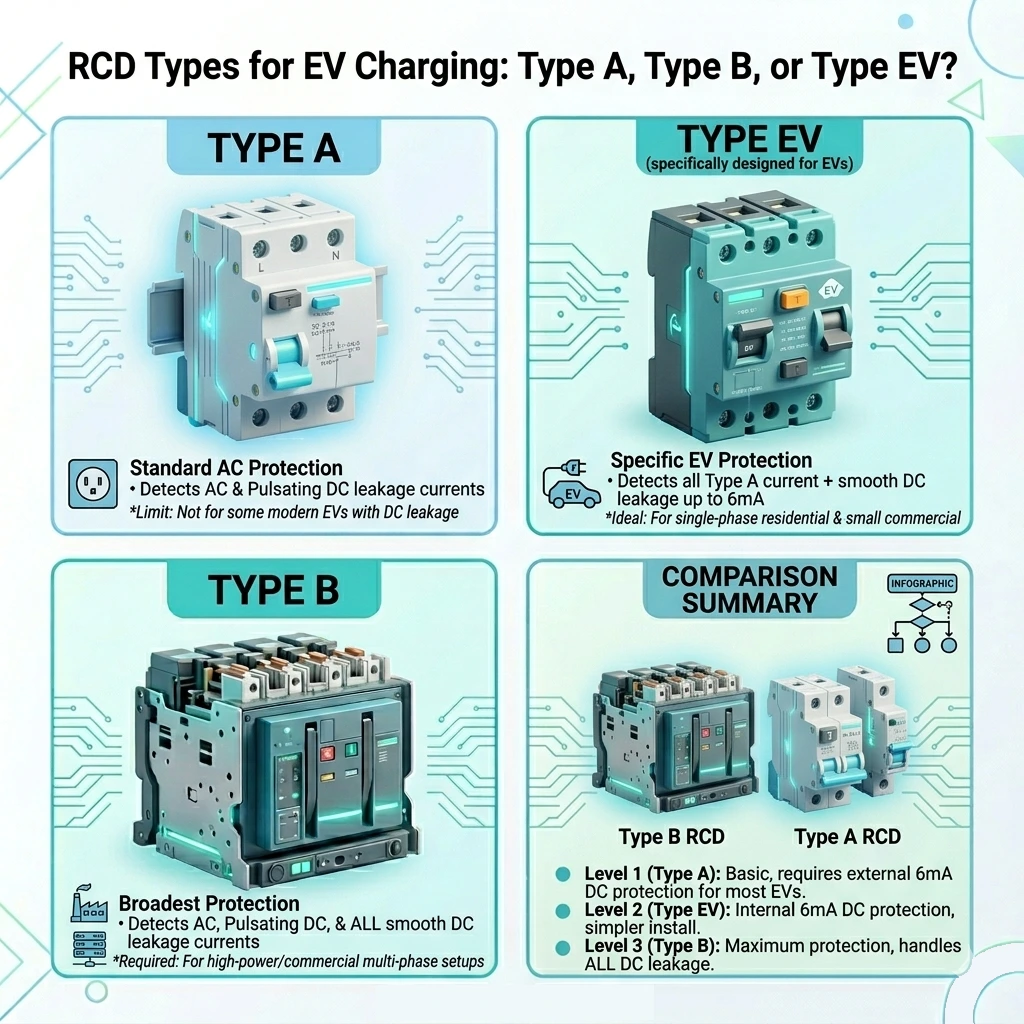
For those seeking an immediate, expert recommendation: the ideal choice depends strictly on the internal capabilities of the charging unit being installed. Type B RCD is the safest option because it detects AC and DC leakage; Type A plus built-in 6mA DC detection (Type EV solution) is a cost-effective modern alternative.
If the electric vehicle supply equipment (EVSE) does not include internal direct current fault protection, a Type B RCD is absolutely mandatory to ensure comprehensive safety. Conversely, if the charger is equipped with an internal 6mA DC monitoring module, installing a standard Type A RCD at the distribution board is entirely sufficient and compliant. Making the correct choice upfront prevents both dangerous electrical hazards and unnecessary project expenditures.
Why Does EV Charging Cause DC Leakage Current?
To fully grasp the importance of proper RCD selection, one must first understand the fundamental physics of how electric vehicles interact with the alternating current (AC) power grid. The generation of DC leakage current is an inherent byproduct of the charging process, requiring robust EV leakage protection strategies.
How EV Chargers Generate DC Leakage
The electrical grid supplies power in AC, but the high-capacity batteries inside electric vehicles store energy exclusively in DC. To bridge this gap, the charging system—whether through the vehicle’s onboard charger (OBC) or an external DC fast charging station—must perform AC to DC rectification. This complex process relies heavily on high-frequency power electronics, semiconductor switches, and advanced inverter/battery management systems.
During this continuous rectification process, minor electrical faults, insulation degradation, or capacitance issues within the charging circuit can allow direct current to “leak” back into the AC supply side. EV chargers can produce smooth DC leakage currents due to internal power electronics and battery charging processes. Unlike standard AC leakage, these continuous, smooth DC faults behave differently when passing through traditional safety mechanisms, creating unique hazards that standard household breakers were never designed to handle.
Why DC Leakage Is Dangerous
The primary danger of DC leakage lies in its insidious effect on standard protective devices. Traditional Type AC and Type A RCDs utilize a magnetic core transformer to detect imbalances between the live and neutral conductors. When smooth DC leakage flows through this sensitive magnetic core, it causes premature magnetic saturation. This phenomenon essentially “blinds” the RCD.
Once blinded, the RCD loses its ability to detect regular AC faults. This means that if a person were to suffer a severe electrical shock from an AC source on the same circuit, the blinded RCD would fail to trip, leaving the victim exposed to potentially lethal currents. Therefore, inadequate EV leakage protection doesn’t just put the charger at risk; it compromises the electrical safety of the entire building’s circuit.
What Is the 6mA DC Threshold?
International electrical standards, particularly those established by the IEC, have rigorously tested and determined the exact point at which smooth DC leakage becomes critical. The consensus across regulatory bodies is that 6 milliamperes (mA) is the absolute limit. When DC leakage exceeds 6mA, standard Type A RCDs may fail to operate properly. Because of this blinding threshold, any EV charging circuit must guarantee that smooth DC leakage above 6mA is detected and immediately interrupted before it can impair the function of upstream protective devices.
Type A vs Type B vs Type EV: What Is the Difference?
Navigating the various classifications of Residual Current Devices can be daunting. Understanding the specific detection capabilities of each classification is the foundation of proper RCD type EV charger selection.
What Is a Type A RCD?
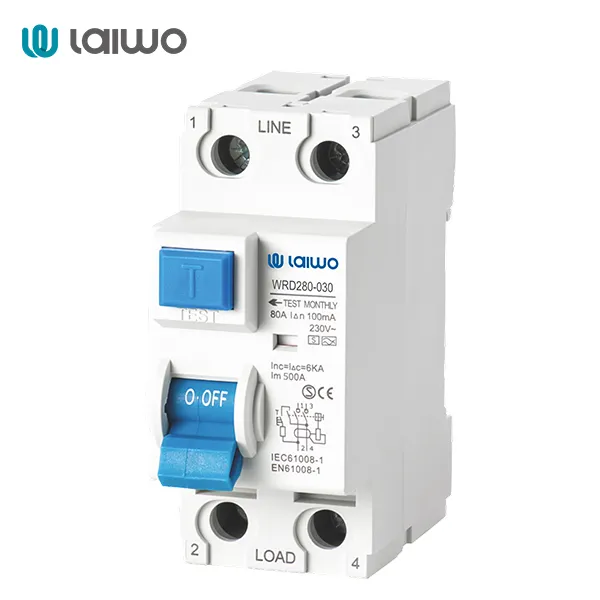
Poles: 2P / 4P
Current: 25–100A
Voltage: 240 / 415V AC
Frequency: 50 / 60 Hz
IΔn: 30 / 100 / 300 / 500 mA
Trip Time: ≤ 0.1 s
Breaking Capacity: 6kA
Mounting: DIN Rail (35mm)
Terminal: up to 25 mm²
Standard: IEC/EN 61008-1, 62423
A Type A RCD is currently the standard requirement for most modern residential and commercial circuits. It is engineered to detect alternating current (AC) leakage as well as pulsating direct current (DC) leakage. Pulsating DC faults commonly arise from household electronics that use simple rectifiers, such as washing machines, dimmers, and computer power supplies.
While Type A devices are ubiquitous, cost-effective, and highly reliable for standard applications, they share a critical limitation: they cannot detect smooth DC leakage. As discussed previously, if smooth DC leakage exceeds 6mA, the Type A RCD will saturate and fail. Therefore, a Type A RCD cannot be used for EV charging unless supplementary DC protection is provided.
What Is a Type B RCD?
Application: EV Charging / PV Systems
Poles: 2P / 4P
Current: 16–100A
Voltage: 110–415V
Type: B (AC + DC detection)
IΔn: 30 / 100 / 300 mA
Trip Threshold: ≥ 0.4 × IΔn or 10mA
Temp: -25°C to +40°C
Wiring: Bidirectional
Standard: IEC 61008-1 / 62423
Certifications: CE, CB, TÜV, UKCA
The Type B RCD represents the pinnacle of leakage protection technology. Type B RCD can detect AC, pulsating DC, and smooth DC leakage currents, making it ideal for EV charging applications. It achieves this comprehensive coverage by utilizing advanced internal circuitry, often incorporating a secondary fluxgate transformer specifically designed to measure smooth and high-frequency DC faults.
Because of its full-type detection capabilities, a type B RCD EV provides the ultimate peace of mind. It is highly sought after for industrial environments, complex medical facilities, and high-end commercial projects where multiple types of complex electrical loads operate simultaneously. However, this sophisticated technology comes at a premium, making Type B units significantly more expensive than their Type A counterparts.
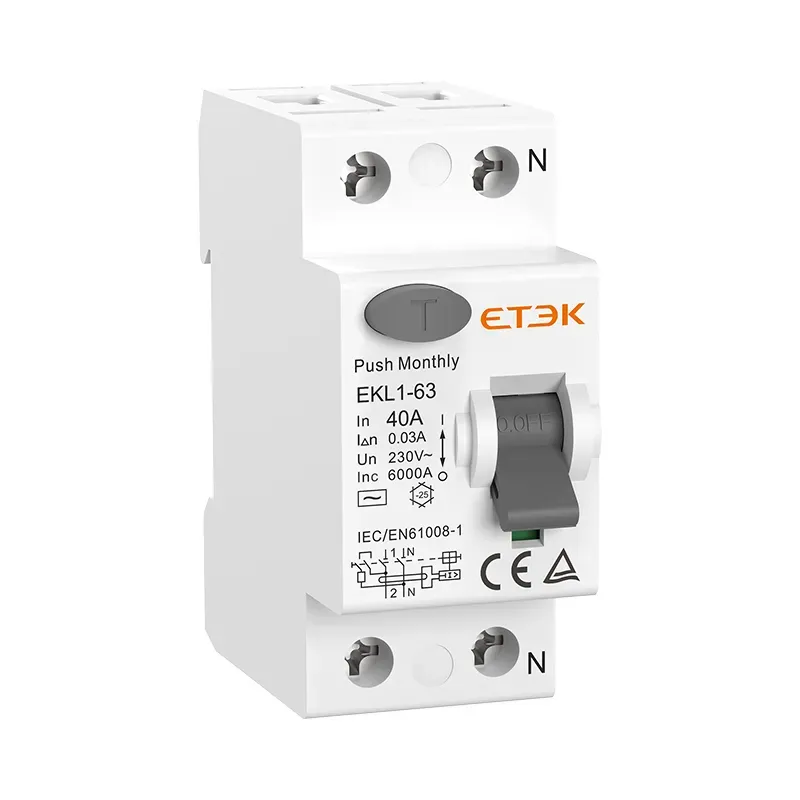
What Is a Type EV (or Type A + DC Detection)?

Application: EV Charging (Mode 3)
Poles: 2P / 4P
Current: 16–63A
Voltage: 230–415V
Type: A + 6mA DC detection
IΔn: 30mA
DC Protection: 6mA
Temp: -25°C to +55°C
Wiring: Top / Bottom
Standard: IEC 61008-1 / 62955
Certifications: CE, CB, TÜV, UKCA
Recognizing the prohibitive cost of deploying Type B RCDs for every single residential and commercial EV charger, the industry innovated a hybrid solution. Type EV refers to a system where a standard Type A RCD is combined with a highly sensitive 6mA DC leakage detection module. In most modern applications, this 6mA detection module is physically integrated into the internal circuitry of the EV charger itself.
If the internal module detects smooth DC leakage exceeding the 6mA threshold, it automatically shuts down the charging session. This prevents the upstream Type A RCD from becoming blinded, ensuring the continued safety of the overall electrical installation while keeping hardware costs manageable.
Comparison Table: Type A vs Type B vs Type EV
To simplify the selection process, the following table summarizes the core capabilities and economic factors associated with each RCD type used in EV leakage protection strategies:
| Feature | Type A | Type B | Type EV |
|---|---|---|---|
| AC leakage detection | Yes | Yes | Yes |
| Pulsating DC detection | Yes | Yes | Yes |
| Smooth DC detection | No | Yes | Yes (via module) |
| Cost | Low | High | Medium |
| EV compatibility | Limited | Excellent | Good |
Cost vs Safety: Which RCD Type Should You Choose?
For B2B procurement managers and lead electricians, balancing project budgets with strict safety compliances is a daily challenge. Selecting the right RCD type EV charger requires careful analysis of the specific site requirements and the EVSE hardware being utilized.
When Is Type B RCD Required?
A type B RCD EV is strictly required in scenarios where the charging hardware lacks internal 6mA DC protection. Older EV charger models, budget-tier imports, and certain heavy-duty commercial units rely entirely on the distribution board’s protection. Furthermore, in large-scale commercial or industrial systems—where multiple chargers operate on a shared infrastructure, or where local regulations demand the highest possible safety standard—Type B RCDs are the undisputed, mandatory choice to prevent catastrophic electrical failures.
When Is Type EV (Type A + 6mA DC Detection) Enough?
For the vast majority of standard installations today, the hybrid approach is more than sufficient. Manufacturers have adapted to safety standards by integrating DC detection directly onto the EVSE motherboard. Most modern EV chargers include built-in 6mA DC detection, allowing the use of a standard Type A RCD. This allows installers to meet all regulatory safety requirements while significantly reducing the material cost of the electrical panel components.
Why Type A Alone Is Not Recommended
It cannot be overstated: installing a bare Type A RCD on an EV circuit without any supplementary 6mA DC detection is a severe code violation and a massive safety risk. The fundamental inability of a Type A device to handle smooth DC leakage means that a fault could go entirely undetected. This scenario risks fatal electric shock to users and creates significant liability for the installing electrician and the facility owner.
Real Electrician Choices: What Is Actually Used in EV Installations?
Theoretical knowledge must translate into practical application. Across the B2B and consumer landscapes, clear trends have emerged regarding how professional installers approach EV leakage protection based on the environment.
Residential EV Charger Installations
In the residential sector, cost-efficiency and space constraints in the consumer unit (breaker box) are primary concerns. The overwhelming standard practice among professional electricians is to supply a high-quality, modern EV charger equipped with built-in 6mA DC detection. Consequently, the standard solution at the distribution board is a simple Type A RCD or a Type A RCBO (Residual Current Breaker with Overcurrent), ensuring safety without inflating the homeowner’s bill.
Commercial EV Charging Stations
Commercial installations, such as fleet depots, workplace parking lots, and public charging hubs, face different challenges. These systems endure continuous heavy usage and are often subject to stricter municipal inspections. In these environments, the common solution frequently defaults to installing standalone type B RCD EV units, or premium Type B RCBO solutions. This guarantees that regardless of the charger brand or potential future hardware swaps, the baseline infrastructure remains fully protected against all fault types.
Regional Practice Differences
It is also crucial to acknowledge that electrical practices vary globally. In European and many Asian markets operating under IEC frameworks, the debate centers heavily around Type B versus Type EV solutions. In contrast, North American installations, governed by the NEC, typically refer to Ground Fault Circuit Interrupters (GFCI). However, the underlying principles of requiring DC fault detection remain universally recognized by global safety authorities.
Installation Guidelines for EV Leakage Protection
Selecting the correct RCD is only the first step. Proper installation is critical to ensure that the device functions correctly when a fault occurs.
Where Should RCD Be Installed?
To provide maximum EV leakage protection, the RCD must be installed upstream of the charging equipment. Typically, this means placing the device inside the main distribution board or inside a dedicated sub-panel situated between the main supply and the EV charger. The protective device must cover the entire length of the cable run leading to the charger to protect against cable damage as well as internal charger faults.
Coordination with Circuit Breakers
An RCD solely protects against earth leakage; it does not protect against short circuits or thermal overloads (unless it is an RCBO). RCDs must be properly coordinated with circuit breakers to ensure both overcurrent and leakage protection. The Miniature Circuit Breaker (MCB) must be sized appropriately for the continuous load of the EV charger, and the RCD must have an amperage rating equal to or greater than that of the MCB to prevent damage to the RCD’s internal contacts.
Compliance with Standards
Professional installations must adhere strictly to international and local codes. The two primary documents governing these installations are IEC 61851 (Electric vehicle conductive charging system) and IEC 60364 (Low-voltage electrical installations). These standards mandate the strict separation of EV charging circuits from standard household loads and outline the specific requirements for detecting and isolating 6mA DC faults.
Common Mistakes in RCD Selection for EV Charging
Despite clear regulations, errors during installation remain common, often leading to failed inspections, safety hazards, or unnecessarily inflated project budgets.
Using Type A Without DC Detection
This is arguably the most dangerous error an installer can make. Assuming that a standard household Type A RCD will suffice for an electric vehicle charger—without verifying the presence of an internal 6mA DC monitor—leaves the entire electrical system vulnerable to core blinding. This is one of the biggest mistakes in modern electrical contracting.
Overusing Type B Where Not Required
On the opposite end of the spectrum is the unnecessary specification of expensive hardware. Mandating a type B RCD EV for a project where the chosen EVSE already features robust internal DC protection leads to redundant safety mechanisms. While not dangerous, this creates unnecessary cost overruns that can make competitive B2B bids economically unviable.
Ignoring Charger Specifications
Many procurement errors stem from a failure to thoroughly review the manufacturer’s data sheets. Every EV charger clearly states its internal protection capabilities and its upstream requirements. Stress checking manufacturer requirements is vital; ignoring them can void warranties and shift legal liability onto the installation team.
FAQ: RCD Types for EV Charging
Do EV chargers require Type B RCD?
Not always. Type B is required only if the charger does not have built-in DC leakage detection. If the charger is unequipped, Type B is mandatory for safety and compliance.
Can I use Type A RCD for EV charging?
Yes, but strictly under the condition that the EV charger includes an internal 6mA DC leakage detection system. Without this internal monitor, a Type A RCD is unsafe and non-compliant.
What is Type EV RCD?
It is a hybrid solution comprising a standard Type A RCD combined with a 6mA DC leakage detection module, an approach commonly utilized in modern, cost-effective EV charging installations.
Why is DC leakage dangerous?
Smooth DC leakage can saturate the magnetic core of standard AC safety devices, effectively preventing standard RCDs from functioning correctly. This “blinding” effect increases severe safety risks and the potential for lethal electric shocks.
Which RCD is most commonly used for home EV chargers?
Due to the integration of internal DC monitoring in consumer chargers, a Type A RCD paired with the charger’s built-in DC detection is the most common, reliable, and cost-effective solution for residential environments.
Conclusion: Choosing the Right RCD for EV Charging
Navigating the complexities of EV leakage protection is essential for any modern electrical professional. As electric mobility continues to expand, ensuring the safety of charging infrastructure protects end-users, property, and the integrity of the broader electrical grid. When evaluating your options, remember that a Type B RCD represents the safest, most comprehensive standalone choice. The Type EV approach offers the best balance of safety and economics, making it the mainstream standard for smart chargers. However, a bare Type A device must never be utilized without verified supplementary DC detection.
The best RCD choice for EV charging depends on whether DC leakage detection is integrated, balancing safety, compliance, and cost. By carefully reviewing the technical specifications of your charging hardware and adhering strictly to established electrical codes, B2B buyers and installers can deliver flawless, secure projects every time. If you are uncertain about the specific requirements for your next installation, we highly recommend consulting detailed product specifications or reaching out to a qualified EV charging supplier and expert installer to guarantee total compliance and safety.