Quick Answer: How Do You Choose the Right Breaker Size?
To choose the correct breaker size for household circuits, calculate the load current and apply the 125% rule for continuous loads. The breaker rating must match the wire capacity and circuit type to ensure safe and reliable operation.
For electrical contractors, facility decision makers, and residential installers, proper residential electrical breaker selection is a fundamental aspect of system design. Determining the correct breaker size for household circuits is not merely a matter of keeping appliances running; it is a critical safety measure that protects infrastructure, prevents electrical fires, and guarantees compliance with industry regulations. This comprehensive guide outlines the technical requirements for home circuit breaker sizing, providing a definitive resource for professionals and B2B procurement teams.
Why Correct Breaker Sizing Matters in Homes
Circuit protection devices serve as the gatekeepers of residential electrical safety. Selecting an appropriate breaker rating ensures that the system can handle daily electrical demands while instantly disconnecting power when hazardous conditions arise.
What Happens If a Breaker Is Too Small?
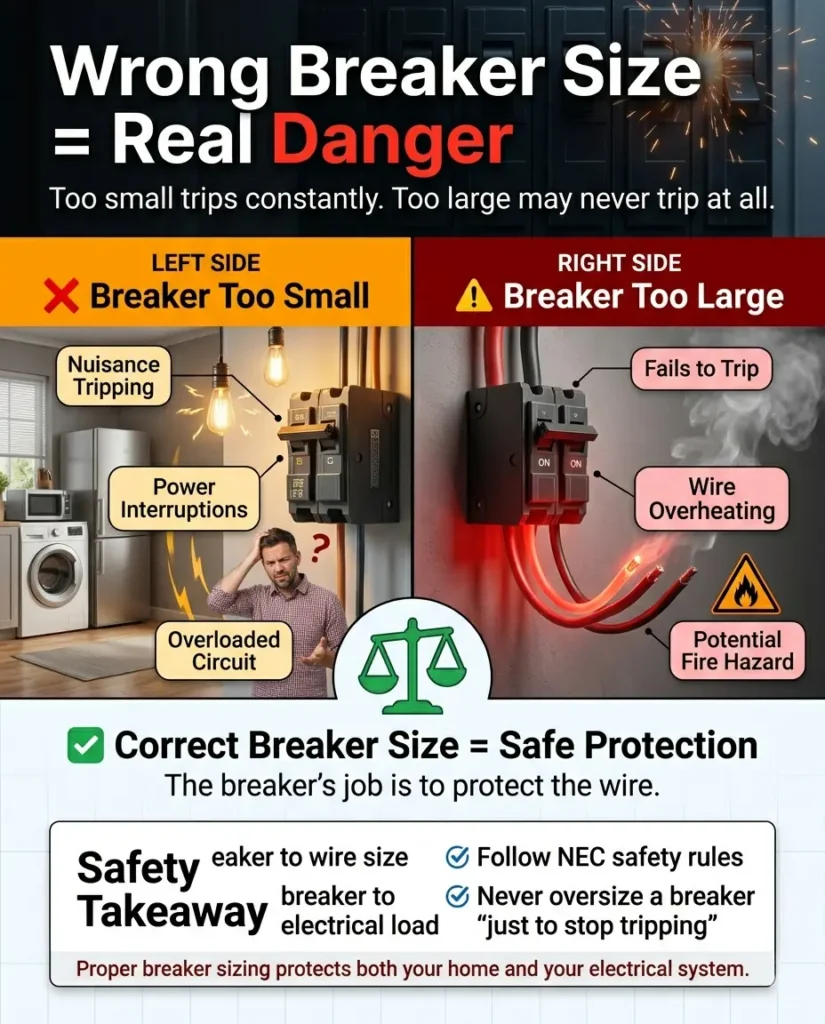
Installing a breaker with a capacity lower than the normal operating load results in persistent issues. The most common symptom is nuisance tripping, where the breaker repeatedly disconnects power during normal appliance usage. This leads to an unstable power supply, frustrates end-users, and can negatively impact the performance and lifespan of sensitive household equipment.
What Happens If a Breaker Is Too Large?
An oversized breaker may fail to trip during faults, increasing the risk of overheating and fire.
This is arguably the most dangerous error in residential electrical breaker selection. If the breaker allows more current to pass than the wiring can safely handle, the wire insulation will degrade, melt, and potentially ignite surrounding building materials before the breaker ever recognizes a problem.
The Role of Breakers in Home Electrical Safety
Circuit breakers provide three primary layers of defense. First, they offer overload protection by interrupting power when too many devices draw current simultaneously. Second, they provide short-circuit protection, instantly cutting power when a direct path to ground causes a massive current spike. Finally, through these mechanisms, they serve as the ultimate method of fire prevention within the home electrical framework.
How to Calculate Load for Household Circuits
Accurate load calculation is the first step in home circuit breaker sizing. Electricians must determine the total electrical demand of the devices operating on a given circuit to select the appropriate breaker rating.
Basic Electrical Formula
The foundational relationship between power, voltage, and current is expressed by Watt’s Law:
P = V × I
Where P represents Power (Watts), V represents Voltage (Volts), and I represents Current (Amps).
How to Convert Power to Current
To determine the load current, rearrange the formula to solve for Amps:
I = P / V
For example, if you are installing a high-powered electric heater rated at 2000W on a standard 220V European or Asian system, the calculation is: 2000W ÷ 220V ≈ 9A. This means the device will draw approximately 9 Amps of current during normal operation.
What Is a Continuous Load?
A continuous load is a circuit that operates for more than 3 hours, requiring additional safety margin.
Identifying continuous loads is vital for proper circuit protection. Devices such as lighting systems, HVAC units, and water heaters often run uninterrupted for extended periods. Because continuous operation generates sustained heat within the wires and the breaker itself, electrical codes mandate derating the breaker or sizing up the circuit to handle the thermal stress.
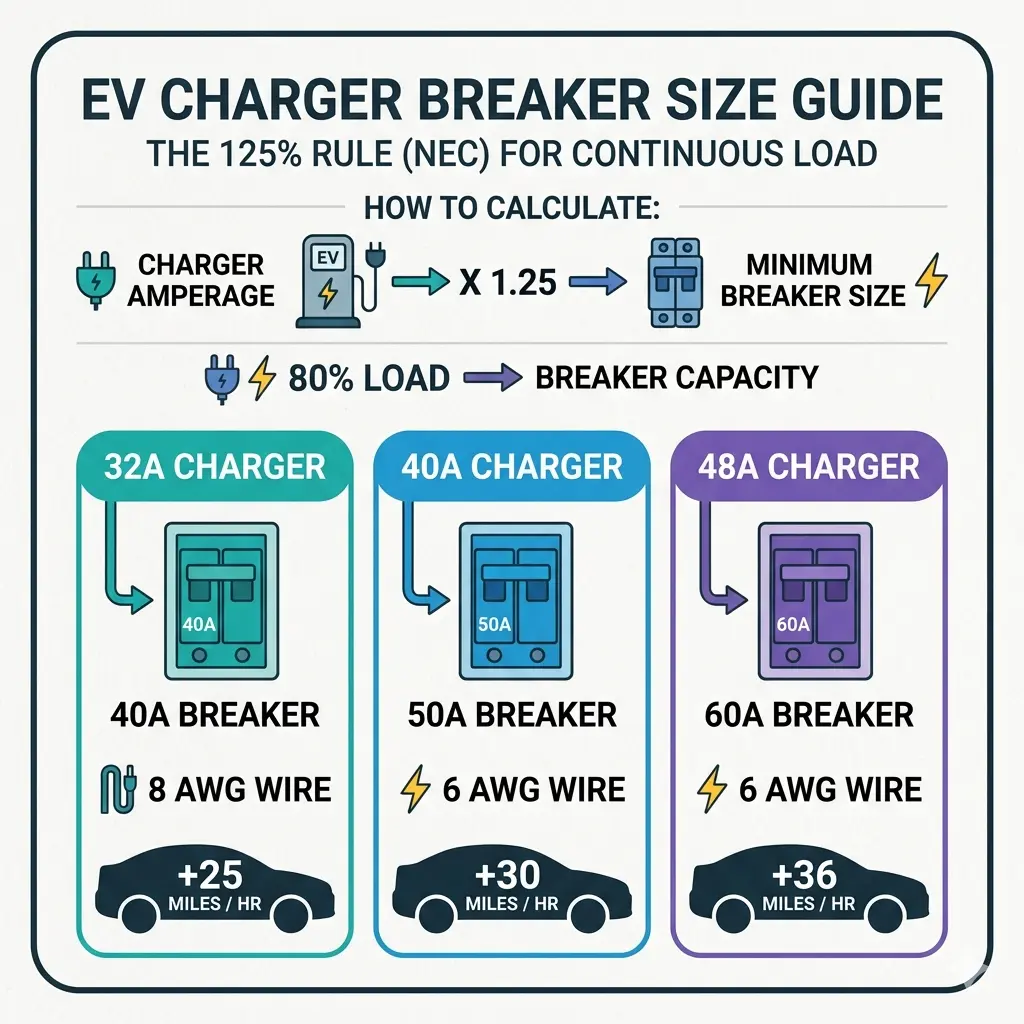
Breaker Sizing Rule: The 125% Principle
When dealing with continuous loads, industry standards (such as the National Electrical Code – NEC) dictate that the protective device must be sized larger than the actual load to prevent thermal tripping and equipment damage.
Standard Breaker Sizing Formula
To calculate the required breaker size for continuous loads, apply the following multiplier:
I_breaker = I_load × 1.25
Example Calculation
Suppose you calculate that an air conditioning unit draws a continuous load of 16A. By applying the formula (16A × 1.25), you arrive at 20A.
A 16A household circuit typically requires a 20A breaker under the 125% rule.
When to Apply the 125% Rule
This principle is mandatory for specific high-draw applications. You must apply the 125% safety margin when sizing circuits for air conditioners, electric heating equipment, and EV charging stations. Electric vehicle chargers, in particular, draw heavy current continuously for hours, making strict adherence to this rule critical for facility safety.
Standard Breaker Sizes for Household Circuits
Manufacturers produce breakers in standardized ratings. B2B distributors and installers must align their project specifications with these standard sizes.
Common Breaker Ratings
| Breaker Rating | Typical Household Application |
|---|---|
| 10A / 15A | Lighting circuits, basic electronics |
| 16A / 20A | Standard wall sockets, kitchen appliances |
| 20A – 32A | Dedicated kitchen appliances, water heaters |
| 32A – 40A | Central air conditioners, electric ranges |
| 40A+ | EV chargers, sub-panel feeds |
Matching Breaker Size to Wire Capacity
Breaker size must never exceed the current-carrying capacity of the wire.
The breaker is designed to protect the wire, not just the appliance. If a circuit uses 14 AWG wire (rated for 15A), installing a 20A breaker creates a severe fire hazard, regardless of what the connected appliance requires. Wire gauge (thickness) and breaker rating must be inextricably linked in every installation.
How to Choose Breaker Size for Different Household Circuits
Different areas of a home have distinct electrical footprints. The breaker size for household circuits varies heavily by application, but the actual selection must always be based on load, voltage, local code, and wire gauge.
Lighting Circuits
Modern LED lighting draws very little power. Typically, a 10A (in 230V regions) or 15A (in 120V regions) breaker is more than sufficient for dedicated lighting circuits, easily handling dozens of fixtures.
Socket Circuits
General-purpose receptacles in bedrooms and living areas are usually protected by 16A or 20A breakers. This capacity supports televisions, computers, and standard vacuum cleaners safely.
Kitchen Appliances
Kitchens demand robust circuit protection. Microwaves, toasters, and refrigerators require 20A to 32A dedicated circuits due to their high wattage and motor startup surges.
Air Conditioner Circuits
HVAC systems require 20A to 40A breakers depending on their cooling capacity (BTU). These systems must also account for the locked rotor amps (LRA) during compressor startup.
EV Charger Circuits
Level 2 EV charging circuits represent the heaviest continuous loads in modern homes, typically requiring 40A to 60A breakers. Electricians must ensure the home’s main electrical service panel has the capacity to support this massive addition.
Other Factors That Affect Breaker Selection
Beyond simple amperage calculations, professional installations require a holistic view of the operating environment and project specifications.
Voltage Level
The operational voltage (e.g., 120V in North America vs. 230V in Europe/Asia) drastically changes the amperage calculation for the same wattage appliance. Procurement teams must source breakers rated for the correct regional voltage.
Installation Environment
Ambient temperature, panel ventilation, and the physical environment of the distribution board affect breaker performance. Extreme heat can cause breakers to trip prematurely, requiring specialized thermal-magnetic breakers or specific panel enclosures.
Breaker Type (MCB vs RCBO)
Selecting the correct protective device for project specification and compliance involves choosing between a Miniature Circuit Breaker (MCB) for basic overcurrent protection, and a Residual Current Breaker with Overcurrent (RCBO) which adds leakage protection to prevent electric shocks. B2B facility managers must prioritize RCBOs in wet areas like bathrooms and kitchens to meet modern safety codes.
Common Mistakes in Household Breaker Sizing
Errors in residential electrical breaker selection can lead to catastrophic failures. Avoid these prevalent industry mistakes.
Ignoring Wire Size
This is one of the most severe errors an installer can make. Upgrading a tripping breaker to a larger size without upgrading the corresponding wall wiring guarantees that the wire will act as the fuse, melting and causing a fire.
Using Oversized Breakers
As emphasized earlier, an oversized breaker fails to provide the necessary thermal protection. It permits dangerous levels of current to flow during a fault condition unchecked.
Not Considering Continuous Loads
Failing to apply the 125% rule for continuous loads leads to chronic overheating at the breaker terminals, eventually destroying the breaker and potentially damaging the distribution panel bussing.
Overloading Circuits
Placing too many high-draw devices (like space heaters and hair dryers) on a single circuit design forces the breaker to operate near its maximum limit constantly, degrading its internal components over time.
FAQ: Breaker Size for Household Circuits
Conclusion: Choosing the Right Breaker Size for Home Circuits
Navigating home circuit breaker sizing requires precision, technical knowledge, and strict adherence to safety protocols. When executing a residential electrical breaker selection, professionals must remember three absolute priorities:
- Calculating load is foundational: Always determine the exact amperage requirements using Watt’s Law.
- The 125% rule must be followed: Apply the safety margin for any continuous loads to prevent thermal degradation.
- Wire capacity takes priority) Never install a breaker that exceeds the safe current-carrying capacity of the circuit wiring.
Proper breaker sizing ensures electrical safety, prevents overheating, and guarantees reliable operation in residential systems.
For B2B distributors, electrical contractors, and facility managers looking to ensure complete compliance and safety in their next project, we recommend sourcing high-quality, certified protective devices. Contact your electrical supplier to request detailed specifications or consult a licensed electrician to review your system loads.