The North American Low Voltage Circuit Breaker (LVCB) market is currently in a “golden age” of growth, driven by technological disruption, regulatory reshaping, and a surge in macro electricity demand. As the United States, Canada, and Mexico commit to deep decarbonization of their energy structures, the terminal protection devices of power distribution systems—low voltage circuit breakers—have evolved from traditional mechanical switches into intelligent, digital, and integrated energy management nodes. In 2025, the North American LVCB market is valued at approximately USD 2.8 billion and is projected to reach USD 5.3 billion by 2035, with a steady Compound Annual Growth Rate (CAGR) of approximately 6.4%. This growth represents not just a volume expansion but a migration up the value chain, particularly with the penetration of solid-state breakers, DC breakers, and IoT-enabled smart breakers in commercial buildings, data centers, and electric vehicle (EV) infrastructure.
- North America Low Voltage Circuit Breaker Market Size & Share 2026 – 2035
- North America Low Voltage Circuit Breaker Market Opportunity, Growth Drivers, Industry Trend Analysis and Forecast 2026-2035
Chapter 1: Macro Market Overview and Growth Engines
As critical safety components in power distribution systems, the primary function of LVCBs is to interrupt current during overloads, short circuits, or ground faults. In North America, market dynamics are deeply influenced by the intersection of industrial automation, digital transformation, and energy transition. Current electricity demand is experiencing its most significant structural growth since World War II, primarily attributed to three core drivers: transport electrification, integration of distributed renewable energy, and the expansion of AI-centric digital infrastructure.
1.1 Market Size Forecast and Segment Structure
The value distribution of the North American LVCB market is shifting from traditional residential markets to high-value Commercial and Industrial (C&I) sectors. The commercial segment, due to its extreme requirements for power reliability and energy efficiency, occupied a 41.6% market share in 2025 and is expected to reach a scale of USD 2 billion by 2035 .
| Metric Type | 2025 Value | 2035 Forecast | CAGR |
|---|---|---|---|
| Total NA Market Value | $2.8 Billion | $5.3 Billion | 6.4% |
| Miniature Circuit Breaker (MCB) Segment | $2.5 Billion (2023) | $2.6 Billion (2035) | >6.5% |
| DC Circuit Breaker Market (NA) | $1.068 Billion (2024) | $1.672 Billion (2030) | 7.7% |
| U.S. Market Valuation | $2.1 Billion | $3.5 Billion (Est.) | 5.2% – 6.0% |
| Commercial Application Share | 41.6% | Expected to Grow | N/A |
1.2 Core Growth Drivers Analysis
Market activity in North America is significantly catalyzed by government policies. For example, the U.S. National Electric Vehicle Infrastructure (NEVI) Formula Program provides nearly USD 5 billion for a nationwide fast-charging network, directly leading to large-scale procurement of UL-compliant LVCBs, panelboards, and switchgear by commercial real estate and public facilities . Simultaneously, grid resilience enhancements and modernization of aging infrastructure have released massive demand. The U.S. Department of Energy (DOE) announced USD 3.46 billion in 2023 for 58 GRIP projects aimed at integrating over 35 GW of renewables and 400 microgrids, driving standardized procurement volumes for low voltage switchgear and breakers .
Chapter 2: EV and Solar Driven Energy Transition
Electrification is the strongest single growth vector for the North American LVCB market. The decarbonization of transportation and the proliferation of distributed solar photovoltaic (PV) systems have not only increased total demand but also changed technical specifications.
2.1 Technical Requirements for EV Charging Infrastructure
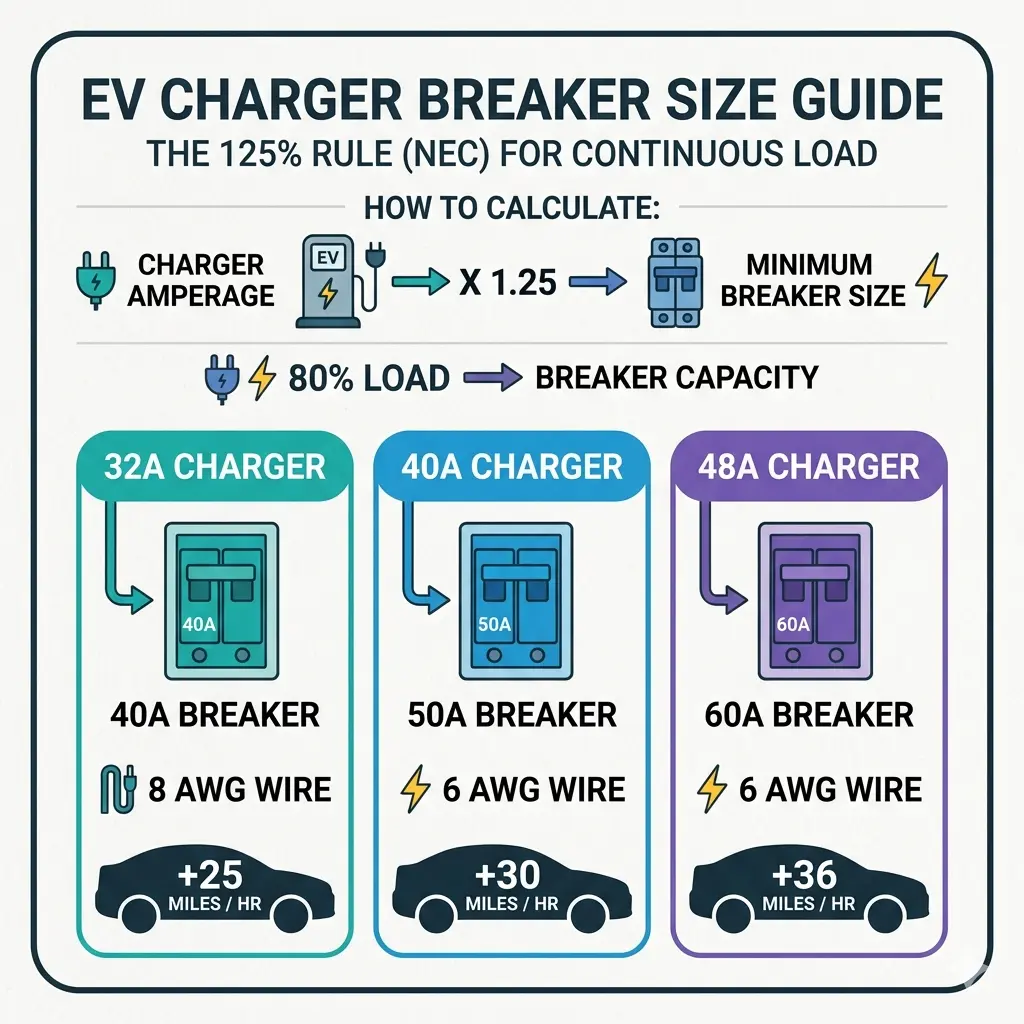
As fast-charging networks expand, operators and utilities must upgrade existing distribution facilities to support high-power charging loads. According to the 2023 National Electrical Code (NEC), branch circuits for EV charging equipment must be treated as continuous loads, with breakers and conductors rated at least 125% of the charger’s rated current .
| Charger Level | Typical Voltage/Phase | Rated Current | Recommended Breaker (125% Rule) |
|---|---|---|---|
| Level 1 | 120V Single-phase | 12A–16A | 15A–20A (Dedicated) |
| Level 2 (Standard) | 240V Single-phase | 32A | 40A |
| Level 2 (High Power) | 240V Single-phase | 48A | 60A |
| DC Fast Charge (DCFC) | 480V Three-phase | 100A–200A+ | 125A–250A+ |
In this context, procurement cycles are tilting toward smart breakers with integrated communication functions for load management, remote diagnostics, and predictive maintenance. Additionally, the MCB segment is seeing significant growth in residential electrification as homeowners upgrade panels to support new EV chargers and heat pumps in compliance with the latest safety codes .
2.2 Integration of Solar PV and Storage Systems
Distributed solar and Battery Energy Storage Systems (BESS) require modern protection devices capable of handling bidirectional and variable fault currents. Solar PV plants are increasingly moving toward higher DC voltages (up to 1,500V DC) to improve efficiency, fostering strong demand for DC breakers compliant with UL 489B standards .
Solar PV plants are expected to dominate the LVCB end-user market during the forecast period. This trend extends beyond utility-scale projects to C&I parks integrating PV with storage and DC microgrids. In these complex DC architectures, breakers must extinguish DC arcs within microseconds, making hybrid and solid-state breakers favored choices due to their ultra-fast fault isolation and low maintenance needs .
- Low Voltage DC Circuit Breaker Market Size to Grow $2.52 billion by 2030
- Low Voltage DC Circuit Breaker Market worth $2.52 billion by 2030
Chapter 3: Surge in Demand for Commercial Buildings and Digital Infrastructure
In North American commercial sectors, particularly data centers and healthcare, the requirements for power continuity and quality are demanding. This drives not only sales volume but also the evolution toward digitized and high-performance products.
3.1 The Power Heart of Data Centers
The rise of AI computing clusters has caused rack densities to skyrocket. Traditional densities of 5-10 kW per rack are rapidly advancing to 30-50 kW or even higher . This concentration of power requires a vast number of LVCBs in Power Distribution Units (PDUs), Remote Power Panels (RPPs), and UPS outputs.
- Power Density Impact: A typical 30-60 MW hyperscale data center campus may require 5,000 to 12,000 LVCBs, compared to only 40-120 medium voltage breakers. This ratio highlights the core role of LVCBs in maintaining server-level uptime.
- Technical Specifications: Due to the high cost of downtime (up to tens of thousands of dollars per hour), operators favor Air Circuit Breakers (ACBs) for their high breaking capacity (Icu), stable continuous performance, and clear visual isolation for maintenance .
- Intelligence Trends: Connected breakers with smart trip units, thermal monitoring, and event logging are now standard for hyperscale facilities, supporting predictive maintenance to allow intervention before catastrophic failure .
3.2 Healthcare and Critical Infrastructure
In hospitals and research labs, breaker reliability is a matter of life safety. Selective coordination is vital to ensure only the breaker closest to the fault trips, avoiding unnecessary wide-area outages. Additionally, energy standards such as ASHRAE 90.1-2025 have strengthened submetering requirements, mandating that owners track energy usage by end-use (e.g., HVAC, lighting, plug loads) . This drives manufacturers to integrate high-precision energy metering directly into breaker control units, simplifying compliance and reducing system complexity.
Chapter 4: Competitive Dynamics: Imported vs. Local Brands
The North American market exhibits a moderately concentrated competitive structure, with a battle between global giants and agile regional/emerging brands.
4.1 Hegemony of Global and Local Giants
The “Big Five”—ABB (Switzerland), Schneider Electric (France), Siemens (Germany), Eaton (Ireland/USA), and GE Vernova (USA)—collectively held approximately 65-75% of the North American ACB market share in 2025 .
| Brand | Headquarters | Core Competitive Advantage | Strategic Focus |
|---|---|---|---|
| ABB | Switzerland | >10% market share in 2025; pioneer in solid-state breakers. | Focused on smart grid solutions, digital protection, and high-performance solid-state tech (e.g., SACE Infinitus). |
| Schneider Electric | France | Leader in IoT integration via the EcoStruxure platform. | Target data centers, healthcare, and large commercial buildings with digital trip units and energy software. |
| Eaton | Ireland/USA | Deep North American channel roots and strong industrial/utility presence. | Emphasize safety and resilience, particularly local advantages in EV charging infra and grid modernization. |
| Siemens | Germany | Strong engineering background and global supply chain integration. | Focus on Industry 4.0, renewables, and high breaking capacity SENTRON series. |
| Rockwell | USA | The backbone of NA industrial automation. | Deep integration of breakers into Allen-Bradley PLC and control architectures. |
4.2 Emerging Import Forces: LS ELECTRIC and NOARK/CHINT
Challengers from the Asia-Pacific region are leveraging cost optimization and supply chain speed to erode the market share of traditional giants.
- LS ELECTRIC (South Korea): LS ELECTRIC has executed an aggressive North American strategy. Its chairman stated that compared to the “Big Four,” LS ELECTRIC delivers more than twice as fast at more competitive prices . To overcome tariffs and “Made in USA” requirements, the company established a production base in Bastrop, Texas, to assemble UL 1066 certified ACBs, qualifying them for federally funded infrastructure projects . Their “Compact ACB” has gained wide recognition in hyperscale data centers.
- NOARK/CHINT (China): As a global brand under the CHINT Group, NOARK has deeply penetrated the North American market, offering a full range of UL-certified products from MCBs to ACBs . Their products are known for high cost-effectiveness and a unique five-year limited warranty, aimed at breaking the brand loyalty monopoly in high-end markets. NOARK is particularly focused on high-growth sectors like Solar (UL 489B) and Storage (UL 489 Supplement SC) .
Chapter 5: Technical Evolution: From Mechanical Protection to Solid-State and Smart Grids
Breaker technology is undergoing its most profound change since its invention in the late 19th century. Future grids will be hybrid AC/DC, requiring protection devices with entirely new physical properties.
5.1 Rise of Solid-State Circuit Breakers (SSCB)
Traditional mechanical breakers are limited by the physical speed of contact closure (typically in milliseconds), whereas SSCBs utilize semiconductor technology to achieve microsecond-level fault interruption. ABB’s SACE Infinitus is the world’s first IEC 60947-2 certified SSCB, with breaking speeds 100 times faster and a lifespan 100 times longer than traditional tech .
- Application Value: In environments sensitive to current fluctuations like DC microgrids, EV fast charging, and semiconductor manufacturing, SSCBs allow near-zero arc energy release, drastically improving safety for personnel and equipment .
- Efficiency and Maintenance: While solid-state technology has conduction losses, ABB has reduced these by 70% through optimized IGCT devices, making them cost-effective over their lifecycle. With no mechanical wear, SSCBs are virtually maintenance-free, offering irreplaceable value in hard-to-reach locations like offshore wind and remote base stations .
5.2 Deep Integration of Digitalization and IoT
LVCBs are no longer just “tripping” devices; they are becoming data sources. Schneider’s MasterPact MTZ and Siemens’ 3VA series represent the peak of this trend:
- Integrated Metering: Built-in Class 1 precision meters allow accurate energy monitoring without external transformers, meeting the strictest green building certifications .
- Wireless Connectivity: Using Bluetooth, NFC, and Zigbee, maintenance personnel can configure parameters or query fault causes via smartphones without opening cabinets, significantly reducing arc flash risks .
- Predictive Maintenance: Data-based algorithms calculate contact health. By analyzing historical interruption currents and operations, the system warns of replacement needs, reducing unplanned downtime to near zero .
Chapter 6: Impact of Policy, Tariffs, and Trade Compliance
In North America, market access and cost structures are deeply influenced by geosecurity and regulatory frameworks.
6.1 Build America, Buy America Act (BABA)
The “Build America, Buy America Act” (BABA), a core part of the 2021 Bipartisan Infrastructure Law, imposes strict domestic requirements on federally funded projects.
- Compliance Standards: Products must be manufactured in the U.S., and the cost of domestic components must exceed 55% of the total (increasing to 75% by 2029) .
- Manufacturer Response: ABB, Eaton, and Schneider have launched BABA-compliant series for breakers and switchgear. For instance, LVCB equipment manufactured at ABB’s Mebane, NC facility carries the “Made in USA” label, which has become a requirement for bidding on public utility, transport, and government building projects.
6.2 Section 301 Tariffs and Supply Chain Reorganization
U.S. Section 301 tariffs on Chinese electrical equipment continue to pressure import brands. Updates in 2024 and 2025 show that tariffs on specific power and electronic products remain high, forcing many brands to move assembly lines to Vietnam, Mexico, or India. This “de-risking” process is restructuring the market, benefiting manufacturers with diversified global production bases.
Chapter 7: Market Challenges and Industry Risks
Despite bright prospects, the North American LVCB market faces several structural challenges.
- Raw Material Price Volatility: Fluctuations in the prices of conductive materials like copper and silver, as well as high-performance polymers, directly affect gross margins.
- Skilled Labor Shortage: Installing and maintaining advanced digital breakers requires cross-disciplinary skills (electrical + IT). North America currently faces a severe shortage of licensed electricians, which may slow the deployment of smart breakers .
- Interoperability and Cybersecurity: As breakers connect to the cloud, power infrastructure becomes a potential target for cyberattacks. Ensuring compliance with strict cybersecurity standards like IEC 62443 has become a high R&D expense .
- Complexity of Legacy Upgrades: North America has a massive stock of old buildings whose distribution systems lack digital interfaces. Retrofitting smart breakers into old switchgear faces technical hurdles like space constraints and busbar compatibility .
Chapter 8: Conclusion and Future Outlook
Looking ahead to 2035, the North American LVCB market will continue to accelerate on the dual tracks of “green” and “digital.” As “the electrification of everything” advances, LVCBs are transforming from simple protective switches into critical “smart gateways” at the edge of the grid.
Key industry trends can be summarized as follows:
- Normalization of DC Architectures: Driven by solar, EVs, and data centers, DC distribution systems will move from the periphery to the center, leading to explosive growth for DC-rated breakers.
- Democratization of Solid-State Tech: As the costs of wide-bandgap semiconductors (SiC, GaN) fall, SSCBs will spread from specialized applications to general industrial and commercial scenarios.
- Emergence of “Breaker-as-a-Service” (SaaS): Manufacturers will move beyond selling hardware to generating recurring revenue through data-based “predictive maintenance” and “energy optimization consulting.”
- Regionalization of Supply Chains: Under the dual pressure of BABA and tariffs, local North American assembly and component sourcing will become core components of competitiveness.
For investors and corporate decision-makers, capturing growth in the North American market requires not only focusing on breaking currents but also understanding the digital ecosystem, compliance paths, and coordination capabilities within EV and renewable integration. In this policy-driven and technology-enabled market, brands that can fuse local response speed with global technical innovation will ultimately prevail.