
Installing an electric vehicle charging station is a significant upgrade for both residential and commercial properties. However, ensuring electrical safety and compliance is paramount. One of the most critical aspects of a safe installation is selecting the correct protective equipment. In this comprehensive guide, we will explore the proper breaker size for EV charger installations, break down the EV charger amp requirement, and explain how to choose the right circuit breaker for level 2 charger setups.
For electrical contractors, charging station distributors, facility managers, property developers, and procurement teams, this is more than a technical detail. Breaker sizing directly affects installation safety, code alignment, equipment longevity, and customer satisfaction. A breaker that is too small can lead to nuisance tripping and service complaints. A breaker that is too large can reduce protection and introduce unnecessary risk. In other words, correct sizing protects both the charging asset and the business case behind it.
As EV adoption accelerates across fleets, workplaces, retail properties, multifamily buildings, and homes, buyers increasingly expect clear guidance on charger selection and electrical design. That is why understanding breaker size for EV charger applications has become essential for manufacturers, resellers, installers, and end users alike. The sections below provide a practical framework you can use to evaluate residential and commercial charging projects with greater confidence.
Quick Answer: What Size Breaker Is Needed for an EV Charger?
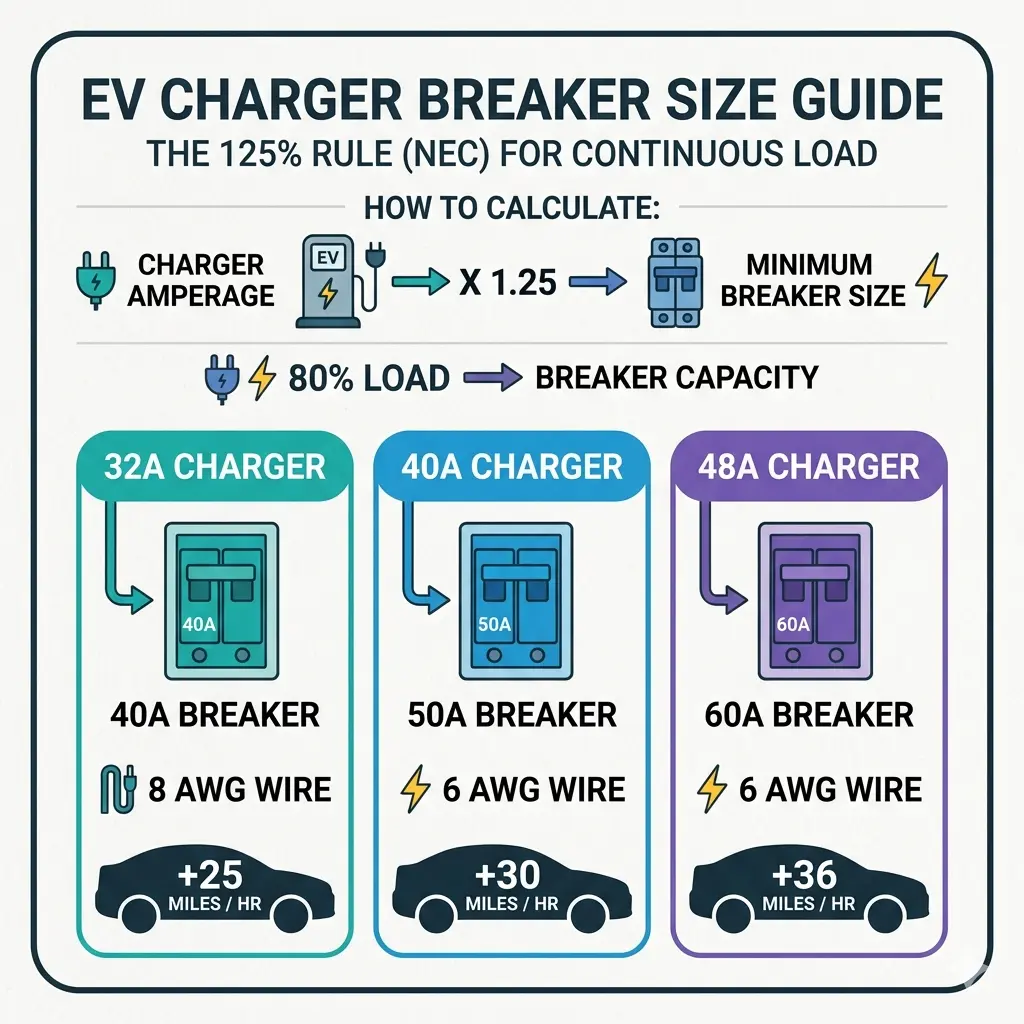
Most Level 2 EV chargers require a 40A to 60A circuit breaker, depending on the charger’s rated current. As a general rule, the breaker size should be 125% of the continuous load, in accordance with standard electrical codes.
Because electric vehicles draw a substantial amount of power over several hours, the electrical panel must be equipped to handle this sustained demand without overheating or tripping prematurely. Applying the 125% rule ensures that your electrical infrastructure remains safe and operates reliably.
In practice, that means you should start with the charger’s continuous output current, multiply it by 1.25, and then select the next suitable standard breaker size. This simple method helps eliminate common installation errors and provides a quick answer for sales teams, project engineers, and site owners comparing charger specifications.
How Is EV Charger Power Calculated?
What Determines EV Charger Power Requirements?
Before selecting a breaker, you must understand the factors that dictate the EV charger amp requirement. The primary determinants include:
- Voltage (V): The electrical supply voltage (e.g., 120V for Level 1, 240V for Level 2).
- Current (A): The maximum amperage the charger can draw.
- Charger type: Level 1, Level 2, or DC Fast Charging systems.
- Vehicle compatibility: The onboard charger limit of the specific electric vehicle.
EV Charger Power Formula (kW Calculation)
To determine the total power output of your charging station, you can use the standard electrical power formula:
P = V × I
Where:
- P = Power in Kilowatts (kW) (divided by 1000)
- V = Voltage (V)
- I = Current (A)
Example Calculation: If you have a charger operating at 240V and drawing 40A, the calculation is 240V × 40A = 9,600 Watts, or 9.6 kW.
Why EV Chargers Are Considered Continuous Loads
In electrical engineering, a continuous load is defined as a maximum current that is expected to continue for three hours or more. EV chargers typically operate for long durations to fully replenish a vehicle’s battery. Therefore, they are universally classified as continuous loads. This classification requires derating when selecting circuit breakers, meaning the breaker and the wiring must be sized to handle 125% of the charger’s maximum output.
Level 1 vs Level 2 vs DC Fast Charging: What Breaker Size Is Required?
Level 1 EV Charger Breaker Size
Level 1 charging uses standard household outlets and provides a slow charge, suitable for overnight top-ups.
- Voltage: 120V
- Current: 12–16A
- Breaker: 15A or 20A single-pole breaker
Level 2 EV Charger Breaker Size
Level 2 charging is the most common solution for homes and commercial locations, offering significantly faster charging speeds. Choosing the right circuit breaker for level 2 charger installations is crucial for system stability.
For B2B buyers, Level 2 systems usually represent the sweet spot between installation cost and charging performance. They are widely used in office parking lots, hotels, dealerships, apartment complexes, logistics depots, and public destinations because they deliver practical charging times without the infrastructure demands of DC fast charging. That also makes accurate breaker selection especially important, since Level 2 projects are often deployed at scale.
- Voltage: 208–240V
- Current: 16–48A
- Breaker: 20A–60A double-pole breaker
Common Configurations:
- 32A charger requires a 40A breaker
- 40A charger requires a 50A breaker
- 48A charger requires a 60A breaker
DC Fast Charging Breaker Requirements
DC Fast Chargers (DCFC) bypass the vehicle’s onboard charger to deliver direct current directly to the battery.
- High power: Ranges from 50kW to 350kW+
- Equipment: Requires a Molded Case Circuit Breaker (MCCB) or higher-level protective equipment.
- Sizing: The breaker size is strictly based on rigorous commercial system design calculations and engineering reviews.
What Is the Correct Breaker Sizing Formula for EV Chargers?
The 125% Rule for Continuous Loads
Electrical safety codes, such as the NEC and IEC (subject to local adoption), require that overcurrent protection devices for continuous loads be sized appropriately.
Ibreaker = Iload × 1.25
This formula ensures that the breaker must be at least 125% of the continuous load current. Conversely, it means the continuous load cannot exceed 80% of the breaker’s rating.
Example Calculation for Level 2 EV Charger
Let us apply the rule to a common residential scenario:
- Charger current = 40A
- Breaker = 40A × 1.25 = 50A
Therefore, a 40A EV charger typically requires a 50A circuit breaker.
How to Choose Between Standard Breaker Sizes
When your calculation results in a non-standard breaker size, you must follow best practices:
- Round Up: Always round up to the next standard breaker size available in the market.
- Environmental Factors: Consider ambient temperature and installation environment, as excessive heat can affect breaker performance.
- Compliance: Always adhere strictly to the applicable NEC or IEC standards governing your specific region.
Real Installation Examples: Home vs Commercial EV Charging
Residential EV Charger Breaker Sizing
Home installations are typically straightforward. A standard configuration involves a 32A charger paired with a 40A breaker. These are usually single-vehicle installations utilizing a Miniature Circuit Breaker (MCB) combined with a Residual Current Device (RCD) for ground fault protection.
Even in residential projects, breaker sizing should never be treated as a plug-and-play decision. The installer must confirm available panel capacity, conductor sizing, circuit length, and whether the homeowner wants future charging upgrades. For example, a customer who currently drives one EV may soon add a second vehicle, making panel planning and breaker coordination more strategic than they appear at first glance.
Commercial EV Charging Station Breaker Sizing
Commercial installations face different challenges. They feature multiple charging stations operating simultaneously, creating a high-demand load on the facility’s electrical grid. In these scenarios, robust Molded Case Circuit Breakers (MCCB) are deployed to handle the high capacity and provide enhanced short-circuit protection.
In commercial environments, breaker selection must also align with demand forecasting, tenant requirements, operating hours, and utility constraints. A workplace charging project may have predictable daytime usage, while a fleet depot may experience long overnight charging sessions across many vehicles. These different load profiles can influence feeder sizing, distribution design, and the coordination between branch protection and upstream service equipment. This is why commercial EV charging station breaker sizing is usually part of a broader engineered power strategy rather than a single isolated calculation.
Multi-Charger Load Management Considerations
For large-scale commercial deployments, managing the EV charger amp requirement across multiple units is vital. Facilities often employ:
Instead of sizing every charger at its theoretical maximum demand and overspending on infrastructure, many modern projects use intelligent controls to maximize site capacity. This approach improves capital efficiency, shortens payback periods, and enables phased expansion as EV adoption grows.
- Load balancing: Distributing available power dynamically among active chargers.
- Smart charging systems: Software-controlled scheduling to optimize power draw.
- Demand control: Preventing the total site load from exceeding the main utility service limits.
Common Mistakes When Sizing Circuit Breakers for EV Chargers
Using Undersized Breakers
Installing a breaker that exactly matches the charger’s output (e.g., a 40A breaker for a 40A charger) violates continuous load rules. This leads to frequent nuisance tripping and can cause premature wear or catastrophic damage to the electrical equipment.
From a business perspective, undersizing also increases maintenance calls, undermines customer trust, and creates avoidable downtime. For charging network operators and property owners, repeated tripping can translate into poor user reviews and reduced charger utilization, which directly impacts return on investment.
Ignoring the 125% Rule
Failing to multiply the load by 1.25 is the most frequent error in DIY or inexperienced installations. This oversight results in non-compliance with electrical codes, potentially voiding warranties and insurance policies.
For B2B projects, code mistakes are even more costly because they can delay inspection approvals, disrupt project timelines, and trigger rework across multiple charging points. A simple sizing error made early in procurement or design can become an expensive correction during commissioning.
Oversizing the Breaker
Conversely, using a breaker that is vastly too large (e.g., an 80A breaker for a 32A charger with 40A wiring) causes the protection mechanism to fail. The breaker will not trip when an overcurrent event occurs, leading to a severe fire hazard.
Not Considering Continuous Load Conditions
EV chargers run at maximum capacity for hours. If continuous load conditions are ignored, the sustained current can lead to severe overheating of the panel, wiring insulation degradation, and eventual system failure.
How to Choose the Right Circuit Breaker for Your EV Charger
Key Factors to Consider
To successfully finalize your breaker size for EV charger integration, review the following:
A good procurement or engineering decision does not focus on breaker rating alone. The correct answer must balance charger output, conductor ampacity, protection method, enclosure conditions, and future operational needs. The best installations are designed as complete systems, not as disconnected components.
- Charger power: Verify the maximum current output of the charging hardware.
- Installation type: Determine if the application is residential, commercial, or industrial.
- Cable rating: Ensure the wire gauge matches or exceeds the breaker rating to prevent overheating.
- Environmental conditions: Account for outdoor installations where extreme temperatures may require specialized enclosures or temperature-rated breakers.
Recommended Breaker Types for EV Charging
- MCB (Miniature Circuit Breaker): Ideal for standard residential Level 1 and Level 2 chargers.
- MCCB (Molded Case Circuit Breaker): Necessary for high-power commercial Level 2 and DC Fast Charging stations.
- RCBO (Residual Current Breaker with Overcurrent): Excellent for integrated overcurrent and ground fault protection in a single unit.
The right product choice also depends on your regional compliance requirements, available panel architecture, and service model. For example, distributors serving residential installers may prioritize compact MCB or RCBO options, while EPC firms handling commercial charging hubs may require adjustable-trip MCCBs, coordination studies, and higher interrupt ratings. Matching breaker type to project scope improves both technical performance and purchasing efficiency.
EV Charger Breaker Size Quick Reference Table
Use the table below to quickly identify the correct breaker size for EV charger units based on their continuous current draw.
| Charger Current (Continuous Load) | Recommended Breaker Size (125% Rule) |
|---|---|
| 16A | 20A |
| 32A | 40A |
| 40A | 50A |
| 48A | 60A |
FAQ: EV Charger Breaker Size
What size breaker do I need for a Level 2 EV charger?
Most Level 2 chargers require a 40A to 60A breaker, depending on the charger’s specific current rating. Always apply the 125% rule to the continuous load.
Can I use a 50A breaker for a 40A EV charger?
Yes, this follows the 125% continuous load rule and is the standard, code-compliant practice for a 40A EV charger.
What breaker is required for a 48A EV charger?
A 60A breaker is typically required for a 48A EV charger (48A × 1.25 = 60A).
Do EV chargers require a dedicated circuit?
Yes, EV chargers should always be installed on a dedicated circuit to prevent overloading and ensure uninterrupted charging performance.
What happens if the breaker is too small?
If the breaker is undersized, it will overheat and trip frequently, interrupting the charging process and potentially causing long-term damage to your electrical panel.
Conclusion: Choosing the Correct Breaker Size for EV Charging
Selecting the correct breaker size for EV charger installations is a fundamental step in building a reliable and secure charging infrastructure. By strictly applying the 125% rule, you can accurately match the EV charger amp requirement with the appropriate protective device. Remember that a proper circuit breaker for level 2 charger setups generally falls between 40A and 60A. Correct sizing guarantees safety, regulatory compliance, and stable, long-term operation of your EV charging assets.
The most effective way to approach the question is simple: start with the charger’s rated current, classify the load correctly as continuous, apply the 125% rule, and then verify that the breaker, cable, and panel design all work together as one coordinated system. This process reduces risk, improves installation quality, and supports a better charging experience for the end user.
If you are planning a commercial installation or have complex site requirements, we highly recommend consulting with a certified electrical engineer or a professional B2B EV charging equipment supplier to ensure your electrical infrastructure is optimized for current and future demands. For manufacturers, distributors, and project developers, providing clear sizing guidance up front can also shorten sales cycles, reduce post-installation issues, and strengthen buyer confidence in your EV charging solutions.