Selecting the correct circuit breaker size is a fundamental responsibility for electricians, panel builders, and electrical engineers. When dealing with continuous loads, the rules change significantly compared to standard non-continuous applications. Failure to understand these specific sizing rules leads to nuisance tripping, overheated panels, and severe code violations. This comprehensive guide breaks down the National Electrical Code (NEC) requirements, the critical 125% rule, and practical calculation methods to ensure reliable and compliant electrical installations.
Key Takeaway: To prevent thermal overload and nuisance tripping, standard circuit breakers must be sized at 125% of the continuous load current. The exact breaker size is calculated by multiplying the continuous load by 1.25 and selecting the next standard breaker size, while ensuring the conductor ampacity is adequately matched.
What Is Breaker Sizing for Continuous Loads?
What Is Considered a Continuous Load?
According to the National Electrical Code (NEC), “A continuous load is an electrical load expected to run at maximum current for three hours or longer.” This specific time threshold is crucial. Common examples of loads operating for 3 hours or more include commercial lighting systems, HVAC systems running during extreme weather, server racks in data centers, and heavy industrial process loads. Recognizing these applications early in the design phase is vital for proper circuit protection.
Why Does Continuous Load Affect Breaker Sizing?
Circuit breakers are primarily thermal-magnetic devices. Continuous long-duration current stress causes steady thermal buildup inside breakers. Because the breaker trip curve behavior relies on internal heat to trigger a thermal trip (protecting against slow overloads), a constant current near the breaker’s maximum rating will accumulate too much heat. This internal heat, combined with conductor heating effects, can cause the breaker’s bi-metallic strip to warp and trip prematurely, even if the current hasn’t technically exceeded the face value rating.
What Happens if a Breaker Is Sized Too Close to the Load?
Sizing a breaker identically to a continuous load is a recipe for failure. The most immediate consequence is nuisance tripping, where the breaker interrupts power during normal operation, causing costly downtime. Continuous operation at 100% capacity leads to severe overheating of the terminals and the panel enclosure. Over time, this thermal stress results in reduced breaker lifespan and degraded wire insulation. Furthermore, ignoring continuous load sizing rules constitutes clear code violations.
Why Is the 125% Rule Used for Continuous Loads?
What Does the NEC 125% Rule Mean?
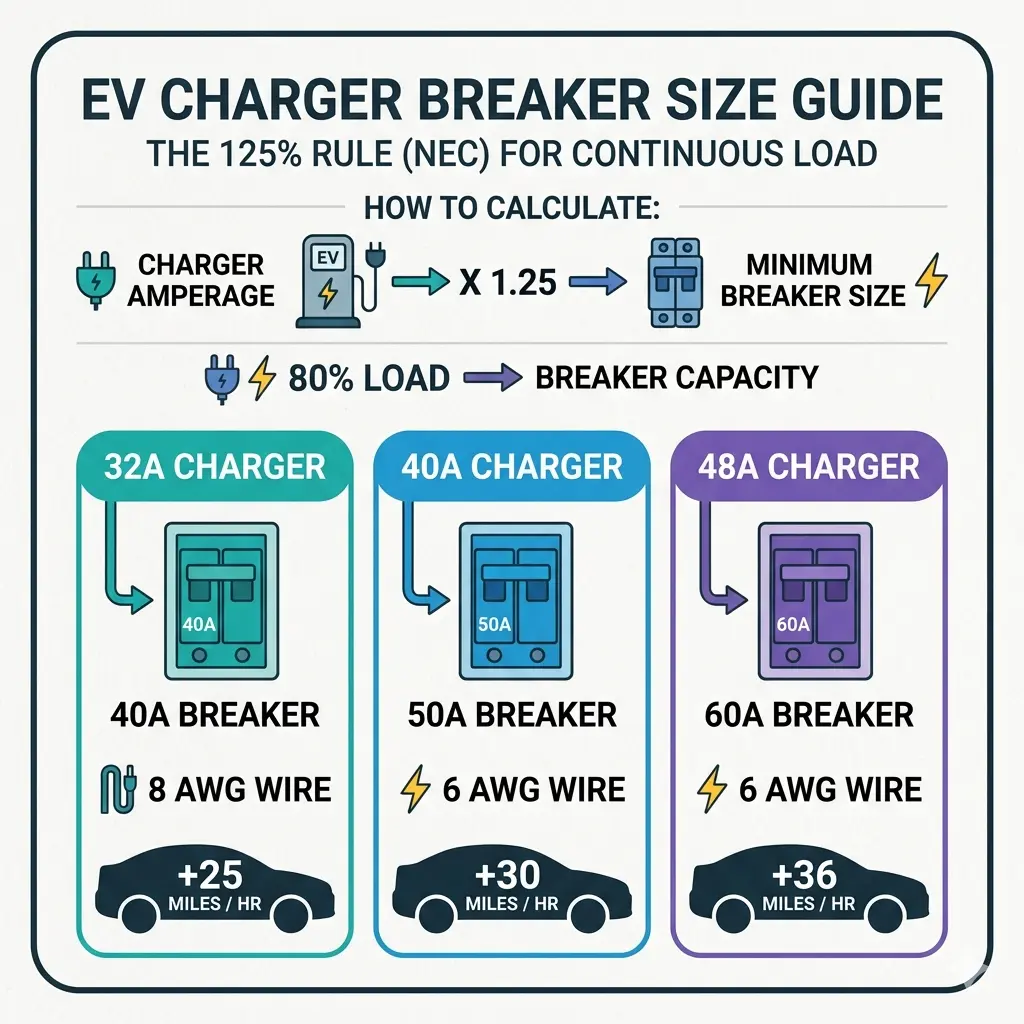
The NEC 125% rule is the fundamental principle governing continuous loads. As outlined in NEC 210.20(A) for branch circuits and NEC 215 for feeders, the overcurrent protection device must have a rating not less than the non-continuous load plus 125% of the continuous load. This introduces a 25% safety margin.
Breaker Size = Continuous Load × 125%
Why Are Breakers Limited to 80% Continuous Loading?
The 125% rule is mathematically identical to saying a standard breaker can only be loaded to 80% of its rating continuously (1 / 1.25 = 0.80). Standard thermal-magnetic breaker limitations revolve around heat dissipation within standard panelboard enclosures. Standard breakers are calibrated in open air but operate inside confined boxes. The 80% limit ensures the internal calibration remains accurate and the device operates safely within standard breaker ratings without thermal runaway.
Is the 125% Rule the Same Worldwide?
While the NEC heavily emphasizes the 125% rule, NEC vs IEC differences exist. The International Electrotechnical Commission (IEC) standards handle continuous currents differently, often relying on derating factors based on ambient temperature and installation methods rather than a blanket 125% multiplier. Regional installation practices and specific industrial panel standards dictate the exact application, making it essential to know which standard governs your project.
How to Calculate Breaker Sizing for Continuous Loads
Following a systematic approach guarantees compliance and safety. Here are the specific calculation steps.
- Step 1 — Determine the Continuous Load CurrentDetermine the full load current or nameplate current of the equipment. Carefully assess whether the load operates continuously. For complex systems, distinguish between diversified vs non-diversified loads to find the true continuous maximum draw.
- Step 2 — Apply the 125% Safety FactorMultiply the continuous current by 1.25. Use specific calculation examples and sizing formulas for the exact circuit. Be aware that this step strictly calculates the minimum breaker rating required before ampacity adjustment for wires.
- Step 3 — Select the Next Standard Breaker SizeBreakers come in standard breaker ratings (e.g., 15A, 20A, 30A, 40A, 50A). If your calculation results in a non-standard number, rounding up rules apply. Choose the next higher standard rating, keeping coordination considerations in mind.
- Step 4 — Verify Conductor AmpacityThe breaker must protect the wire. The conductor sizing relationship requires that the wire ampacity (after temperature correction factors) must be equal to or greater than the non-continuous load plus 125% of the continuous load, ensuring cable overheating prevention.
Continuous Load Breaker Sizing Examples
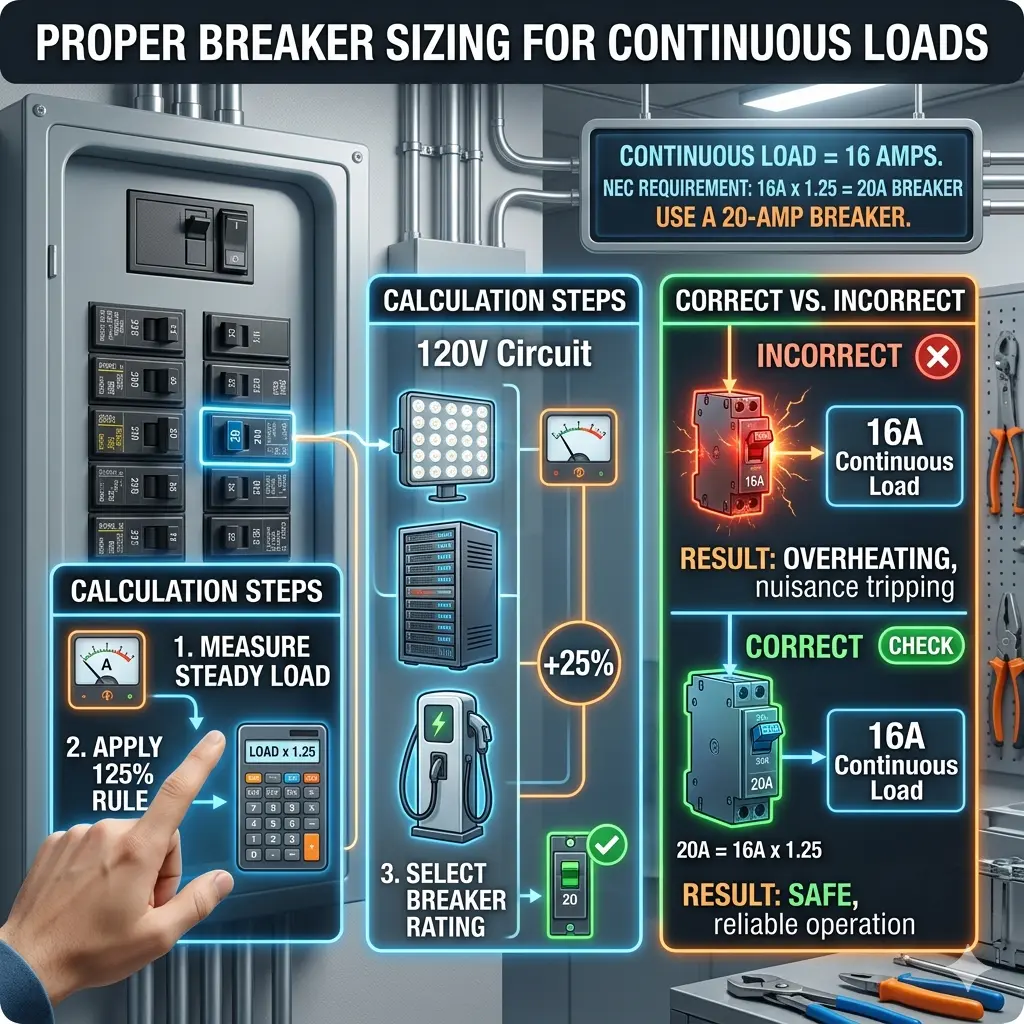
Example — Sizing a Breaker for a 16A Continuous Load
Suppose you have an industrial heater drawing exactly 16 Amps continuously.
- Calculation: 16A × 125% = 20A
- Recommended breaker size: 20A
A 20A breaker and wiring rated for at least 20A must be used.
Example — HVAC Continuous Load Breaker Sizing
HVAC systems require special attention due to compressor startup considerations. Nameplates typically list Minimum Circuit Ampacity (MCA) and Maximum Overcurrent Protection (MOP). The manufacturer has already factored in continuous load rules into the MCA. HVAC code considerations generally dictate sizing the wire to the MCA and the breaker to the MOP to handle inrush currents without tripping.
Example — Commercial Lighting Circuit Sizing
In retail stores, LED lighting loads often run for 12+ hours daily. Although individual LEDs draw little power, entire circuits must be treated as continuous. You must calculate total wattage, convert to amps, and apply the 125% rule, while also considering driver inrush current that might affect the continuous operation periods.
Breaker Sizing vs Wire Sizing — What Is the Difference?
How Breakers Protect Conductors
A breaker’s primary job is to protect the downstream wiring from melting or catching fire. The breaker must trip before the wire insulation exceeds its temperature rating.
Why Oversized Breakers Are Dangerous
If a breaker is too large for the wire, a fault or overload could cause the wire to burn before the breaker trips, creating a severe fire hazard.
Why Undersized Breakers Cause Nuisance Trips
An undersized breaker will trip during normal continuous operation because it cannot handle the thermal load, leading to operational disruptions.
How Wire Ampacity Affects Breaker Selection
The selected breaker must align with the wire’s ampacity. Even if you calculate a 40A breaker requirement, if the installed wire is only rated for 30A, you cannot safely use the 40A breaker without upgrading the conductors.
80% Rated vs 100% Rated Breakers — What Is the Difference?
| Feature | 80% Rated Breaker (Standard) | 100% Rated Breaker |
|---|---|---|
| Continuous Load Capacity | Up to 80% of face value rating | Up to 100% of face value rating |
| NEC Calculation | Load × 1.25 | Load × 1.00 |
| Enclosure Requirements | Standard panelboards | Specific ventilated enclosures required |
| Cost & Availability | Standard cost, highly available | Premium cost, specialized order |
| Typical Applications | General commercial, residential, light industrial | Data centers, large UPS systems, heavy continuous industrial |
What Is an 80% Rated Breaker?
This is the standard breaker found in almost all distribution panels. Due to standard thermal breaker behavior and enclosure heat limitations, they cannot run at their full printed rating continuously. They require the 125% load calculation.
What Is a 100% Rated Breaker?
A 100% rated breaker is engineered to carry its full face-value current continuously. However, it involves special design requirements. It must be installed in specific enclosures with strict ventilation requirements to dissipate heat. There are also significant cost implications.
When Should You Use a 100% Rated Breaker?
These are typically reserved for large-scale applications where up-sizing wires and breakers becomes cost-prohibitive or physically impossible. Common environments include massive data centers, heavy industrial continuous loads, and large UPS systems.
Common Breaker Sizing Mistakes for Continuous Loads
Ignoring the 125% Rule
The most common error is treating continuous loads like standard loads, leading directly to overheating.
Confusing Startup Current with Continuous Current
Motors draw massive inrush current (LRA) for seconds, but run at a lower continuous current (FLA). Sizing entirely based on startup current without proper motor curves leads to dangerously oversized breakers.
Using the Exact Load Current as Breaker Size
Matching a 50A continuous load with a 50A standard breaker guarantees a thermal trip within hours.
Forgetting Ambient Temperature Corrections
If a panel is in a boiler room exceeding 30°C (86°F), both the breaker and the wire must be derated. Ignoring ambient temperature corrections causes unexpected failures.
Not Considering Harmonic Loads
Modern non-linear loads (like VFDs and large IT equipment) create harmonics that generate extra heat in the neutral and phase conductors, requiring careful upsizing.
How to Prevent Continuous Load Breaker Trips
Proper Load Calculations
Always perform rigorous, code-compliant calculations before installation.
Thermal Management Inside Panels
Ensure panels have adequate spacing. Do not cram high-current continuous breakers directly next to each other if possible; allow breathing room.
Load Balancing Across Phases
In three-phase systems, unbalanced continuous loads can overheat the neutral and cause localized panel heating.
Periodic Infrared Inspections
Use thermal imaging to detect terminal overheating on continuous loads before a nuisance trip or failure occurs.
Selecting Correct Trip Curves
Ensure the breaker’s trip curve (B, C, D, etc.) matches the load characteristics to handle momentary surges without compromising continuous protection.
NEC vs IEC Breaker Sizing for Continuous Loads
NEC Continuous Load Requirements
The NEC strictly enforces the 125% rule for standard breakers, focusing heavily on preventing thermal degradation of conductor insulation within North American panel board designs.
IEC Protective Device Philosophy
IEC standards (common in Europe and Asia) often rate breakers to carry 100% of their nominal current in open air at a specific reference temperature (e.g., 30°C or 40°C). They rely on derating tables based on mutual heating when multiple breakers are grouped.
Regional Design Differences
Because of these fundamental differences, equipment designed for the European market often requires careful recalculation when imported and installed under NEC jurisdiction.
Which Standard Is More Conservative?
The NEC’s blanket 125% rule is generally considered more conservative and rigid, designed to provide a broad safety net against overheating in enclosed spaces.
FAQ — Breaker Sizing Continuous Load
Why Must Continuous Loads Be Sized at 125%?
Because standard circuit breakers generate internal heat. If run at 100% capacity for over 3 hours, the combined heat of the load and the enclosure will cause the breaker’s thermal element to trip prematurely. The 125% rule provides the necessary thermal buffer.
What Is the 80% Rule for Circuit Breakers?
It is the inverse of the 125% rule. It states that a standard circuit breaker should only be loaded to 80% of its maximum marked rating for continuous loads.
Can a Breaker Run at 100% Capacity Continuously?
Only if both the breaker and the enclosure are specifically marked and listed as “100% Rated.” Standard breakers cannot.
What Happens if a Breaker Is Undersized?
An undersized breaker will experience nuisance tripping, interrupting normal operations. It will also run excessively hot, potentially damaging the panel busbars and wire terminations.
How Do You Size a Breaker for a Motor Load?
Motor loads are governed by specific NEC articles (like Article 430). You typically use the motor’s Full Load Amps (FLA) multiplied by a specific factor (often 250% for inverse time breakers) to allow for startup inrush, while the continuous running overload protection is handled separately.
Does Ambient Temperature Affect Breaker Sizing?
Yes. Thermal-magnetic breakers are calibrated for a specific ambient temperature. If installed in a hot environment, they will trip at a lower current. Conductors also require derating in high temperatures.
What Is the Difference Between MCA and MOP?
Minimum Circuit Ampacity (MCA) dictates the minimum wire size needed for continuous and non-continuous loads. Maximum Overcurrent Protection (MOP) dictates the maximum breaker size allowed to protect the equipment while allowing for compressor inrush current.
Disclaimer: The information provided in this article is for educational purposes only. Electrical installations are inherently dangerous. Always ensure that actual project designs, breaker selections, and installations are performed by licensed professionals and strictly adhere to local electrical codes, manufacturer data, and receive AHJ (Authority Having Jurisdiction) approval.