For electricians, electrical contractors, HVAC professionals, wholesalers, and B2B buyers, understanding the correct MCB size for heat pump installations is a fundamental requirement. A heat pump represents a significant electrical load, combining continuous running currents with high initial starting surges. Installing the wrong circuit breaker for a heat pump can lead to disastrous consequences ranging from frequent nuisance tripping that results in expensive service callbacks, to severe safety hazards like cable overheating and electrical fires. This comprehensive engineering and installation guide provides the definitive parameters for calculating and selecting the precise breaker size heat pump systems demand across residential, commercial, and industrial applications.
Quick Answer: What Size MCB Do You Need for a Heat Pump?
Executive Summary: The correct MCB size for a heat pump depends on its rated current and starting load, but most residential systems typically require a 16A to 40A MCB. Always size the breaker at 125% of the continuous load and follow manufacturer specifications.
Finding the exact breaker size heat pump units require is not a matter of guesswork; it is a strict mathematical calculation mandated by international electrical codes and manufacturer guidelines. Whether you are installing a compact ductless mini-split or a massive multi-ton commercial geothermal system, the principles of circuit protection remain consistent. You must safeguard the conductors from overheating while simultaneously allowing the compressor motor to draw its required starting amperage without interrupting the circuit.
How to Calculate MCB Size for a Heat Pump
The foundation of electrical safety in HVAC installations lies in accurate load calculation. Heat pumps are considered continuous loads because they can, and often do, operate for more than three hours at maximum capacity, particularly during extreme summer heatwaves or freezing winter nights. Consequently, the circuit breaker for heat pump systems cannot be rated exactly at the maximum operating current; it requires a built-in safety buffer.
Basic Sizing Formula
To mathematically determine the correct MCB size for heat pump equipment, electrical professionals utilize a standard oversizing multiplier. The basic calculation is as follows:
I_breaker = 1.25 × I_load
Where I_breaker is the required circuit breaker amperage rating, and I_load is the continuous full load amperage (FLA) or minimum circuit ampacity (MCA) provided by the heat pump. The breaker should be sized at 125% of the heat pump’s rated current to handle continuous operation safely.
What Is Heat Pump Rated Current?
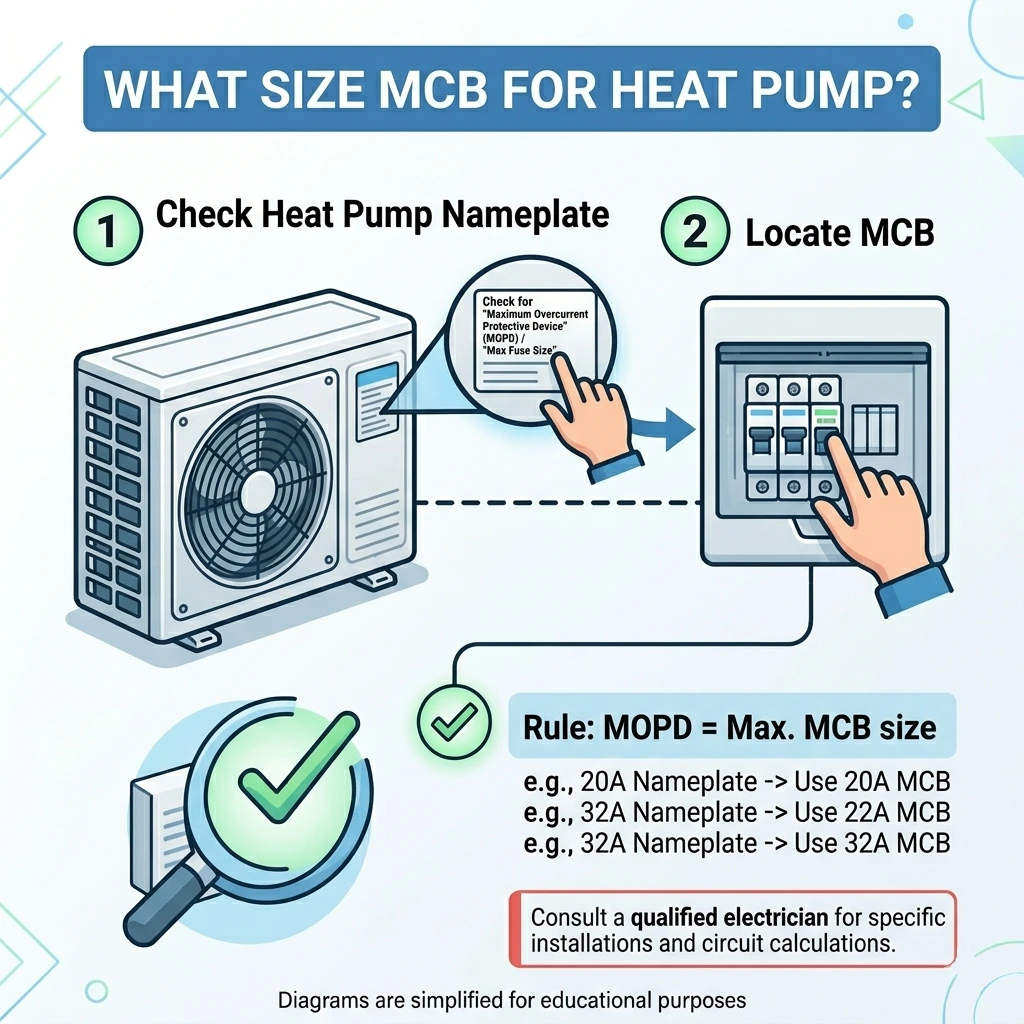
The rated current of a heat pump is the maximum amount of electrical current, measured in Amperes (Amps), that the unit will draw during normal, continuous operation under full load conditions. As an electrician or contractor, your primary source of truth for this metric is the equipment nameplate securely affixed to the outdoor condensing unit. The nameplate provides critical engineering data including the Minimum Circuit Ampacity (MCA), which is pre-calculated to include the necessary 125% continuous load buffer, and the Maximum Overcurrent Protection (MOCP) or Maximum Fuse/Breaker size. Proper interpretation of these nameplate amps ensures the selected breaker size heat pump installations utilize complies with safety standards.
Why the 125% Rule Matters
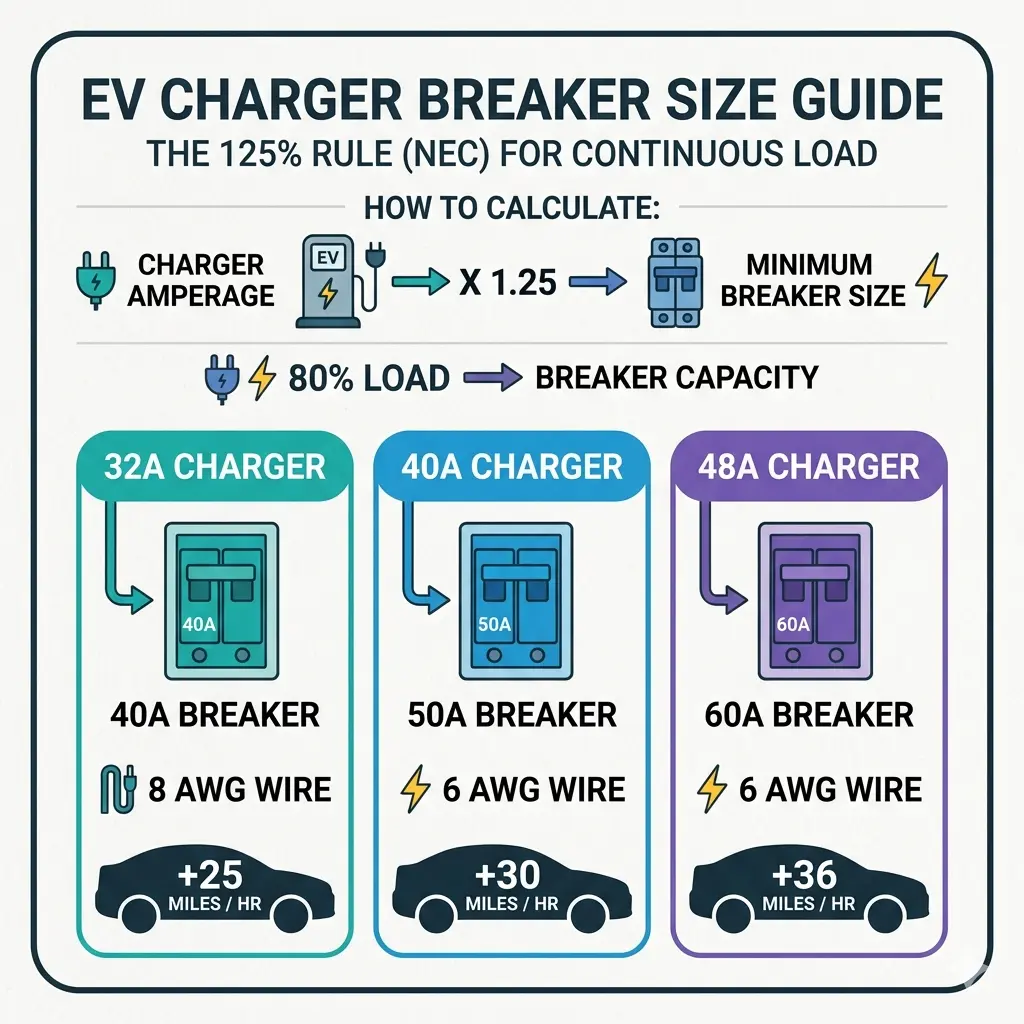
Electrical codes mandate the 125% rule for continuous loads to prevent thermal degradation of the circuit protection devices and conductors. Circuit breakers are essentially thermal-magnetic devices. If a breaker operates precisely at 100% of its rated capacity for extended periods, the internal bimetallic strips will accumulate excessive ambient and operational heat. This heat accumulation leads to nuisance tripping, where the breaker safely opens the circuit even though no actual short circuit or severe overcurrent event has occurred. Furthermore, providing a 25% overhead guarantees continuous load operation without risking the integrity of the cable insulation, thereby maximizing the safety and longevity of the entire electrical infrastructure.
Typical MCB Sizes for Heat Pumps
While exact specifications vary by brand and efficiency ratings (SEER/HSPF), industry averages provide a solid baseline for procurement and project estimation. B2B electrical wholesalers and HVAC technicians frequently encounter standard capacity groupings. The table below outlines standard electrical demands and typical circuit breaker sizing for common installations.
| Heat Pump Capacity | Typical Current | Recommended MCB |
|---|---|---|
| Small (≤2 tons) | 10–15A | 16A–20A |
| Medium (2–4 tons) | 15–25A | 20A–32A |
| Large (>4 tons) | 25–35A | 32A–40A |
Most residential heat pumps require MCB sizes between 16A and 40A depending on system capacity. It is important to note that these values represent standard central split systems or packaged units. Inverter-driven units may exhibit slightly different current profiles, but the core sizing parameters remain anchored to the nameplate data.
Factors That Affect MCB Size Selection
Selecting the optimal MCB size for heat pump applications extends beyond a simple calculation of continuous load. Professional electrical design requires a holistic evaluation of the operating environment, equipment mechanics, and infrastructural limitations.
Starting Current (Inrush Current)
When a heat pump compressor initiates its cycle, the motor must overcome significant mechanical inertia and refrigerant pressure differentials. This demands a massive, instantaneous surge of electrical energy known as Locked Rotor Amps (LRA) or inrush current. This surge can be three to seven times higher than the continuous running current, lasting for a fraction of a second. Heat pumps have high startup current, which must be considered when selecting breaker size. If the MCB is too tightly sized or has the incorrect trip curve, this momentary inrush will trigger the magnetic trip mechanism, causing a nuisance trip right at startup.
Voltage and Phase Type
The electrical supply characteristics profoundly dictate the necessary breaker size heat pump units require. Residential properties predominantly utilize single-phase power (typically 230V or 240V, depending on regional standards). Single-phase heat pumps naturally draw higher amperage per phase to achieve their required wattage. Conversely, commercial and industrial heat pumps operate on three-phase power (400V or 480V). Because the power delivery is distributed across three alternating currents, a three-phase heat pump of the same kilowatt capacity will draw significantly less current per phase than its single-phase counterpart, allowing for a numerically smaller, multi-pole MCB.
Cable Size and Installation Conditions
The primary function of a circuit breaker is to protect the wiring, not the appliance itself. Therefore, the MCB size must strictly align with the conductor ampacity—the maximum current the specific gauge of wire can carry without exceeding its temperature rating. Furthermore, installation conditions heavily influence cable capacity. If wires run through heavily insulated walls, are bundled with other current-carrying conductors, or traverse areas with high ambient temperatures (like attics or industrial boiler rooms), the cables must be derated. The circuit breaker for heat pump installations must be sized downwards if the derated cable ampacity falls below the initial breaker calculation, necessitating a larger wire gauge to match the required MCB.
Manufacturer Specifications
Regardless of independent calculations or general rules of thumb, the equipment manufacturer’s engineering specifications hold supreme authority. The Maximum Overcurrent Protection (MOCP) printed on the heat pump’s data plate is an absolute ceiling established through rigorous laboratory testing and safety certification processes (such as UL, CE, or CSA). Always follow the manufacturer’s recommended breaker size for safe and compliant installation. Failure to adhere to these specifications not only violates local electrical codes but frequently voids the equipment warranty.
MCB vs MCCB for Heat Pumps: Which Should You Use?
As capacity scales up from residential domestic heating to massive commercial climate control, the type of overcurrent protection device must evolve. Understanding when to transition from a Miniature Circuit Breaker (MCB) to a Molded Case Circuit Breaker (MCCB) is vital for B2B electrical specifiers and commercial contractors.
When MCB Is Enough
Miniature Circuit Breakers are the standard protective devices for almost all residential and light commercial applications. They are highly cost-effective, compact, and designed to mount effortlessly onto standard DIN rails in consumer units and distribution boards. An MCB is typically perfectly sufficient for heat pumps drawing up to 63A to 100A, which covers virtually all single-phase residential split systems, ductless mini-splits, and standard household geothermal units.
When MCCB Is Required
For heavy industrial environments, large multi-story commercial buildings, or centralized chiller/heat pump arrays, an MCB will not suffice. MCCBs are used for larger heat pump systems that require higher current capacity and adjustable protection. MCCBs can handle current ratings well into the thousands of amperes. More importantly, they offer much higher short-circuit breaking capacities (often up to 100kA or more) and feature adjustable thermal and magnetic trip settings. This adjustability allows electrical engineers to finely tune the protection curve to perfectly match the massive inrush currents of industrial three-phase heat pump compressors without compromising continuous overload protection.
Common Mistakes When Choosing MCB Size
Errors in selecting the correct breaker size heat pump units need are unfortunately common, leading to expensive downtime, equipment damage, and severe safety liabilities. B2B contractors must meticulously avoid these standard pitfalls.
Undersized Breaker
Installing an undersized circuit breaker for heat pump systems is the primary cause of frequent nuisance tripping. When the breaker is rated too closely to the heat pump’s normal running load, it leaves no headroom for voltage fluctuations, high ambient temperatures at the breaker panel, or the natural temporary amperage spikes that occur during heavy load conditions (such as the heat pump running during extreme cold while also initiating a defrost cycle). The resulting frequent tripping is highly inconvenient for the end-user and causes unnecessary wear on the breaker’s internal mechanisms.
Oversized Breaker
Conversely, installing a breaker that is vastly larger than required is a critical safety hazard. If a 20A heat pump circuit is protected by a 50A breaker, the equipment could experience a severe, sustained electrical fault—drawing 45 amps—and the breaker would never trip. In this scenario, the wiring will rapidly overheat, melting the insulation and potentially igniting surrounding building materials. Oversizing the breaker can reduce protection and increase fire risk. Never exceed the maximum breaker size listed on the equipment nameplate.
Ignoring Startup Current
Even if the amperage rating is mathematically correct for the continuous load, ignoring the nature of the startup current will lead to failure. If a technician uses a standard, fast-acting breaker curve on a high-inertia compressor motor, the breaker will perceive the normal startup surge as a short circuit and trip instantaneously. The MCB size for heat pump applications must be paired with the correct tripping characteristics.
Not Following Code Requirements
Local and national electrical codes dictate specific protocols for HVAC circuits, including required disconnect switch placements, cable types, and precise sizing formulas. Bypassing these codes to save time or materials not only risks the safety of the property but leaves the contractor legally and financially liable for any resulting damage or failure.
Installation Tips for Heat Pump Circuit Protection
To guarantee a robust, long-lasting, and compliant installation, electrical contractors should adhere to professional best practices when configuring the circuit breaker for heat pump systems.
Use Dedicated Circuit
A heat pump must absolutely be supplied by its own, exclusive dedicated circuit directly from the main distribution board. It should never share a breaker or wiring with lighting, general-purpose receptacles, or other appliances. HVAC dedicated circuits ensure that the massive load of the heat pump does not cause voltage drops that could damage sensitive electronics elsewhere in the building, and guarantees that any fault in the heat pump isolates itself without plunging the rest of the property into darkness.
Choose Correct Trip Curve (B/C/D)
The trip curve (or tripping characteristic) defines how quickly the breaker opens under different levels of overcurrent. Type B breakers trip at 3 to 5 times the rated current and are generally only suitable for resistive loads like heaters and lighting. Type C or D breakers are often preferred for heat pumps due to higher inrush current. Type C breakers trip at 5 to 10 times the rated current, perfectly accommodating the typical compressor startup surge of residential and standard commercial heat pumps. For extremely large industrial compressors with prolonged startup times, Type D breakers (tripping at 10 to 20 times rated current) might be necessary.
Ensure Proper Earthing
Correct MCB sizing is functionally useless if the system lacks proper grounding (earthing). Heat pumps have metal chassis exposed to the outdoors and internal components handling water and refrigerant. A robust, properly sized earthing conductor must run alongside the phase and neutral conductors back to the main grounding terminal. This ensures that in the event of an internal short to the metal casing, the massive fault current has a low-resistance path back to the panel, guaranteeing the immediate and forceful tripping of the MCB to protect human life from electrocution.
FAQ: MCB Size for Heat Pumps
Electricians and HVAC technicians frequently encounter similar questions during system design and installation. Below are the definitive answers to the most common queries regarding breaker size heat pump applications.
What size breaker for a 3-ton heat pump?
Typically 20A–32A depending on specifications. A modern high-efficiency 3-ton (36,000 BTU) unit may only require a 20A or 25A breaker, while older or less efficient models might require up to a 32A MCB. Always verify the MCA and MOCP on the manufacturer data plate.
Can I use a 16A MCB for a heat pump?
Only for small units with low current rating. A 16A MCB is generally sufficient for small ductless mini-split systems (typically 9,000 to 18,000 BTU or roughly 0.75 to 1.5 tons) that draw between 8 and 12 continuous amps.
Why does my breaker trip when the heat pump starts?
Because of high startup current or undersized breaker. If the MCB trips immediately upon compressor startup, it is likely due to the inrush current exceeding the magnetic trip threshold of the breaker (often resolved by upgrading to a Type C or Type D curve breaker), or the breaker itself is undersized or faulty.
Should I oversize the breaker?
No, always follow the 125% rule and manufacturer guidelines. Arbitrarily oversizing the breaker to prevent nuisance tripping defeats the purpose of the safety device, putting the wiring and the property at severe risk of fire.
Do heat pumps need a dedicated circuit?
Yes, for safety and performance. A dedicated circuit is mandated by major electrical codes to prevent overloading shared circuits, minimize voltage drop during startup, and isolate heavy mechanical loads from the rest of the electrical system.
Conclusion: Choosing the Right MCB Size for Heat Pumps
Determining the appropriate circuit breaker for heat pump installations is a critical task that bridges electrical engineering principles with practical HVAC functionality. By strictly utilizing the 125% continuous load rule, contractors can establish a safe baseline that prevents thermal degradation of protective devices. Furthermore, professionals must carefully consider the mechanical startup current of the compressor, ensuring the selected MCB features the correct tripping curve (typically Type C) to tolerate brief inrush surges without nuisance tripping. Ultimately, the manufacturer’s data plate serves as the supreme guide, providing maximum overcurrent protection ratings that must never be exceeded.
Selecting the correct MCB size for a heat pump ensures safe operation, prevents nuisance tripping, and protects both the equipment and electrical system. For B2B suppliers, wholesalers, and field electricians, adhering to these structured sizing guidelines guarantees professional, compliant installations that protect the client’s investment and property.
Disclaimer: The information provided in this guide is for educational and general reference purposes only. Electrical regulations vary significantly by region and jurisdiction. Always consult and strictly adhere to your local electrical codes (such as NEC, IEC, or BS 7671), local authority having jurisdiction (AHJ), and the specific heat pump manufacturer’s installation manuals before performing any electrical sizing or installation work.