In modern electrical systems, ensuring the safety and reliability of power distribution networks is a critical responsibility for electricians, electrical contractors, and facility managers. A core component of this safety infrastructure is the circuit breaker, an essential device designed to interrupt current flow to protect equipment and prevent fire hazards in the event of overloads, short circuits, or electrical faults. However, navigating the myriad of circuit breaker options can be complex. This comprehensive circuit breaker comparison will provide clarity on three of the most widely used types in the industry.
Key Takeaway
Understanding the difference between MCB MCCB ACB is crucial for proper electrical system design. Choosing the correct breaker guarantees optimal protection, regulatory compliance, and cost-efficiency. This guide breaks down their definitions, core differences, applications, and common selection mistakes.
Quick Answer: MCB vs MCCB vs ACB
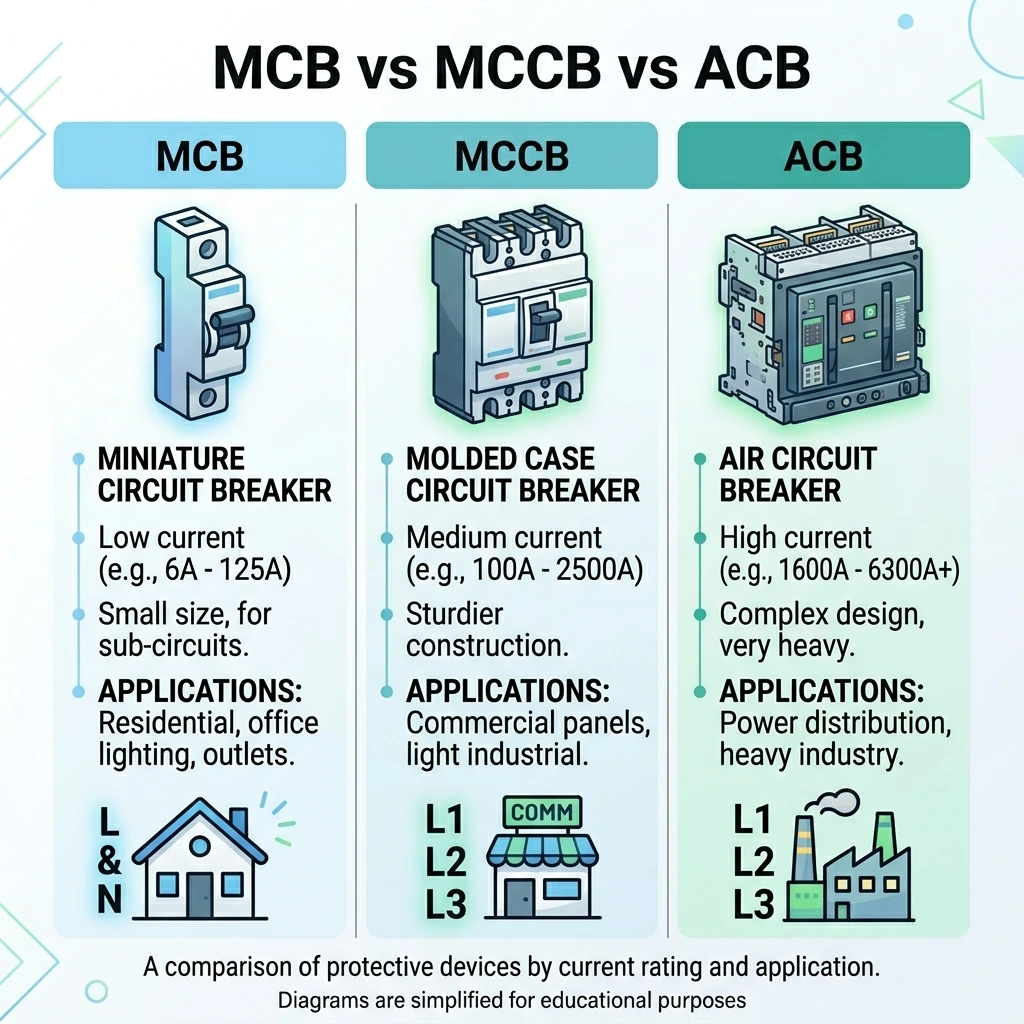
If you are looking for an immediate summary to guide your procurement or installation process, here is the fundamental distinction: MCB, MCCB, and ACB differ mainly in current capacity, application, and protection features. MCBs are used for low-current circuits, MCCBs for medium to high-power distribution, and ACBs for high-current industrial systems and main power distribution.
What Are MCB, MCCB, and ACB?
To accurately evaluate the MCB vs MCCB vs ACB dynamic, it is essential to define what each acronym stands for and understand the foundational mechanics and intended environment for each breaker type.
What Is an MCB (Miniature Circuit Breaker)?
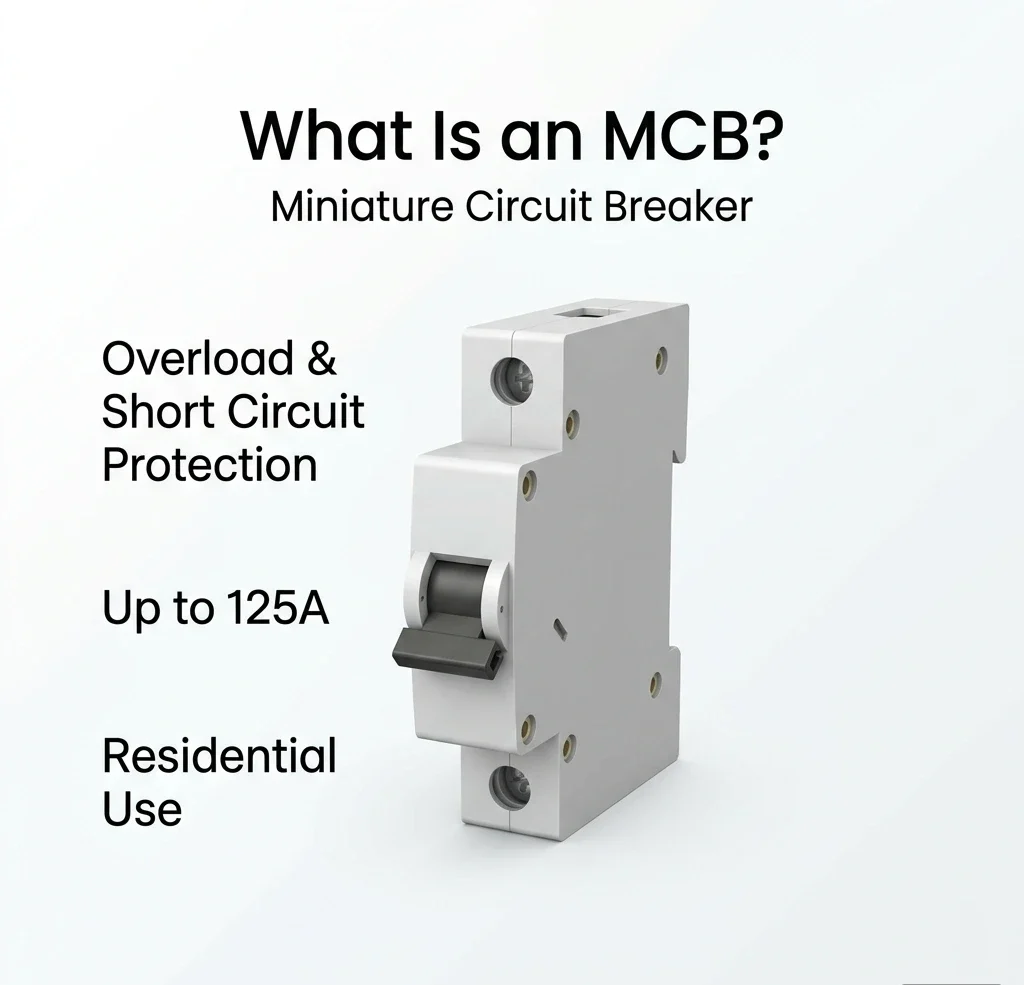
An MCB, or Miniature Circuit Breaker, is an electromechanical device designed to automatically switch off an electrical circuit during abnormal conditions such as an overload or a short circuit. Typically rated for low currents, MCBs handle loads up to 125 Amps (125A). They possess fixed trip settings, meaning the operational threshold cannot be adjusted by the user after manufacturing. Due to their compact size and low fault clearance capacity, MCBs are standard in domestic distribution boards and consumer units. MCBs are designed for low-current protection in residential and light commercial circuits.
What Is an MCCB (Molded Case Circuit Breaker)?
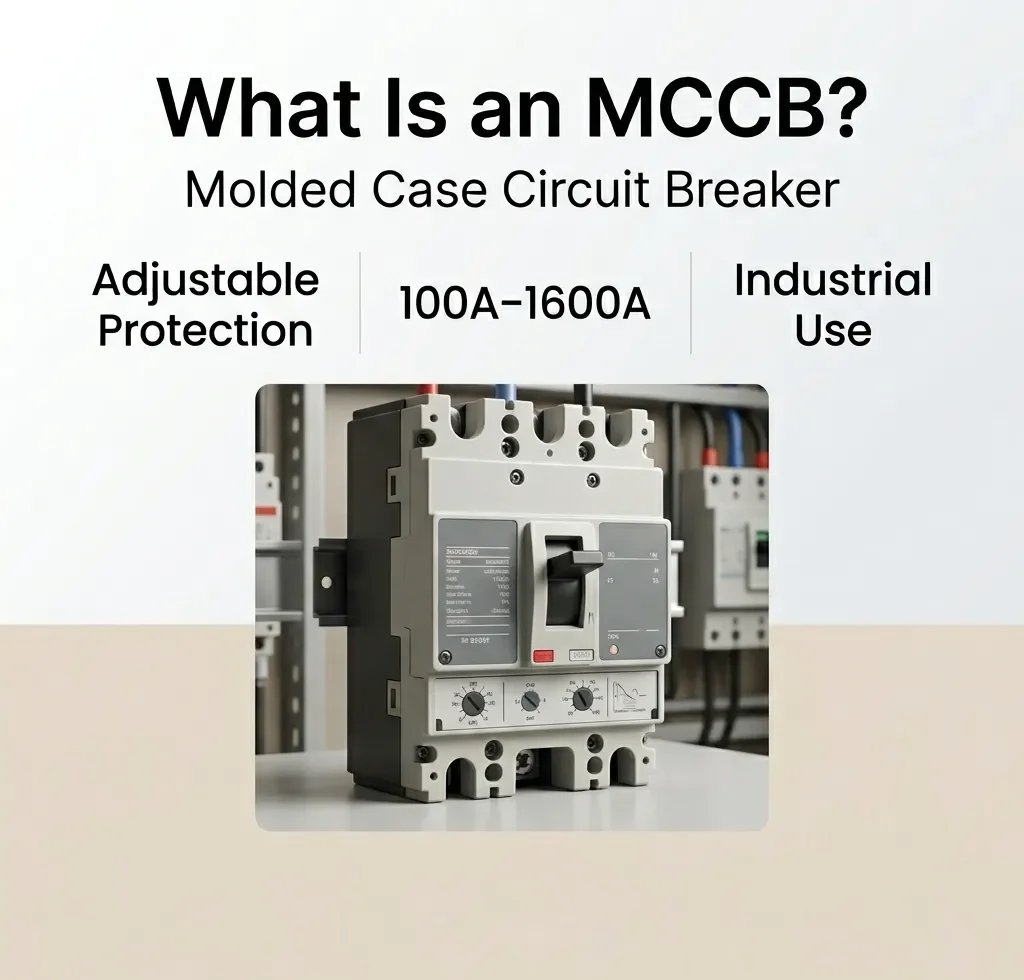
An MCCB, or Molded Case Circuit Breaker, bridges the gap between light-duty residential breakers and massive industrial units. Enclosed in a heavy-duty, molded plastic housing that provides insulation and mechanical strength, MCCBs accommodate much higher loads, typically ranging from 100A to 1600A. Unlike their miniature counterparts, MCCBs feature adjustable trip mechanisms. This allows electrical engineers and contractors to precisely tune the overload and short-circuit protection thresholds to match the specific demands of the connected load. MCCBs provide flexible protection settings and are widely used in industrial distribution systems.
What Is an ACB (Air Circuit Breaker)?
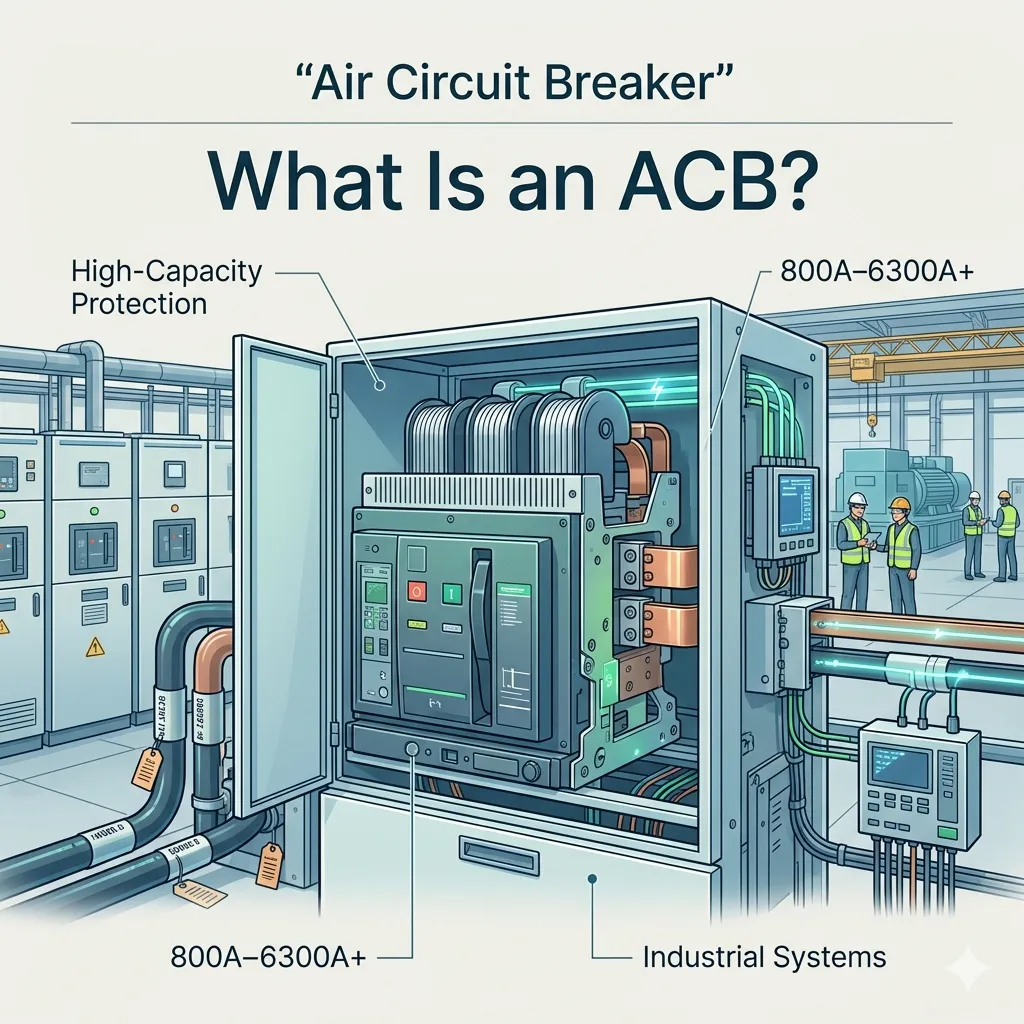
An ACB, or Air Circuit Breaker, operates by using air as the medium for arc quenching. These are robust, physically massive devices designed for the highest current ratings in low-voltage applications, typically starting from 800A and going upwards of 6300A or more. They are almost exclusively installed at the origin of a major installation, such as on the main incoming lines of power plants, heavy industrial facilities, or large commercial complexes. Because they govern massive loads, they incorporate highly sophisticated micro-processor-based trip units. ACBs are used for high-capacity industrial systems where advanced protection and control are required.
MCB vs MCCB vs ACB: Key Differences
When conducting a thorough circuit breaker comparison, evaluating the technical specifications and operational parameters is paramount. The difference between MCB MCCB ACB becomes evident when breaking down their current ratings, breaking capacities, protection features, and application scope.
Current Rating
The continuous current rating (often denoted as In) dictates the maximum steady current the breaker can carry without tripping.
- MCB: Up to 125A.
- MCCB: Ranges from 100A to 1600A.
- ACB: 800A and above (up to 6300A or more).
This progressive scale ensures that as the power demands of a facility grow, there is a corresponding breaker class built to handle the continuous thermal stress.
Breaking Capacity
Also known as short-circuit breaking capacity, this refers to the maximum fault current the breaker can safely interrupt without destroying itself. Breaking capacity increases from MCB to MCCB to ACB, making them suitable for progressively larger systems. An MCB might have a breaking capacity around 10kA, an MCCB can manage anywhere from 16kA to 100kA, while an ACB can safely clear fault currents upwards of 100kA to 150kA.
Protection Features
The level of customization available to the user scales with the size of the breaker:
- MCB: Fixed thermal-magnetic trip parameters.
- MCCB: Adjustable thermal and magnetic settings, allowing fine-tuning for specific motor or load characteristics.
- ACB: Intelligent, micro-processor-controlled protection featuring adjustable long-time, short-time, instantaneous, and ground fault (LSIG) settings, along with system monitoring and communication capabilities.
Application Scope
Given the technical parameters above, the operational environment for each type is distinct.
- MCB: Domestic housing, small retail spaces, and final sub-circuits.
- MCCB: Commercial buildings, factories, motor control centers, and secondary distribution panels.
- ACB: Main switchboards, transformers, heavy industrial plants, and utility distribution.
Comparison Table: MCB vs MCCB vs ACB
| Feature | MCB | MCCB | ACB |
|---|---|---|---|
| Current Range | ≤125A | 100–1600A | ≥800A |
| Breaking Capacity | Low | Medium–High | Very High |
| Protection Type | Fixed | Adjustable | Advanced |
| Application | Residential | Industrial | Main distribution |
| Cost | Low | Medium | High |
When to Use MCB vs MCCB vs ACB
Practical application is where the difference between MCB MCCB ACB truly matters. Proper selection ensures longevity, compliance with electrical codes, and optimum safety.
When to Use MCB
MCBs should be deployed at the terminal end of the distribution network. They are utilized to protect individual lighting circuits, domestic appliance sockets, small HVAC units in homes, and office computer networks. MCBs are best suited for low-power residential circuits.
When to Use MCCB
You should transition to an MCCB when the continuous current exceeds 100 Amps or when the application requires specialized trip curves. They are the go-to choice for feeding industrial machinery, large commercial lighting banks, chiller units, and significant motor loads where inrush currents must be carefully managed. MCCBs are ideal for applications requiring adjustable protection and higher current capacity.
When to Use ACB
ACBs sit at the top of the hierarchy. They are installed immediately after the primary step-down transformer or the main generator output. They act as the primary defense mechanism for the entire facility, coordinating with downstream MCCBs and MCBs to ensure fault isolation. ACBs are used as main breakers in large-scale industrial power systems.
Advantages and Limitations of Each Type
A balanced circuit breaker comparison requires looking at both the strengths and the inherent limitations of each device class.
MCB Pros and Cons
- Pros: Highly cost-effective; compact and space-saving; easy to replace and install via standard DIN rails; rapid response to minor faults.
- Cons: Non-adjustable trip settings; restricted to low current and low fault-level applications; cannot be serviced or repaired.
MCCB Pros and Cons
- Pros: Versatile and flexible with adjustable trip settings; higher breaking capacities; robust casing suitable for harsh environments; available in a wide range of frame sizes.
- Cons: Considerably more expensive than MCBs; larger footprint requires larger distribution panels; adjusting settings requires technical expertise.
ACB Pros and Cons
- Pros: Unmatched performance under extreme electrical stress; fully customizable intelligent tripping; high durability and repairable components; excellent integration with modern SCADA and building management systems.
- Cons: Very high initial cost; physically massive and heavy, requiring specialized enclosures and lifting gear; requires regular, specialized maintenance to ensure the arc chutes and mechanical linkages operate correctly.
Common Mistakes When Choosing Between MCB, MCCB, and ACB
Procurement teams and electrical contractors sometimes err when specifying breakers, leading to hazardous conditions or unnecessary expenditure.
Choosing Only Based on Current Rating
A frequent error is looking only at the continuous current. For example, a 100A load could theoretically be served by a 100A MCB or a 100A MCCB. However, if the prospective short-circuit current at that point in the network is 25kA, an MCB rated for 10kA will explode during a fault. Always check the fault level.
Ignoring Breaking Capacity
Failing to account for the breaking capacity can have catastrophic consequences. The breaker must be able to withstand the maximum available fault current from the utility. Specifying a cheaper, lower-rated breaker to save budget is a severe safety violation.
Using MCB in Industrial Systems
Attempting to use banks of high-amperage MCBs to manage heavy inductive loads (like large industrial motors) is a poor design choice. Industrial loads experience severe inrush currents that can cause nuisance tripping in fixed-curve MCBs. Using undersized breakers can lead to system failure and safety risks.
FAQ: MCB vs MCCB vs ACB
What is the main difference between MCB, MCCB, and ACB?
They differ in current capacity, protection features, and application. MCBs are for light loads with fixed settings, MCCBs handle medium loads with adjustable settings, and ACBs handle massive loads with intelligent controls.
Which breaker is used for industrial systems?
MCCB and ACB are commonly used. ACBs handle the main utility incomers, while MCCBs handle the secondary distribution to individual machines and sub-panels.
Can MCB replace MCCB?
No, MCB is not suitable for high-current applications. They lack both the continuous current rating and the high breaking capacity required in environments where MCCBs are specified.
Why are ACBs expensive?
Because they offer advanced protection and high current capacity. They are engineered with massive copper contacts, complex arc chutes, and sophisticated digital relay systems to protect critical infrastructure reliably.
Which breaker is best for home use?
MCB is typically used for residential systems. They provide the perfect balance of cost, size, and fixed protection ideal for standard domestic wiring and appliances.
Conclusion: Choosing Between MCB, MCCB, and ACB
Navigating the electrical protection landscape requires a clear understanding of your facility’s demands. As demonstrated in this guide, the hierarchy of these devices is logically structured based on escalating power needs. You start with MCBs for end-user circuits, scale up to MCCBs for branch and industrial distribution, and cap the system with heavy-duty ACBs at the primary electrical intake. Ultimately, choosing between MCB, MCCB, and ACB depends on system size, current requirements, and protection needs. Proper specification ensures a resilient, code-compliant, and safe electrical network.