Understanding how circuit breakers trip is crucial for electricians, engineers, and B2B procurement professionals. Selecting the right breaker means the difference between a safely protected facility and a catastrophic electrical failure. The core concepts of electrical protection revolve around three distinct mechanisms. In this comprehensive guide, we will break down the mechanics of the thermal vs magnetic trip and the critical role of residual current protection.
Quick Answer: How Do Circuit Breakers Trip?
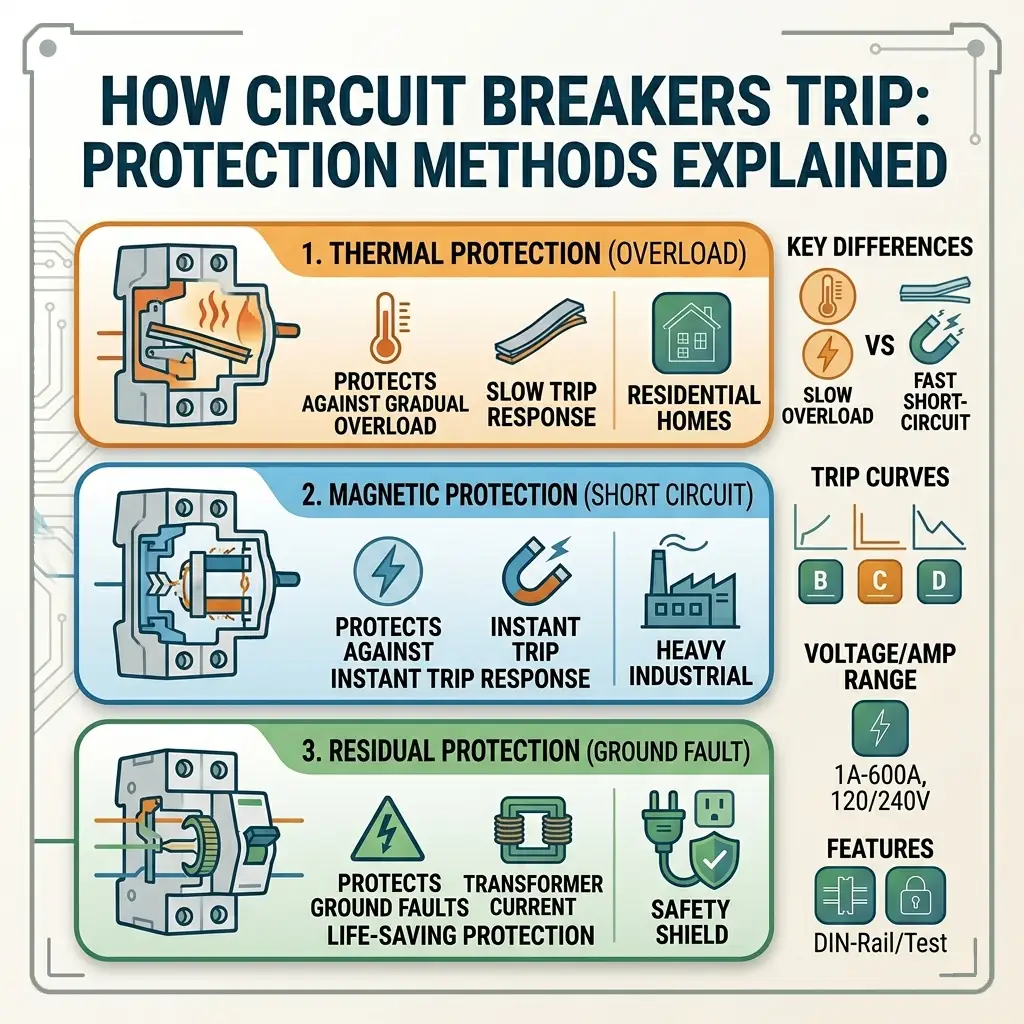
Circuit breakers trip using different protection mechanisms depending on the type of fault. Thermal protection responds to overloads, magnetic protection reacts instantly to short circuits, and residual protection detects leakage current to prevent electric shock.
What Does “Trip” Mean in a Circuit Breaker?
Definition of Tripping
In electrical engineering, “tripping” refers to the mechanical action that interrupts the flow of electricity in a circuit. It is a safety feature designed to prevent electrical fires, equipment damage, and human injury.
A circuit breaker trips when it automatically disconnects power to protect the electrical system from damage or danger.
Why Breakers Need Different Trip Mechanisms
Electrical systems face various types of threats. A slow, creeping increase in current poses a different danger than a sudden, massive spike or a tiny current leaking to the ground. The primary faults include:
- Overload: Drawing more current than the circuit is designed to handle over a period of time.
- Short circuit: A massive surge in current caused by a direct connection between phase and neutral or phase and phase.
- Leakage current: Current escaping from the intended path, often flowing to the earth, creating a shock hazard.
Different electrical faults require different protection mechanisms because they occur under different conditions and speeds.
What Is Thermal Protection in Circuit Breakers?
How Thermal Trip Works
Thermal protection is the mechanism designed to handle overloads. It utilizes a bimetal strip inside the breaker. As current flows through this strip, it generates heat. Under normal operating conditions, the heat dissipates safely. However, during an overload, excess current generates excess heat. Because the bimetal strip is made of two metals with different expansion rates, the heat causes it to bend. Once it bends far enough, it physically triggers the trip latch, opening the circuit.
Thermal protection reacts to sustained overload current by using heat-sensitive components.
What Faults Thermal Protection Detects
Thermal mechanisms are specifically designed to detect overloads. These are situations where the current exceeds the rated capacity of the circuit, but not by a massive margin. For example, plugging too many high-wattage appliances into a single residential circuit will cause a prolonged overcurrent, which the thermal trip will catch before the wires overheat and catch fire.
Thermal Trip Characteristics
The defining feature of a thermal trip is its inverse time-current characteristic. The higher the overload current, the faster the strip heats up and bends, resulting in a faster trip time. However, even at significant overloads, it is a delayed response mechanism.
Thermal trips are relatively slow because they depend on heat buildup over time.
Common Applications of Thermal Protection
Thermal protection is fundamental in almost all electrical circuits. You will find it heavily relied upon in:
- Residential lighting and power circuits.
- General appliance protection (HVAC, refrigerators).
- Motor circuits (protecting the motor windings from sustained overloads).
What Is Magnetic Protection in Circuit Breakers?
How Magnetic Trip Works
When analyzing the thermal vs magnetic trip, magnetic protection is the counterpart designed for speed. It uses an electromagnetic coil (solenoid) connected in series with the main circuit. Under normal current or mild overloads, the magnetic field generated by the coil is too weak to move the tripping armature. But during a severe fault, the massive current spike creates a powerful magnetic field that instantly pulls the armature, tripping the breaker.
Magnetic protection responds almost instantly to high short-circuit current.
What Faults Magnetic Protection Detects
Magnetic protection is built to detect and isolate short circuits and severe fault currents. These faults involve thousands of amps of current flowing in a fraction of a second, which would melt wires and cause explosions if not stopped immediately.
Magnetic Trip Characteristics
Speed is the defining trait here. Magnetic trips operate in milliseconds. Unlike the thermal trip, which waits for heat to build, the magnetic trip is an immediate mechanical response to the magnetic force of a massive current.
Magnetic trips operate much faster than thermal trips to prevent catastrophic damage.
Common Applications of Magnetic Protection
Because short circuits can happen anywhere, magnetic protection is universally required. It is especially critical in:
- Heavy industrial systems with large power feeds.
- Motor starting circuits, where short-circuit protection is needed but high inrush currents must be tolerated temporarily (requiring specific magnetic trip curves).
- Main switchboards and distribution panels.
What Is Residual Current Protection?
How Residual Protection Works
While thermal and magnetic mechanisms monitor the total current flowing through the circuit, residual current protection monitors the balance of current. It constantly compares the current flowing out through the live (phase) wire with the current returning through the neutral wire. Under normal conditions, these values are identical. If someone touches a live wire, some current flows through their body to the earth. This creates an imbalance (leakage detection) that the residual mechanism senses, tripping the circuit immediately.
Residual protection detects current leakage between live and neutral conductors.
What Faults Residual Protection Detects
Residual protection is designed to detect ground faults and prevent electric shocks. It operates at very low current thresholds, typically 30mA for life protection, which is far below what would trigger a thermal or magnetic trip.
Residual Current Devices (RCD, RCCB, RCBO)
This protection is housed in specific devices rather than standard miniature circuit breakers (MCBs).
- RCD (Residual Current Device): A general term for earth leakage protection devices.
- RCCB (Residual Current Circuit Breaker): Provides only residual protection; must be paired with an MCB for overcurrent protection.
- RCBO (Residual Current Breaker with Overcurrent): A combined device that offers residual, thermal, and magnetic protection in one unit.
Residual protection is commonly integrated into RCCB and RCBO devices.
Why Residual Protection Is Important
An MCB will not save your life if you touch a live wire because the current required to stop your heart is a tiny fraction of the current required to trip a standard breaker. Residual protection fills this life-saving gap.
Residual protection helps prevent electric shock and electrical fires caused by leakage current.
Thermal vs Magnetic vs Residual: What Are the Key Differences?
To fully grasp how circuit breakers trip, professionals must understand how these three protections compare.
| Protection Type | Detects | Response Speed | Common Devices |
|---|---|---|---|
| Thermal | Overload | Slow (Delayed) | MCB, MCCB, RCBO |
| Magnetic | Short circuit | Instant (Milliseconds) | MCB, MCCB, RCBO |
| Residual | Leakage current | Fast (Milliseconds) | RCCB, RCBO, GFCI |
Fault Type Comparison
Thermal deals with the slow accumulation of excess power. Magnetic deals with violent surges caused by direct faults. Residual deals with tiny currents escaping the intended circuit path.
Response Speed Comparison
Magnetic and residual trips are designed to act immediately—magnetic to stop fire and explosion, residual to stop electrocution. Thermal trips deliberately wait, allowing temporary, harmless overloads (like a motor starting) to pass without nuisance tripping.
Safety Function Comparison
Thermal and magnetic protection mainly protect equipment and wiring, while residual protection mainly protects people.
How Thermal and Magnetic Protection Work Together
Why Most MCBs Use Both Mechanisms
A breaker with only thermal protection would melt during a short circuit before it could trip. A breaker with only magnetic protection would ignore dangerous, slow-building overloads. Therefore, for complete overcurrent safety, both are necessary.
Modern MCBs combine thermal and magnetic protection to handle both overloads and short circuits.
Thermal-Magnetic Breakers Explained
The standard Miniature Circuit Breaker (MCB) and Molded Case Circuit Breaker (MCCB) are thermal-magnetic devices. They contain both the bimetal strip and the electromagnetic coil connected in series. The load dictates which mechanism trips the breaker. This dual-action design makes thermal-magnetic breakers the most common type of MCB used globally.
Which Protection Type Do You Need?
Residential Applications
In homes, standard circuits require thermal-magnetic MCBs in the distribution board. However, modern electrical codes mandate that most residential circuits—especially in bathrooms, kitchens, and outdoors—also have residual protection. This is usually achieved by using RCBOs (which combine all three protections) to save space and provide individual circuit safety.
Industrial Applications
Industrial settings utilize larger MCCBs (Molded Case Circuit Breakers) or ACBs (Air Circuit Breakers). These often feature advanced, adjustable thermal-magnetic or electronic trip units. Heavy motors and machinery require precise tuning of the magnetic trip curve to allow for massive starting currents without tripping, while still providing robust short-circuit protection.
EV Charging and Solar Systems
Emerging technologies present unique challenges. Solar inverters and Electric Vehicle (EV) chargers can introduce DC leakage currents into AC systems, which can blind standard AC-type residual protections.
EV charging and solar systems often require both overcurrent and advanced residual current protection (like Type B RCDs) to handle complex leakage scenarios.
Common Mistakes About Breaker Protection
Confusing Overload and Short Circuit Protection
A common error is assuming an MCB tripping repeatedly is just a short circuit. If the breaker is warm to the touch and takes a few minutes to reset, it is a thermal trip indicating an overload (e.g., too many heaters). If it trips violently with a loud crack the instant you turn it on, it is a magnetic trip indicating a short circuit.
Assuming MCB Provides Leakage Protection
Many people believe their standard panel protects against electric shock. This is a fatal misconception.
Standard MCBs do not provide residual current protection. They will not trip if a person touches a live wire and the earth.
Ignoring Residual Protection in Wet Areas
Water significantly lowers the electrical resistance of the human body and the surrounding environment, increasing the risk of lethal leakage currents. Failing to install RCCBs or RCBOs in wet areas (kitchens, bathrooms, outdoor sockets) violates electrical codes and endangers lives.
FAQ: Thermal vs Magnetic vs Residual Protection
What is the difference between thermal and magnetic trip?
Thermal responds to overloads using a heat-sensitive bimetal strip, causing a delayed trip. Magnetic responds to short circuits using an electromagnetic coil, causing an instant trip.
What is residual current protection?
It is a safety mechanism that monitors the balance of current between live and neutral wires. It detects tiny leakage currents to the earth to prevent electric shock.
Do MCBs have residual protection?
No. Standard Miniature Circuit Breakers (MCBs) only have thermal and magnetic protection. For residual protection, you must use an RCCB or an RCBO.
Why do breakers trip instantly?
If a breaker trips instantly with a loud noise, it is usually because of the magnetic short-circuit protection detecting a massive fault current, or a residual device detecting a severe earth leakage.
Which protection is most important?
All are critically important because they protect against entirely different electrical faults. You need thermal/magnetic to stop fires and wire damage, and residual to stop electrocution.
Conclusion: Understanding How Circuit Breakers Trip
Navigating the complexities of electrical protection is simple once you understand the distinct roles of the internal mechanisms. The breakdown is clear:
- Thermal protection handles the slow threat of an overload.
- Magnetic protection stops the instant violence of a short circuit.
- Residual protection catches the silent, deadly threat of leakage current.
Circuit breakers use thermal, magnetic, and residual protection mechanisms to protect electrical systems, equipment, and human safety from different types of faults.