Counterfeit circuit breakers imitate legitimate brands or certifications but may fail to provide proper overcurrent protection during electrical faults. For electricians, OEM buyers, distributors, panel builders, and procurement teams, the ability to spot fake breakers is not just about protecting brand reputation—it is a critical safety imperative. Identifying low-quality breakers and preventing them from entering the supply chain ensures that electrical systems operate safely and reliably under load.
Key Takeaways
- Safety Risks: Fake breakers often fail to trip, leading to severe fire hazards and equipment damage.
- Identification: Look for poor print quality, misspelled labels, irregular weight, and unverified UL or IEC markings.
- B2B Procurement: Only source from authorized suppliers and mandate factory audits and third-party testing (e.g., SGS, TUV).
- Refurbished vs. Counterfeit: Used breakers relabeled as new pose significant risks and are often technically counterfeit.
What Are Counterfeit Circuit Breakers?
How Is a Counterfeit Breaker Different from a Low-Quality Breaker?
A counterfeit breaker is intentionally manufactured to deceive. It utilizes fake branding, copied certifications (like fraudulent UL listed marks), and substandard manufacturing to mimic a genuine product. A low-quality breaker, on the other hand, may be an unbranded or off-brand product that simply cuts corners on materials and testing, often failing to meet standard specifications but not actively impersonating a specific major brand.
Why Are Counterfeit Breakers Dangerous?
The dangers of fake breakers cannot be overstated. When a fault occurs, these devices are prone to a failure to trip. This failure leads directly to severe overheating risks, arc flash hazards, and devastating electrical fires. The result is often catastrophic equipment destruction and a profound threat to life safety.
Where Do Counterfeit Breakers Commonly Enter the Market?
Counterfeit breakers typically infiltrate the supply chain through unauthorized distributors, gray market imports, and unvetted online marketplaces. Additionally, reused or refurbished breakers relabeled as new represent a significant vector for non-genuine products entering the ecosystem.
How to Identify Counterfeit Circuit Breakers
What Are the Most Common Visual Signs of Fake Breakers?
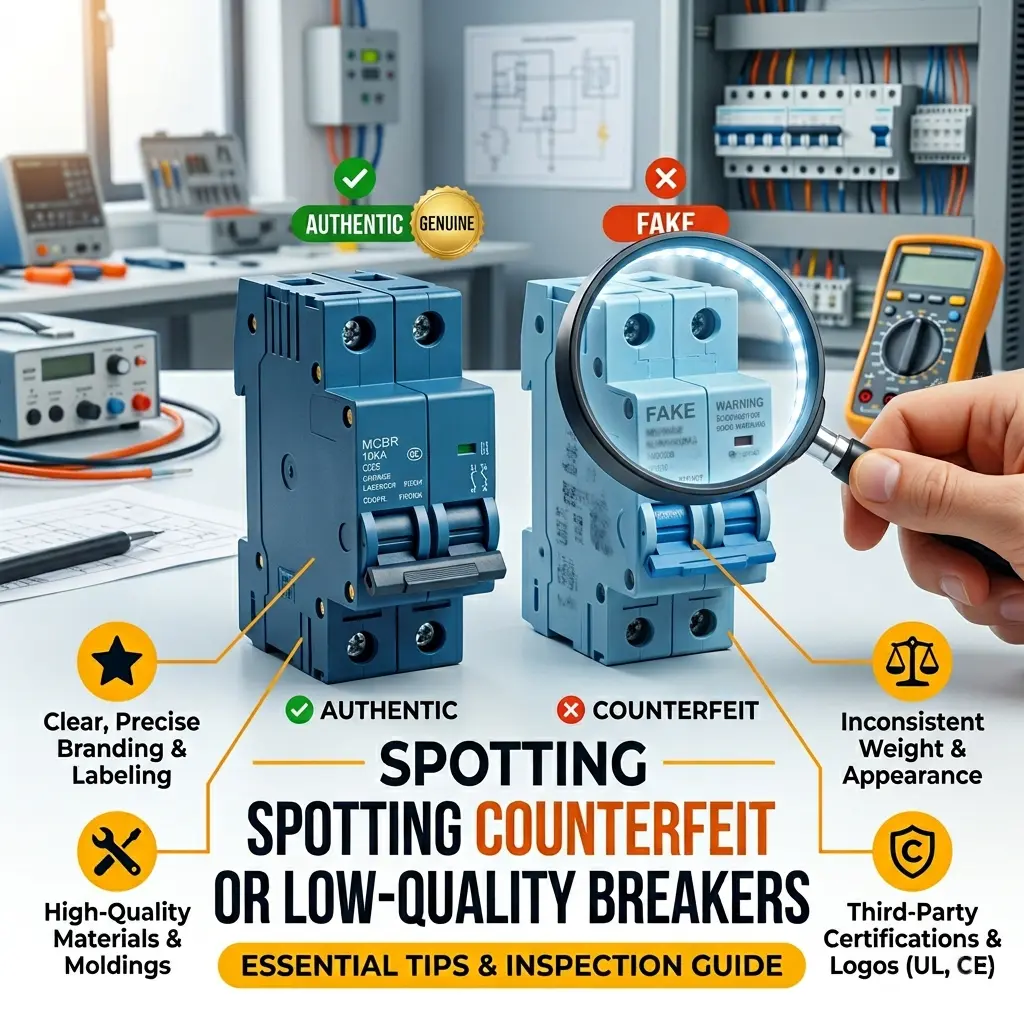
Visual inspection is the first line of defense. Common signs include poor print quality, inconsistent logos, and misspelled labels. The physical construction often reveals uneven casing finishes and the use of low-quality plastics that feel brittle or lack the robust texture of genuine materials.
How Can You Check Breaker Certification Labels?
Checking breaker certification is crucial. Look for clear, well-printed UL listing verification or precise IEC markings. Counterfeiters often commit CE marking misuse, printing slightly altered logos. Always utilize online certification database lookups (like the UL Product iQ) to verify the authenticity of the file number printed on the device.
Why Does Breaker Weight Sometimes Indicate Poor Quality?
Genuine breakers rely on substantial metal components to handle electrical loads. A lighter breaker often indicates reduced copper content, smaller internal contacts, and lightweight thermal elements. Weighing a suspect breaker against a known genuine unit can quickly reveal these deficiencies.
Can Terminal Construction Reveal a Counterfeit Breaker?
Yes. Fake breakers frequently feature weak terminal clamps, poor screw quality (often stripping easily), and thin busbar materials. These inferior terminals increase contact resistance, leading to overheating under normal load conditions.
How to Compare Genuine vs Counterfeit Breakers
A direct comparison highlights the stark differences between genuine and counterfeit units. Below is a structural breakdown of the key features.
| Feature | Genuine Breaker | Counterfeit Breaker |
|---|---|---|
| Certification | Verified UL/IEC markings, traceable file numbers | Fake or copied marks, unverifiable databases |
| Materials | High-grade copper/alloy, flame-retardant plastics | Thin metal parts, cheap, brittle casing |
| Trip Reliability | Tested rigorously to standards (e.g., IEC 60898) | Unpredictable, frequent failure to trip |
| Label Printing | Consistent, sharp, correct spelling | Poor quality, smudged, incorrect fonts |
| Safety | Certified overcurrent protection | Severe fire and arc flash risk |
Why Cheap Circuit Breakers Often Fail
What Happens When a Breaker Fails to Trip?
A failure to trip allows excessive current to flow unimpeded. This results in short-circuit damage, severe conductor overheating, and ultimately, electrical fires. The subsequent equipment destruction can halt operations and incur massive replacement costs.
How Poor Internal Components Affect Protection
Low-quality breakers utilize weak bimetal strips that fail to react accurately to thermal overloads. Undersized magnetic coils lack the force required to interrupt high fault currents, and cheap contact materials are highly susceptible to contact welding, effectively locking the breaker in the “ON” position permanently.
Can Low-Quality Breakers Cause Nuisance Trips?
Conversely, poor manufacturing can lead to nuisance trips. Unstable calibration, inconsistent thermal response, and poor trip curve accuracy mean the breaker may trip during normal motor startups or minor, permissible load fluctuations, disrupting operations unnecessarily.
Genuine vs Counterfeit Circuit Breakers — What Is the Difference?
Material Quality Differences
Genuine vs counterfeit breakers differ fundamentally at the material level. Authentic devices use specific alloys for contacts and arc chutes designed to quench arcs safely. Counterfeits substitute these with cheaper metals that melt or vaporize under stress.
Internal Safety Mechanism Differences
The internal safety mechanisms, particularly the arc extinguishing chambers, are often severely compromised in fake breakers. Where a genuine breaker has a multi-plate arc chute, a counterfeit may have a rudimentary setup or lack one entirely.
Certification and Testing Differences
Genuine breakers undergo exhaustive destructive testing to earn their UL or IEC credentials. Counterfeit devices bypass this entirely, falsely bearing the marks without ever having proven their capacity to safely interrupt a fault.
Lifespan and Reliability Comparison
The lifespan of a genuine breaker is measured in decades of reliable service. A counterfeit breaker may fail on its first significant fault, offering zero reliability and a foreshortened operational life.
How to Verify Breaker Certifications and Compliance
How to Check UL Listed Circuit Breakers
To verify a UL listed circuit breaker, locate the holographic label (if applicable) and the control number. Enter this data into the official UL certification database to confirm the manufacturer and product category are legitimate.
What IEC Standards Apply to Breakers?
For international applications, verify compliance with specific standards. IEC 60898 applies to circuit breakers for overcurrent protection for household and similar installations. IEC 60947 covers low-voltage switchgear and controlgear, specifically circuit breakers used in industrial settings.
What Is the Difference Between UL and CE Markings?
UL is an independent safety science company that conducts rigorous testing. The CE marking, however, is largely a self-declaration by the manufacturer that the product meets EU directives. Counterfeiters find CE marks much easier to falsify than UL listings.
How to Verify Manufacturer Authenticity
Verify authenticity by purchasing exclusively through official distributor networks. Utilize serial number verification tools provided by major brands and consult manufacturer databases to ensure the product origin is legitimate.
How OEM Buyers and Distributors Can Avoid Counterfeit Breakers
Why Authorized Suppliers Matter
For B2B procurement, utilizing authorized suppliers is non-negotiable. Authorized channels ensure an unbroken chain of custody from the factory to the end-user, drastically reducing the risk of counterfeit infiltration.
How to Audit a Breaker Manufacturer
OEM buyers should conduct thorough factory audits before approving a new supplier. This involves inspecting the production line, reviewing quality control procedures, and verifying the traceability of raw materials.
What Factory Certifications Should Buyers Request?
Procurement teams should demand documented proof of ISO 9001 quality management systems. Furthermore, request comprehensive test reports and valid type test certificates from recognized laboratories.
Why Extremely Low Prices Are a Warning Sign
If a price seems too good to be true, it likely is. Extremely low prices are a primary warning sign of a counterfeit or dangerously low-quality product. The cost of materials alone for a genuine breaker establishes a baseline price.
Should Buyers Request Third-Party Testing?
Absolutely. Requesting independent third-party testing from organizations like SGS, TUV, or Intertek provides an unbiased validation of the breaker’s performance and safety compliance, mitigating risk significantly.
Counterfeit Breakers vs Refurbished Breakers — What Is the Difference?
Are Refurbished Breakers Legal?
Refurbished breakers are legal when processed by certified reconditioners and clearly labeled as such. However, strict guidelines dictate which types of breakers can be safely reconditioned.
Risks of Reconditioned Electrical Protection Devices
The risks involve internal wear that is not visible. If the breaker has previously cleared a major fault, its internal components may be degraded, reducing its ability to clear future faults safely.
How Used Breakers Are Sometimes Resold as New
A major counterfeit vector involves cleaning up used breakers, applying new, fake labels, and packaging them in counterfeit boxes to be resold as new. This deceptive practice is highly dangerous and illegal.
How to Test Circuit Breaker Quality Before Installation
Note: All testing should be performed by qualified personnel using calibrated equipment.
Visual Inspection Procedures
Before any electrical testing, conduct a rigorous visual inspection for signs of tampering, inconsistent labeling, and physical damage.
Mechanical Operation Testing
Cycle the breaker manually several times. The toggle action should be crisp and decisive. A sluggish or “mushy” feel is a red flag.
Trip Function Verification
Using primary or secondary injection testing equipment, qualified technicians can verify the trip function against the manufacturer’s published time-current curves.
Thermal Inspection Under Load
Once installed, perform a thermal inspection using an infrared camera under normal load to detect abnormal heating at the terminals or within the breaker body.
Insulation and Contact Resistance Testing
Conduct micro-ohmmeter testing to ensure contact resistance is within acceptable limits. High resistance indicates poor internal connections or degraded contacts.
What Industries Face the Highest Counterfeit Breaker Risks?
Construction Projects
Large-scale construction projects requiring bulk purchases are prime targets for counterfeiters offering cut-rate pricing on massive orders.
Industrial Control Panels
Panel builders rely on precise specifications. Counterfeit components in industrial control panels can lead to catastrophic failure of automated systems.
Data Centers
Data centers demand zero downtime. A counterfeit breaker failing to isolate a fault can cause widespread power loss and massive data disruption.
Renewable Energy Systems
Solar and wind installations utilize specialized DC and AC breakers. The influx of cheap, non-certified components in this booming sector presents a significant hazard.
Export and Import Supply Chains
Complex global supply chains offer numerous entry points for gray market and counterfeit goods, requiring intense vigilance during international procurement.
FAQ — Counterfeit Circuit Breakers
How Can You Tell if a Circuit Breaker Is Counterfeit?
Look for poor label printing, lack of verified UL/IEC markings, unusually light weight, and sourcing from unauthorized distributors.
Why Are Fake Breakers Dangerous?
They often fail to trip during an overload or short circuit, leading directly to fires, arc flash incidents, and equipment damage.
Can Counterfeit Breakers Fail to Trip?
Yes, failure to trip is the most common and dangerous flaw, due to substandard internal components like weak magnetic coils and cheap bimetal strips.
Are Cheap Breakers Always Low Quality?
While not always technically counterfeit, excessively cheap breakers almost universally compromise on materials and testing, making them low-quality and unreliable.
How Do I Verify a UL Listed Breaker?
Locate the control or file number on the breaker and cross-reference it with the official UL Product iQ online database.
Should I Buy Breakers from Online Marketplaces?
It is highly discouraged unless the seller is a definitively verified, authorized distributor for that specific brand.
What Certifications Should a Genuine Breaker Have?
Depending on the region and application, genuine breakers should have verifiable UL listings, CSA marks, or comply with relevant IEC standards (like IEC 60898 or IEC 60947).