As residential EV adoption accelerates, safe charger installation has become a priority not only for homeowners but also for electricians, electrical distributors, charger brands, and project contractors. A home charging point may look simple from the outside, yet behind it sits a demanding electrical load that can stress wiring, breaker capacity, and panel performance for hours at a time. For that reason, effective home EV charger protection is both a technical requirement and a commercial differentiator. Installers who specify the right EV charger circuit breaker, leakage protection, and dedicated circuit design reduce callbacks, improve compliance, and build trust with end users. For B2B buyers, choosing the right low voltage breaker for EV projects means better product reliability, smoother installations, and a stronger value proposition in a fast-growing electrification market.
Quick Answer: How Do You Protect a Home EV Charger?
Home EV chargers are protected using properly sized low voltage circuit breakers, residual current protection (RCD), and dedicated circuits. The breaker must match the charger load and follow the 125% rule for continuous operation to ensure safe and reliable charging.
Why Do Home EV Chargers Need Electrical Protection?
What Makes EV Chargers Different from Other Home Appliances?
Installing an electric vehicle (EV) charger at home introduces a significant new load to residential electrical systems. Unlike common appliances such as microwaves or televisions that run intermittently, EV chargers operate under continuous high load conditions. They draw substantial power, especially Level 2 chargers, and often run for extended periods, such as during overnight charging sessions.EV chargers place higher and longer electrical demand on home systems compared to typical appliances.
This unique operational profile means that standard electrical infrastructure is pushed to its limits, necessitating specialized home EV charger protection to prevent system degradation and ensure long-term safety.
What Risks Exist Without Proper Protection?
Failure to implement adequate EV charger circuit breaker protection exposes the home and the vehicle to severe risks. Continuous drawing of high currents can lead to overload conditions, causing wires and terminals to overheat. Short circuits can occur due to faults in the wiring or the charger itself, potentially damaging the vehicle’s onboard electronics. Furthermore, there is a serious electric shock risk associated with leakage currents, and the combination of overheating and electrical faults creates a significant fire hazard in residential settings.
What Does a Low Voltage Circuit Breaker Do for EV Chargers?
Core Protection Functions
The primary defense mechanism in any electrical installation is the circuit breaker. In the context of residential EV infrastructure, a low voltage breaker for EV applications is critical.A low voltage circuit breaker protects EV chargers by interrupting power during overloads, short circuits, and abnormal electrical conditions.
It acts as a designated fail-safe. If the charger draws more current than the circuit is designed to handle, the breaker trips, disconnecting the power supply and preventing thermal damage to the wiring. It also responds instantaneously to short circuits, isolating the fault before catastrophic damage occurs.
Where Is the Breaker Installed in a Home Setup?
The installation hierarchy is straightforward but essential for safety and compliance. The configuration flows linearly from the source to the destination:
- Main Panel: The central electrical distribution board of the house.
- Breaker: The specific EV charger circuit breaker installed within the main panel.
- EV Charger: The end device connected via dedicated wiring.
Residential EV Charger Setup: Typical Configuration
Standard Home Installation Layout
For electricians and B2B contractors designing residential systems, standardizing the installation layout is key. A professional setup begins at the main panel. From there, a dedicated circuit must be established exclusively for the EV charger. Sharing this circuit with other high-draw appliances is a severe code violation and a safety hazard. This dedicated run ensures that the EV charger receives uninterrupted, clean power protected by its specific low voltage breaker for EV.
Recommended Protection Devices
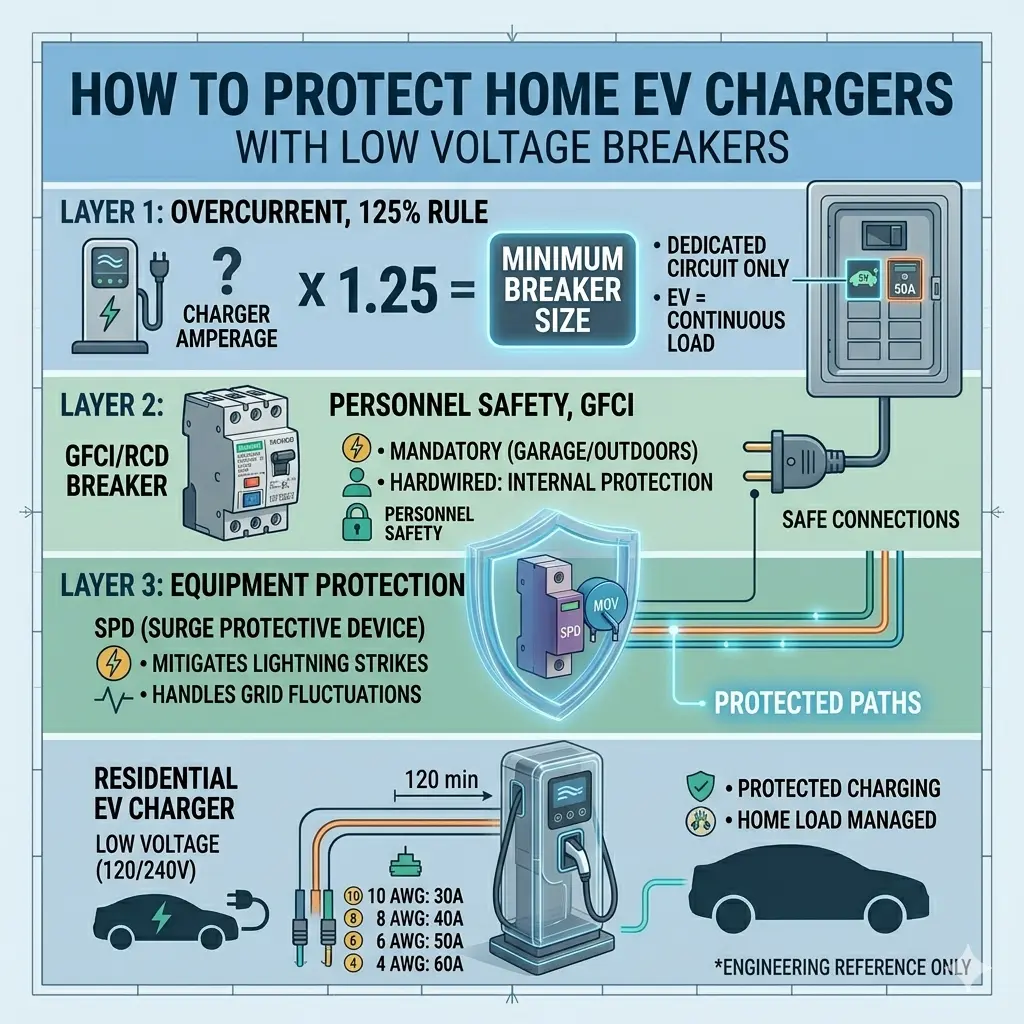
Comprehensive home EV charger protection requires a multi-layered approach to safety devices:
| Protection Device | Primary Function | Application Notes |
|---|---|---|
| MCB / MCCB (Miniature/Molded Case Circuit Breaker) | Overload and Short Circuit Protection | Essential for all installations. Sized based on the continuous load rule. |
| RCD / RCBO (Residual Current Device / with Overcurrent) | Leakage Current / Electric Shock Protection | Mandatory for wet or outdoor locations. RCBO combines MCB and RCD functions. |
| SPD (Surge Protective Device) | Transient Overvoltage Protection | Optional but highly recommended to protect sensitive EV electronics from lightning or grid surges. |
Example Setup for a Level 2 Charger
Level 2 chargers operate at 240V and deliver charging speeds significantly faster than standard wall outlets, making them the standard for home installations.A typical Level 2 home EV charger uses a 40A–60A breaker with a dedicated circuit and RCD protection.
This configuration balances the need for rapid overnight charging with the practical limitations of residential electrical panels. For electricians, the exact breaker size still depends on the charger’s nameplate current, cable sizing, installation environment, and local code requirements. For B2B decision-makers, standardizing around common residential breaker ranges can also simplify procurement, inventory planning, and after-sales technical support.
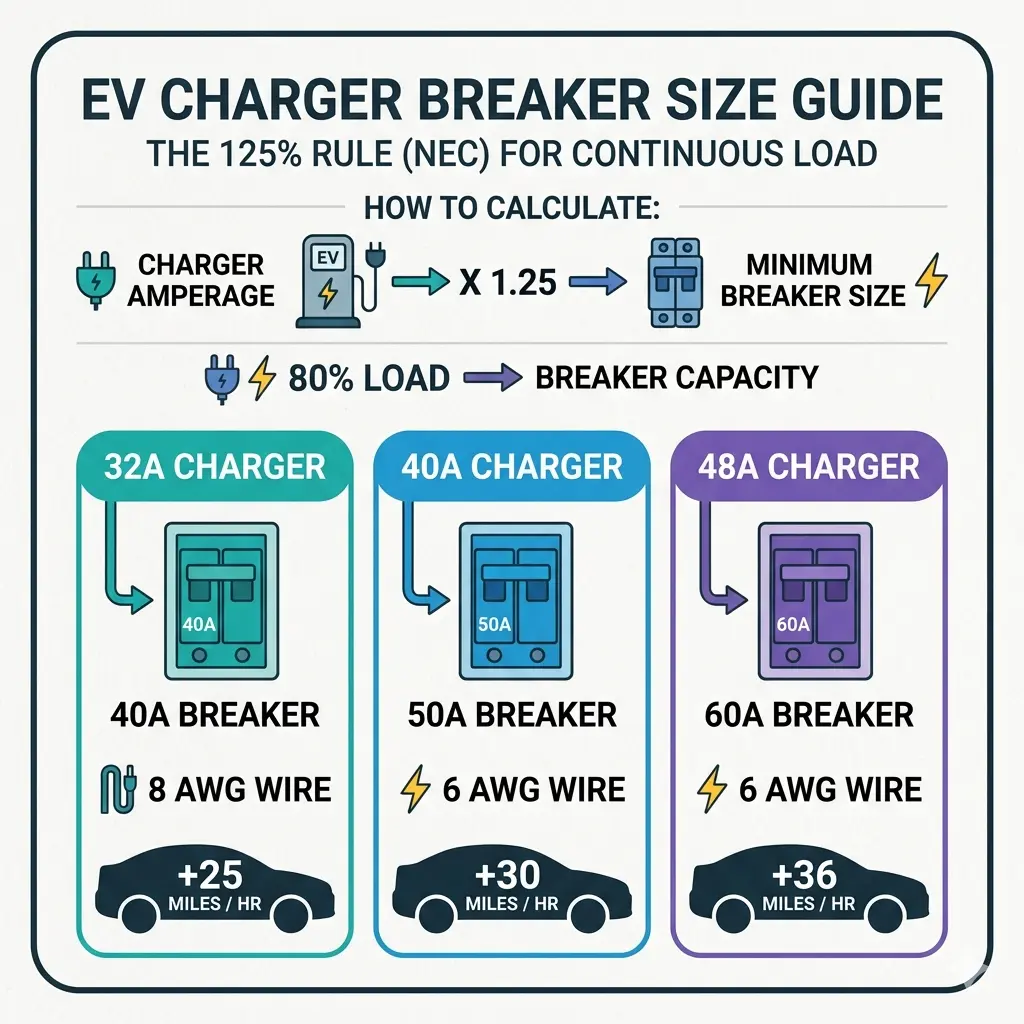
| Level 2 Charger Output | 125% Rule Result | Typical Breaker Size | Installation Note |
|---|---|---|---|
| 32A | 40A | 40A breaker | Common for compact residential wall chargers. |
| 40A | 50A | 50A breaker | Widely used for mainstream home Level 2 charging. |
| 48A | 60A | 60A breaker | Requires careful panel and conductor verification. |
This type of sizing table is especially useful for contractors quoting residential projects at scale. It provides a repeatable reference point for matching charger output, breaker rating, and installation planning while helping procurement teams avoid mismatched components across different housing developments or retrofit projects.
How to Calculate the Correct Breaker Size for a Home EV Charger
EV Charger Load Calculation Formula
Accurate sizing of the EV charger circuit breaker is non-negotiable. Because EV charging is considered a continuous load (defined as operating for 3 hours or more), electrical codes mandate that the breaker must be sized at 125% of the charger’s maximum continuous output.
Ibreaker = Icharger × 1.25
Example Calculation
If a homeowner purchases an EV charger capable of delivering a continuous maximum current of 40 Amps, the calculation is straightforward: 40A × 1.25 = 50A.A 40A EV charger typically requires a 50A breaker based on the 125% rule.
Installing a 40A breaker for a 40A charger would lead to nuisance tripping and potential overheating due to the continuous nature of the load.
Why the 125% Rule Matters
The 125% continuous load requirement is a fundamental safety margin. Circuit breakers generate heat when operating near their maximum capacity. If a breaker operates at 100% capacity continuously, the internal thermal mechanisms can degrade, leading to failure or fire. The 25% buffer prevents overheating, ensuring the breaker remains cool and functional over years of daily, hours-long charging sessions.
Understanding Home Electrical Panel Limitations
Can Your Panel Handle an EV Charger?
Before installing a low voltage breaker for EV, electricians must perform a thorough load calculation on the existing main panel. Key factors include the total panel capacity (typically 100A, 150A, or 200A in modern homes), the physical available breaker space, and the existing load from other appliances (HVAC, electric ranges, dryers). A panel operating near its limit cannot safely accommodate the substantial addition of a Level 2 charger.
When Panel Upgrades Are Required
In many older homes, or homes with extensive electrical heating and cooling, the existing panel may be insufficient.A panel upgrade may be necessary if the existing electrical system cannot safely support the additional EV charger load.
Attempting to bypass this requirement by using undersized wiring or improper breakers compromises the entire home’s safety.
Load Management Options
If a full panel upgrade is cost-prohibitive, smart load management solutions offer a viable alternative. Load sharing devices can pause EV charging when other heavy appliances (like a stove) are in use. Smart EV chargers and comprehensive energy management systems dynamically adjust the charging rate based on real-time overall household consumption, ensuring the main breaker never trips while still maximizing charging efficiency.
Choosing the Right Circuit Breaker for Home EV Chargers
Recommended Breaker Types
The choice of breaker dictates the reliability of the home EV charger protection system. MCBs (Miniature Circuit Breakers) are standard for most residential uses, providing basic overcurrent protection. However, RCBOs (Residual Current Breaker with Overcurrent) offer higher safety by integrating both overload and leakage protection into a single unit, saving panel space and simplifying installation.
Key Selection Factors
When B2B buyers or contractors source breakers, they must evaluate several technical specifications. The current rating must match the 125% rule calculation. The breaking capacity (typically measured in kA) must be sufficient to safely clear the maximum prospective short-circuit current at the panel. Compatibility with the specific EV charger model and the existing panel brand is also crucial for a certified and safe installation. In addition, professionals should review ambient temperature conditions, enclosure requirements for indoor or outdoor mounting, terminal quality, and whether the breaker platform supports future maintenance and replacement. From a supply-chain perspective, standardizing breaker platforms across multiple EV charger SKUs can reduce installation complexity, technician training time, and spare-part fragmentation. In competitive B2B markets, these details directly affect project margins, compliance risk, and customer satisfaction.
Common Mistakes When Protecting Home EV Chargers
Using an Undersized Breaker
Ignoring the continuous load rule and installing an undersized breaker is a frequent error. This inevitably results in frequent tripping, interrupting the charging process and causing frustration for the homeowner, while also degrading the breaker’s internal contacts.
Not Using a Dedicated Circuit
Tapping into an existing circuit that powers other garage outlets or appliances is dangerous. When the EV charger and other devices run simultaneously, the circuit will overload, risking wire insulation damage and potential electrical fires.
Ignoring Leakage Protection
Failing to install RCD protection poses a severe safety risk. EV chargers operate in environments (garages, driveways) where moisture is common. Without leakage protection, a fault in the charging cable or the vehicle could result in a lethal electric shock.
Overloading the Panel
Adding a large EV load to a panel already at capacity leads to system instability. It can cause the main house breaker to trip, leaving the entire residence without power and creating an unsafe situation during peak load times.
FAQ: Home EV Charger Protection
What size breaker do I need for a home EV charger?
Most Level 2 chargers require a 40A–60A breaker, depending on the charger’s maximum continuous current. Always apply the 125% rule for sizing.
Do I need a dedicated circuit for an EV charger?
Yes, EV chargers must always be installed on a dedicated circuit to prevent overloading and ensure safe, continuous operation.
Can my existing panel support an EV charger?
It depends on your panel’s available capacity and existing load. A professional load calculation is required; some homes will need panel upgrades or smart load management.
Do EV chargers need RCD protection?
Yes, residual current protection (RCD) or an RCBO is essential for safety, protecting against ground faults and electric shock risks, especially in damp locations.
What happens if the breaker is too small?
An undersized breaker will trip frequently due to the continuous high load, interrupting the charging session and potentially damaging the breaker over time.
Conclusion: Safe and Reliable EV Charging at Home
Establishing robust home EV charger protection is not merely a matter of convenience; it is a critical safety requirement. Selecting the correct EV charger circuit breaker is the core of a secure installation. Electricians must always account for continuous load requirements and strictly adhere to the 125% rule. Furthermore, assessing the existing panel capacity dictates whether a straightforward installation is possible or if an upgrade or load management system is necessary.Proper protection of home EV chargers requires correctly sized breakers, dedicated circuits, and an electrical panel capable of handling the load.