Selecting the correct circuit breaker is one of the most critical responsibilities for electricians, panel builders, and B2B procurement managers. Circuit breakers are essential safety devices designed to protect electrical networks from severe damage caused by overloads and short circuits. While the amperage and voltage ratings are paramount, understanding the exact differences between 1 pole, 2 pole, 3 pole, and 4 pole circuit breakers is just as crucial. Choosing the correct pole configuration ensures compatibility with either single-phase or three-phase systems while guaranteeing maximum safety for both the equipment and the personnel handling it.
Quick Answer: What Is the Difference Between 1P, 2P, 3P, and 4P Circuit Breakers?
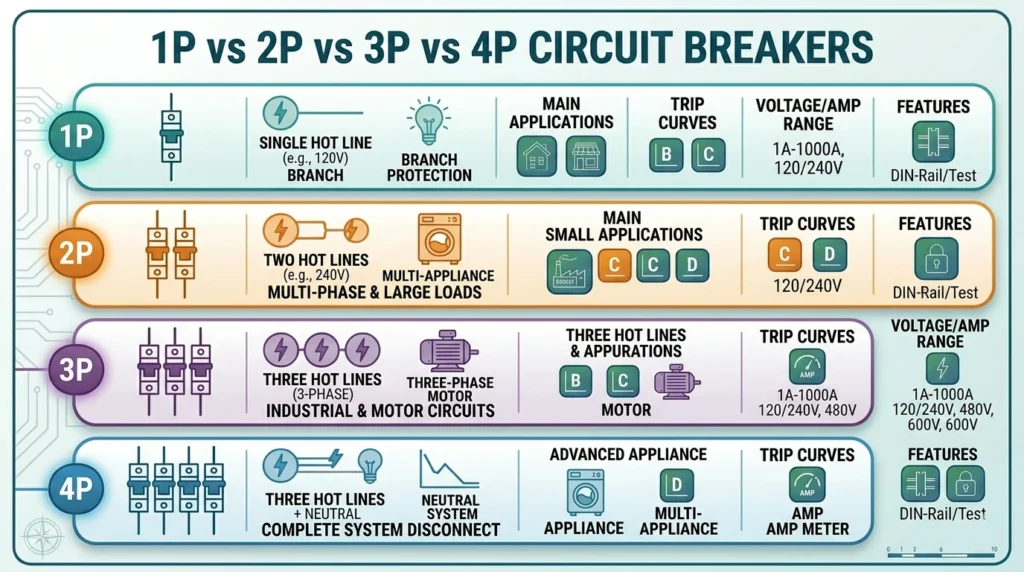
1P, 2P, 3P, and 4P circuit breakers differ mainly in the number of poles (phases/conductors they protect). 1P is used for single-line protection, while 3P and 4P are used for three-phase systems, with 4P including neutral protection. The more poles a breaker has, the more conductors it can disconnect simultaneously for safety.
What Does 1P, 2P, 3P, and 4P Mean in Circuit Breakers?
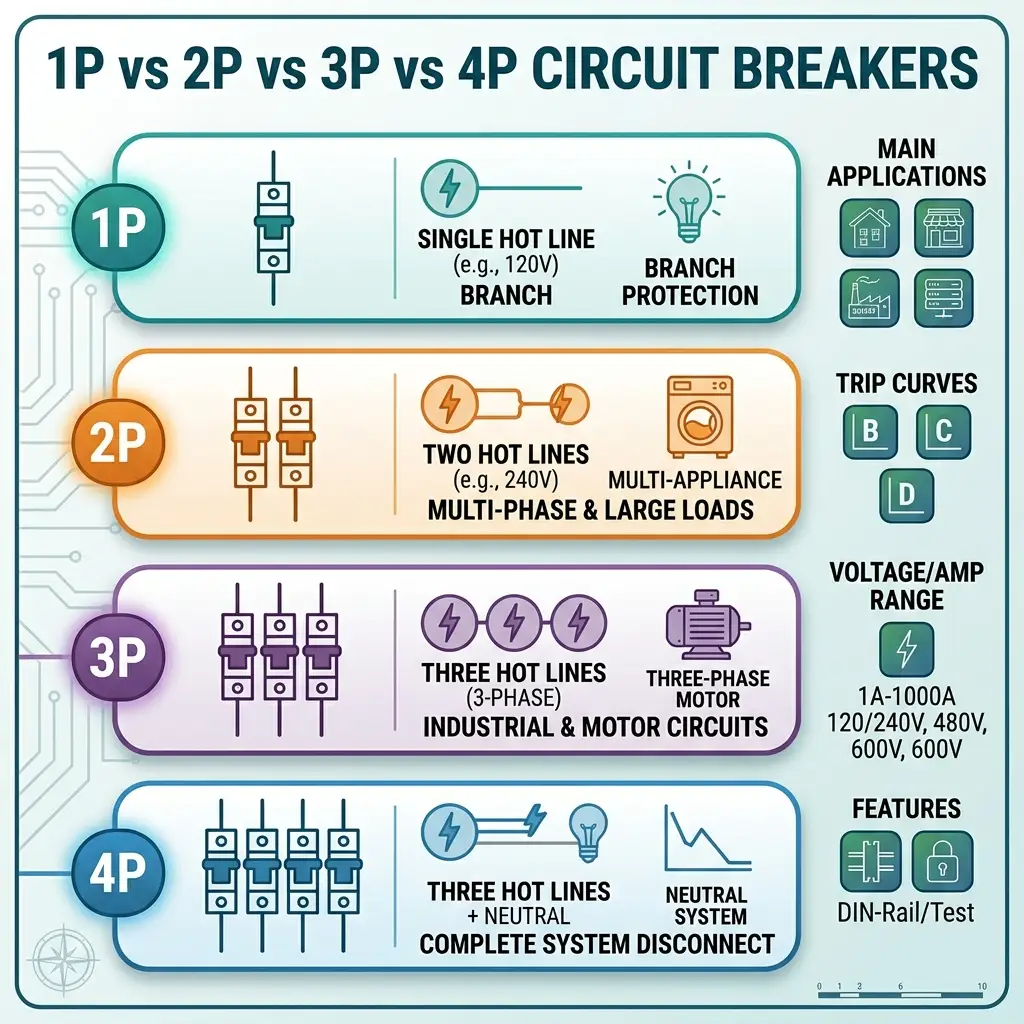
The “P” in 1P, 2P, 3P, and 4P stands for “Pole.” In electrical terminology, a pole refers to a separate, distinct switchable internal circuit within the breaker housing. The number of poles directly correlates to how many independent conductors (wires) the circuit breaker can monitor, protect, and disconnect simultaneously when an electrical fault occurs.
What Does 1P (Single Pole) Circuit Breaker Mean?
A 1P, or single-pole circuit breaker, is the most fundamental type of protective device found in modern electrical panels. It is designed to monitor and switch a single ungrounded conductor (the live or hot wire). When current exceeding the breaker’s rated capacity passes through this single live line, the breaker’s internal bi-metallic strip (for thermal overloads) or magnetic coil (for short circuits) triggers the tripping mechanism, disconnecting the power supply to that specific circuit.
These breakers are incredibly common in residential and light commercial distribution boards. They are specifically utilized for standard household lighting circuits, standard wall outlets, and minor appliance loads that operate on standard domestic voltages (such as 120V in North America or 230V in Europe and Asia).
A 1P circuit breaker protects a single live wire in a single-phase system.
What Does 2P (Double Pole) Circuit Breaker Mean?
A 2P, or double-pole circuit breaker, physically connects two single-pole switching mechanisms together, allowing them to operate in unison. It typically monitors two distinct conductors. In many global electrical systems, a 2P breaker is wired to disconnect both the live (phase) wire and the neutral wire at exactly the same time. This provides an enhanced level of electrical safety, particularly in environments where reverse polarity is a risk or where strict isolation rules mandate that no voltage whatsoever (including potentially floating neutral voltages) remains in the circuit during maintenance.
By breaking the single-phase plus live+neutral connections, technicians can work on equipment with complete peace of mind. They are heavily favored in regions utilizing specific earthing configurations (like TT systems) and for higher-draw single-phase appliances.
A 2P circuit breaker disconnects both live and neutral wires simultaneously.
What Does 3P (Triple Pole) Circuit Breaker Mean?
Moving into higher power applications, a 3P, or three-pole circuit breaker, features three synchronized switching poles. It is explicitly designed to handle three-phase power systems where three distinct live conductors (L1, L2, and L3) carry alternating currents that are out of phase with one another. If a fault occurs on any single one of these three phases, the internal common-trip mechanism forces all three poles to open instantaneously.
This common-trip functionality is vital. If only one or two phases were disconnected during a fault, three-phase industrial equipment—such as three-phase motors—would experience a highly destructive condition known as “single-phasing.” Therefore, 3 pole circuit breakers are essential for protecting heavy industrial machinery, large HVAC systems, and high-capacity manufacturing lines.
A 3P circuit breaker is used in three-phase systems to protect all three phases.
What Does 4P Circuit Breaker Mean?
A 4P, or four-pole circuit breaker, is the most robust and comprehensive option in this category. It integrates four distinct poles into one unit, intended to connect and protect the three active phase conductors (L1, L2, L3) alongside the neutral (N) conductor. In advanced commercial and industrial electrical networks, harmonic currents or unbalanced phase loads can cause significant electrical current to return through the neutral wire. Under these conditions, the neutral wire must be actively protected and isolated in the event of a system failure.
4P breakers are highly utilized in systems featuring three-phase plus neutral configurations, generator transfer switches, and high-end industrial systems where absolute and complete electrical isolation of all current-carrying conductors is mandated by local safety codes.
A 4P circuit breaker protects three phases plus neutral, ensuring complete isolation.
1P vs 2P vs 3P vs 4P: Key Differences Explained
Number of Poles Comparison
The most straightforward way to conceptualize circuit breaker pole differences is by observing the direct relationship between the breaker designation and the number of conductors it actively controls:
- 1P → Connects and protects 1 conductor (Live)
- 2P → Connects and protects 2 conductors (Live + Neutral, or Two Lives depending on regional grids)
- 3P → Connects and protects 3 phases (L1, L2, L3)
- 4P → Connects and protects 3 phases + neutral (L1, L2, L3, N)
Protection Scope
The scope of protection provided by a breaker is directly tied to its physical architecture. A 1P breaker only safeguards the specific wire it is attached to. If a fault happens on the neutral wire or another phase, the 1P breaker is entirely blind to it. In contrast, multi-pole breakers provide cross-phase protection. If one phase experiences a massive short circuit, a 3P or 4P breaker guarantees that the entire machine is shut down, preventing partial-power scenarios that often lead to fires or motor burnout.
The protection scope increases with the number of poles, providing higher safety and system isolation.
System Compatibility
System compatibility is rigidly defined by the utility supply and the load requirements. 1P and 2P breakers are strictly intended for single-phase systems (though a 2P can sometimes be used across two phases in split-phase systems like in the US). Conversely, 3P and 4P breakers are explicitly engineered for three-phase systems. Attempting to mix these incompatible categories will result in either an unsafe installation or a completely non-functional circuit.
Switching Behavior
A defining characteristic of multi-pole breakers (2P, 3P, and 4P) is their internal tripping linkage. While they may appear to simply have their external handles tied together with a plastic bar, they possess a sophisticated internal trip mechanism. If the thermal or magnetic sensor in Pole 1 detects a fault, the internal linkage forcibly trips Poles 2, 3, and 4 simultaneously, usually within milliseconds.
Multi-pole breakers ensure simultaneous disconnection of all conductors to prevent electrical hazards.
Comparison Table: 1P vs 2P vs 3P vs 4P
The following table provides a concise, professional reference guide for B2B buyers and contractors regarding standard pole configurations.
| Type | Poles | System Type | Application |
|---|---|---|---|
| 1P | 1 | Single-phase | Lighting |
| 2P | 2 | Single-phase | Appliances |
| 3P | 3 | Three-phase | Motors |
| 4P | 4 | Three-phase | Industrial systems |
Applications: When to Use 1P, 2P, 3P, or 4P Circuit Breakers?
When to Use 1P Circuit Breakers?
1P circuit breakers are the backbone of domestic electrical distribution. They should be used for low-load, single-phase applications. Typical use cases include residential ceiling lighting, standard wall receptacles in living spaces and bedrooms, and small-power circuits powering minimal electronics. They are cost-effective, take up only one slot in a distribution board (DIN rail), and are perfectly suited for basic ungrounded hot-wire protection.
When to Use 2P Circuit Breakers?
Contractors specify 2P circuit breakers for household sockets located in potentially hazardous environments, such as bathrooms, kitchens, and outdoor areas where water ingress is possible. Furthermore, 2P breakers are indispensable in high-safety areas and specialized earthing systems where floating neutral voltages pose a risk of electric shock even after the live wire is disconnected.
2P breakers are used where full isolation of live and neutral is required.
When to Use 3P Circuit Breakers?
In the industrial and commercial sectors, 3P circuit breakers are the standard. They are heavily relied upon to supply power to industrial motors, heavy duty pumps, commercial air conditioning compressors, and various balanced three-phase loads. Because a balanced three-phase motor theoretically draws zero current on a neutral wire, a 3P breaker (which lacks a neutral connection) is usually sufficient and optimal for these pure motor applications.
When to Use 4P Circuit Breakers?
4P breakers are utilized in highly complex electrical environments. They are the go-to solution for unbalanced three-phase loads where substantial current returns via the neutral conductor. Panel builders also specify 4P breakers as the main incoming switch-disconnectors in large distribution panels to guarantee that total isolation can be achieved before panel maintenance begins.
4P breakers are required in systems where neutral isolation is critical, such as industrial distribution networks.
Single-Phase vs Three-Phase Systems: Why Pole Number Matters
What Is a Single-Phase System?
A single-phase electrical system delivers power via one alternating current voltage waveform. It utilizes two main wires to complete the circuit: one active (live) phase wire and one neutral wire. Because the power delivery dips to zero during the AC cycle, it is not suitable for ultra-heavy machinery. It is standard for home electricity and commercial environments dealing exclusively with lower loads.
What Is a Three-Phase System?
A three-phase system utilizes three distinct alternating currents, each offset in time by 120 electrical degrees. This staggered delivery ensures that the total power supplied to a load is continuous, never dropping to zero. Consequently, this leads to significantly smoother motor operation, smaller wiring requirements for the same power output, and overall superior electrical transmission capabilities.
Three-phase systems provide higher efficiency and are used in industrial and commercial applications.
Why Pole Configuration Depends on System Type
Choosing the breaker is not simply a matter of preference; it is a rigid technical requirement dictated by the architecture of the facility’s power grid. Installing a single-pole breaker on a three-phase line is impossible and disastrous, just as installing a three-pole breaker on a single-phase residential panel is physically incompatible and economically wasteful.
Pole number must match system configuration to ensure proper circuit protection and safety.
Common Mistakes When Choosing 1P–4P Circuit Breakers
Using 1P in Three-Phase Systems
One of the most dangerous errors an installer can make is using three separate 1P breakers to protect a three-phase motor. If one phase overloads and its respective 1P breaker trips, the other two phases will continue to supply power. The motor will continue attempting to run on two phases (single-phasing), which rapidly leads to immense thermal buildup and catastrophic motor failure.
Ignoring Neutral Protection Needs
Many systems possess harmonic distortions or severe phase imbalances. In these situations, the neutral wire carries significant electrical current and can overheat. Ignoring the need for a 2P or 4P breaker in these scenarios means the neutral wire is left completely unprotected against overcurrent conditions, creating a severe fire hazard.
Mismatching System Voltage and Poles
Multi-pole breakers are inherently rated for higher voltages. For example, a 1P breaker may be rated for 230V AC, whereas a 3P breaker will be rated for 400V or 415V AC. Mismatching the pole configuration often inadvertently results in utilizing a breaker with an inadequate voltage rating, compromising its ability to extinguish the electrical arc during a trip.
Over-Specifying Poles
While upgrading safety is generally recommended, blindly specifying 4P breakers for applications where 3P breakers are perfectly adequate (like perfectly balanced, neutral-less motor circuits) simply consumes valuable panel space and inflates the project budget needlessly.
Over-specifying poles increases cost without improving system performance.
How to Choose the Right Pole Configuration
Step 1: Identify System Type
Begin by strictly defining the incoming utility supply. If the building is supplied with a single-phase feed, your choices are immediately narrowed down to 1P or 2P breakers. If the facility requires heavy power and is supplied with a three-phase feed, your focus must shift exclusively to 3P and 4P solutions.
Step 2: Determine Load Type
Evaluate what the breaker is physically protecting. Is the application residential (lighting, simple heating) where 1P is sufficient? Or is it an industrial application (conveyor belts, CNC machines) demanding synchronized 3P protection?
Step 3: Check Safety Requirements
Consult the specific grounding and isolation requirements of the equipment. If the manufacturer of an industrial machine dictates that all current-carrying conductors must be severed for maintenance, standard phase protection is not enough.
Neutral protection requirements often determine whether 3P or 4P is needed.
Step 4: Follow Electrical Standards
Ensure total compliance with relevant international and regional regulatory frameworks. Refer to IEC standards (such as IEC 60898 for residential and IEC 60947-2 for industrial applications) as well as strictly adhering to local codes (like the NEC in North America or BS 7671 in the UK). These documents clearly outline when neutral switching is mandatory.
FAQ: 1P vs 2P vs 3P vs 4P Circuit Breakers
What is the difference between 1P and 2P circuit breakers?
The primary distinction lies in their isolation capabilities. A 2P circuit breaker disconnects both live and neutral wires simultaneously, ensuring zero voltage remains in the circuit. A 1P circuit breaker only disconnects the live wire, leaving the neutral connected to the main busbar.
Which is better, 3P or 4P?
Neither is inherently “better”; their suitability depends entirely on the application. However, a 4P provides full isolation including neutral, which is absolutely critical for systems with heavy unbalanced loads, whereas a 3P is optimal and more cost-effective for perfectly balanced three-phase motor loads without a neutral connection.
Can 1P be used in industrial systems?
No, standard industrial systems operate on three-phase power and strictly require multi-pole breakers (3P or 4P) to prevent single-phasing and ensure synchronized shutdown. While a 1P breaker might be found in an industrial control panel for a minor single-phase auxiliary circuit (like panel lighting), the primary industrial systems require multi-pole protection.
Why use a 4P circuit breaker?
A 4P breaker is utilized for complete isolation in three-phase systems. It guarantees that the L1, L2, L3, and Neutral lines are all thoroughly disconnected from the power source, making the downstream equipment completely safe for maintenance and protecting the system against neutral-line overcurrents.
What is the most common breaker type in homes?
Because domestic electrical grids overwhelmingly rely on single-phase distribution, 1P and 2P circuit breakers are most commonly used in residential consumer units and load centers.
Conclusion: Understanding Circuit Breaker Pole Configurations
To effectively design and secure modern electrical networks, engineering and procurement teams must deeply understand circuit breaker pole configurations. Fundamentally, selecting the exact pole number equals matching system compatibility with the mandated safety level. Small-scale residential and light commercial locations rely extensively on 1P and 2P breakers for single-phase safety. In direct contrast, high-capacity, complex environments demand 3P and 4P breakers to manage the rigorous demands of industrial three-phase power delivery.
Choosing between 1P, 2P, 3P, and 4P circuit breakers depends on system phase configuration, load type, and safety requirements.