Quick Answer: What Does Rated Current Mean in Circuit Breakers?
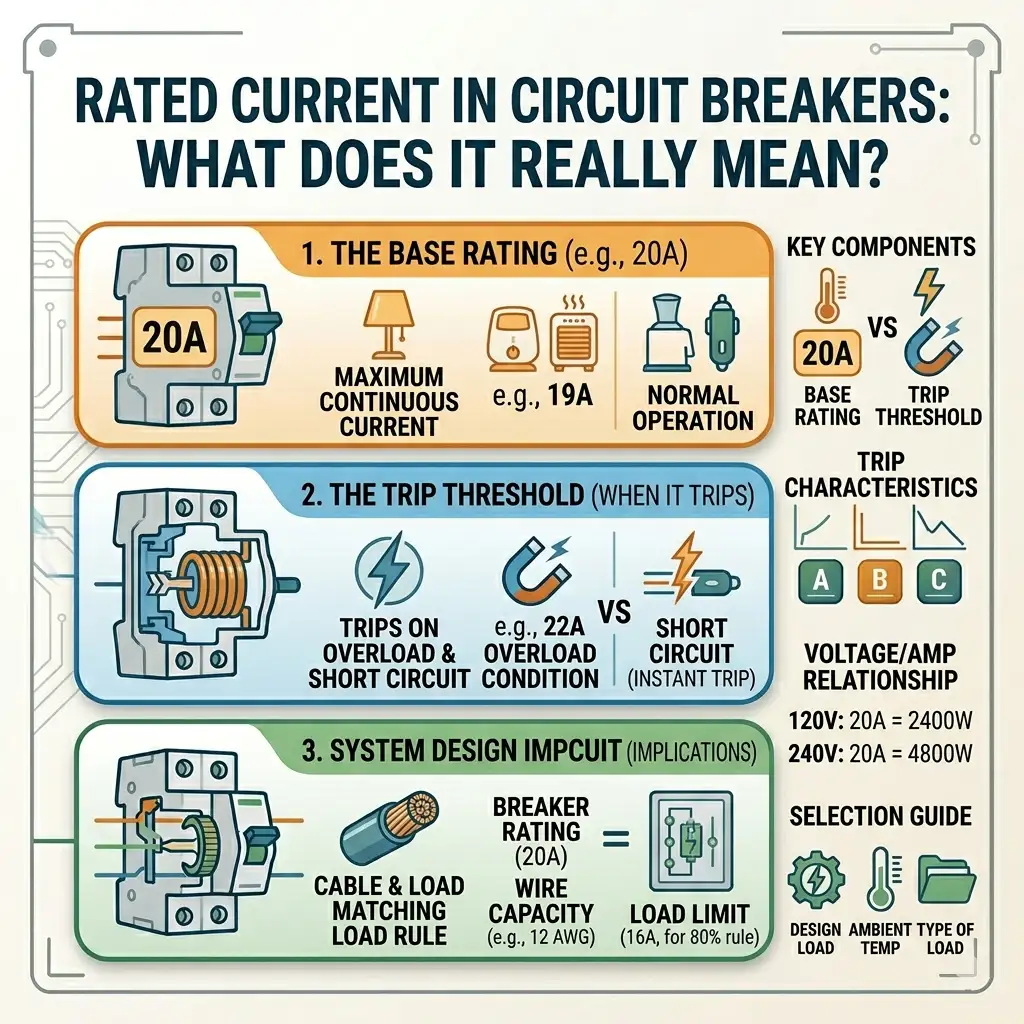
Rated current is the maximum continuous current a circuit breaker can carry without tripping under normal operating conditions. It defines exactly how much electrical load the breaker can safely handle continuously and is typically expressed in amperes (e.g., 10A, 20A, 32A). When B2B buyers or engineers ask what is rated current, they are fundamentally identifying the normal operational threshold of the protection device before its thermal mechanism activates.
What Is Rated Current in Circuit Breakers?
Definition of Rated Current
Rated current, often denoted as In, refers to the continuous current level that a breaker can carry without activating its protection mechanism in an ambient temperature specified by the manufacturer. It represents the baseline for the breaker rating and serves as the primary metric for overload protection. If an electrical system operates at or below this specific amperage, the breaker remains closed, allowing seamless power delivery. When the continuous current exceeds this value for a predetermined duration, the breaker will interrupt the circuit to prevent overheating and potential fire hazards.
Where You See Rated Current (Markings)
In practical applications, identifying the rated current is straightforward. The rated current is usually printed on the breaker body and forms part of its identification code. For instance, you will frequently see markings like C16, C20, or C32 on a Miniature Circuit Breaker (MCB) or Molded Case Circuit Breaker (MCCB). The number in these alphanumeric codes represents the rated current in amperes. An understanding of these markings is essential for spec sheet verification during B2B purchasing processes and equipment audits.
Why Rated Current Matters
Choosing the correct rated current ensures safe operation and prevents overload or nuisance tripping. From an engineering standpoint, if a breaker’s rated current is significantly lower than the normal electrical load, it will cause continuous, frustrating power interruptions. Conversely, if the rating is too high, the breaker fails to provide adequate overload protection, meaning the wires could overheat and melt before the breaker trips. Precise application matching guarantees the integrity of the electrical infrastructure.
Rated Current vs Breaking Capacity: What Is the Difference?
What Is Breaking Capacity?
While rated current dictates normal operations, breaking capacity (or interrupting capacity) is measured in kiloamperes (kA) and represents the absolute maximum fault current the breaker can safely interrupt without being physically destroyed or causing an arc flash hazard. For example, a breaker might have a rated current of 20A but a breaking capacity of 6kA or 10kA.
Key Difference Explained
Rated current defines normal operating load, while breaking capacity defines the maximum fault current a breaker can safely interrupt. You can think of the rated current as the speed limit for normal traffic, whereas the breaking capacity is the crash-test rating of a vehicle in the event of a catastrophic pile-up (a short circuit). Short-circuit rating awareness is a critical competency for panel builders assessing heavy industrial networks.
Why Confusing Them Is Dangerous
Mixing up rated current and breaking capacity can lead to improper protection and system failure. If a procurement officer sources a breaker solely based on its continuous current (e.g., 63A) but ignores that the facility’s fault potential requires a 25kA breaking capacity instead of 10kA, a short circuit could cause the breaker to weld shut or explode. Clear supplier communication tips always emphasize confirming both ratings during the quoting phase.
Rated Current vs Trip Curve (B, C, D): What’s the Relationship?
What Is a Trip Curve?
A trip curve categorizes how a circuit breaker handles temporary inrush currents—brief surges of power that occur when certain electrical devices are turned on. The standard classifications are B, C, and D curves. Curve B trips at 3 to 5 times the rated current, Curve C trips at 5 to 10 times, and Curve D trips at 10 to 20 times the rated current.
How It Affects Breaker Behavior
The trip curve determines how quickly a breaker responds to overcurrent, while rated current defines the threshold. Two breakers can share the identical continuous current rating but behave completely differently upon motor startup. This intersection of characteristics allows engineers to tailor protection precisely to the load dynamic without unnecessarily increasing the baseline amp rating.
Example: C20 Breaker Explained
A C20 breaker has a rated current of 20A with a Type C trip characteristic suitable for moderate inrush loads. This means it will happily carry 20 amps all day long. However, if a momentary surge of 100A to 200A occurs (5 to 10 times the 20A rating), the magnetic protection mechanism will engage instantly to trip the breaker. This is ideal for commercial lighting and standard motors.
How to Choose the Correct Rated Current
Step 1: Calculate Load Current
The first foundational step for any electrician or electrical engineer is to accurately determine the expected electrical load. Load current can be calculated by dividing power by voltage. This provides the exact operational draw of the connected devices under normal conditions.
I = P / V
Where I is Current (in Amperes), P is Total Power (in Watts), and V is Voltage (in Volts). For three-phase systems, the formula adjusts slightly to incorporate the square root of three and power factor, but the fundamental principle of deriving the continuous load remains the same.
Step 2: Apply Safety Margin (125%)
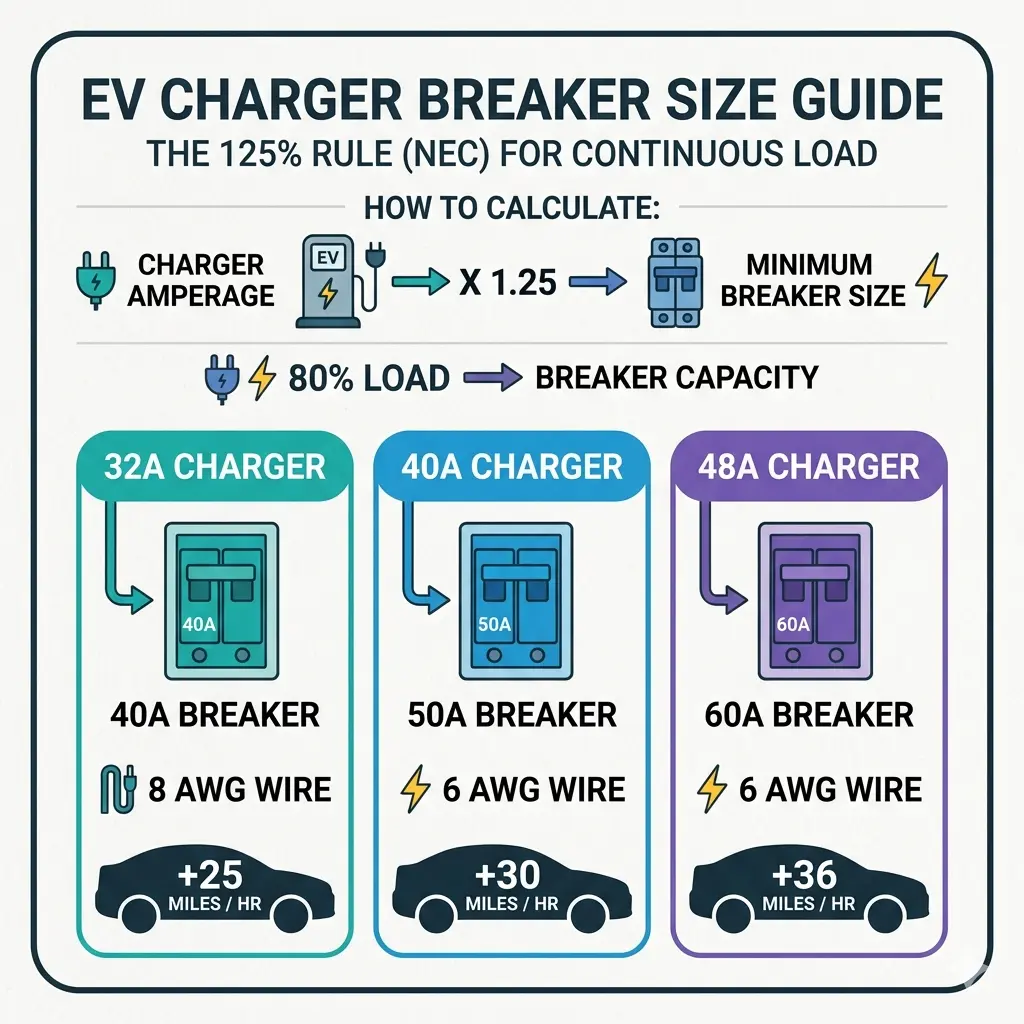
Per standard engineering practices and local electrical codes, one should never run a breaker at 100% of its capacity continuously. Breakers should be sized at 125% of the continuous load to ensure reliable operation. This safety margin accounts for slight voltage fluctuations and thermal accumulation within the breaker panel.
I_breaker = 1.25 × I_load
Step 3: Match Cable Rating
Proper coordination with cable size is absolutely non-negotiable. The breaker amp rating meaning fundamentally ties back to protecting the conductor. The rated current of the circuit breaker must always be less than or equal to the maximum current-carrying capacity (ampacity) of the wire. If a 20A breaker is installed on a wire rated for only 15A, the wire will become the weak point, leading to thermal degradation.
Step 4: Consider Application Type
Different environments dictate different safety parameters. Residential circuits primarily handle resistive loads (like heaters) or minor inductive loads. Conversely, an industrial environment relies on massive motors, transformers, and HVAC units. Application matching ensures that the rated current aligns with both steady-state loads and operational demands.
Typical Rated Current Values and Applications
For B2B buyers stocking inventory or contractors planning installations, knowing standard rated current values is highly beneficial. Below is a professional reference table outlining common parameters.
| Rated Current | Typical Use |
|---|---|
| 6A–10A | Lighting |
| 16A–20A | Sockets |
| 25A–32A | Appliances |
| 40A+ | HVAC / EV |
Professional Summary: Accurate rated current selection is not just a regulatory requirement; it is the cornerstone of electrical system reliability. A well-selected breaker harmonizes the thermal limits of cables with the operational demands of the connected load.
Common Mistakes When Selecting Rated Current
Choosing Too Low (Undersized)
Selecting a rated current that is too close to the actual load current without factoring in the 125% margin results in chronic nuisance tripping. When a breaker is undersized, normal fluctuations or minor inrush currents will cause the bi-metallic strip to bend prematurely, cutting off power. This leads to costly downtime in industrial facilities and constant frustration for homeowners.
Choosing Too High (Oversized)
Oversized breakers may fail to provide adequate protection and increase fire risk. Upgrading a tripping 16A breaker to a 32A breaker without upgrading the wiring is a dangerous error often encountered by electricians during retrofits. The 32A breaker will allow twice the heat to build up in wires designed for 16A, virtually guaranteeing insulation failure.
Ignoring Load Type
Failing to account for the type of electrical load—specifically its starting current—often leads professionals to misjudge the required rated current. Electric motors, transformers, and large LED lighting banks have massive startup surges. If the load type is ignored, the standard rated current might mathematically suffice, but the inrush will cause continuous breaker activation.
Not Following Standards
Relying on guesswork instead of rigorous adherence to local electrical codes or manufacturer data sheet specifications is a major liability. OEMs and panel builders must thoroughly document their selections to meet strict certification requirements. Ignoring these formalized standards exposes facilities to insurance invalidation and safety hazards.
How Rated Current Applies in Different Systems
Residential Systems
In standard residential systems, rated current selection is highly standardized. Lighting circuits typically utilize 6A to 10A breakers, while general-purpose socket outlets are protected by 16A or 20A breakers. The focus here is on protecting relatively thin copper wiring from user error, such as plugging in too many high-wattage space heaters.
Industrial Systems
Industrial systems require precise rated current selection due to higher load variability. Here, engineers deal with MCCB (Molded Case Circuit Breaker) units that may range from 100A to over 1000A. In these environments, fine-tuning the continuous current settings via electronic trip units is common. Panel builders must consider ambient temperature derating within large, enclosed switchgear and coordinate extensively with OEMs.
EV Charging Systems
Electric Vehicle (EV) chargers introduce prolonged, heavy, continuous loads to electrical panels. A typical Level 2 EV charger running at 32A requires a 40A rated circuit breaker (following the 125% continuous load rule). Because EV charging maintains maximum current draw for several hours, any miscalculation in the rated current or failure to verify cable coordination can lead to catastrophic panel overheating.
FAQ: Rated Current in Circuit Breakers
What does 20A mean on a circuit breaker?
It means the breaker can carry up to 20A continuously. This is its rated current under standard operating conditions. If the current exceeds this 20-amp limit for an extended period, the thermal protection mechanism will trigger and trip the breaker.
Can I use a higher rated breaker?
Not recommended unless properly designed. You can only install a higher rated breaker if the existing wiring infrastructure has the ampacity to handle the increased continuous current. Simply swapping breakers without verifying cable size removes the overload protection and creates a severe fire hazard.
What happens if rated current is exceeded?
The breaker will trip to protect the circuit. The time it takes to trip depends on how far the rating is exceeded. A slight overload (e.g., 110% of rated current) might take several minutes to trip, while a severe overload will cause a trip in seconds.
Is rated current the same as load current?
No, it is the maximum safe operating current. Load current is the actual amount of electricity being consumed by your devices at any given moment. Rated current is the absolute limit of what the breaker is designed to allow before intervening.
How do I find the correct breaker rating?
Calculate load and apply safety margin. Determine the total wattage, divide by the voltage to find the base load current, multiply by 1.25 for continuous loads, and finally, verify that the chosen breaker rating does not exceed the wire’s maximum ampacity.
Conclusion: Understanding Rated Current
Rated current is a fundamental parameter that determines how much load a circuit breaker can safely handle under normal conditions.
To summarize, the rated current is exactly equal to the maximum normal working continuous current a system should see. It is distinctly different from breaking capacity (which handles faults), and it serves as the most critical specification for electrical safety. Whether you are an electrician wiring a commercial building or a B2B procurement specialist vetting components, properly matching the breaker amp rating meaning to the load and cable size is the foundation of electrical engineering safety.