Quick Answer: What Protection Do EV Charging Stations Need?
EV charging stations require multiple electrical protection devices, including circuit breakers, residual current devices (RCD/RCCB), surge protection devices (SPD), and DC protection components. Low voltage circuit breakers play a critical role in protecting EV chargers from overload, short circuits, and system faults.
Introduction: Why EV Charging Needs Specialized Electrical Protection
As the global transition to electric mobility accelerates, the infrastructure supporting it must be robust, reliable, and inherently safe. At the core of this reliability is EV charging protection. Unlike standard commercial or residential electrical systems, electric vehicle supply equipment (EVSE) demands specialized safeguarding mechanisms. A standard low voltage breaker for EV applications is not just a regulatory requirement; it is a fundamental safety barrier.
What Makes EV Charging Different from Traditional Electrical Loads?
EV charging is fundamentally different from typical electrical loads. First, it involves high power transfer, particularly in fast charging or DC charging scenarios, where power levels can exceed 350 kW. Second, it is a long-duration load. A vehicle might draw maximum current continuously for several hours, stressing electrical components far more than intermittent loads like HVAC systems. Finally, with the advent of Vehicle-to-Grid (V2G) technology, EV chargers must handle bidirectional current potential. Therefore, an EV is not a normal load; it requires a meticulously designed electrical architecture.
What Happens Without Proper Protection in EV Charging Systems?
The absence of adequate EV charging protection can lead to catastrophic failures. Continuous high current without proper thermal management can cause severe overheating of internal components. This heat degrades insulation, leading to cable damage. In extreme cases, thermal runaway or electrical arcing poses a significant fire risk. Ultimately, inadequate protection results in expensive equipment failure and prolonged station downtime, severely impacting the return on investment for infrastructure developers.
What Are the Main Electrical Risks in EV Charging Systems?
Overcurrent and Overload in EV Chargers
The primary risk in EV charging is overcurrent caused by long-duration high current operation. If multiple vehicles charge simultaneously, the combined load can exceed the system’s rated capacity. This makes EV charger circuit breaker selection absolutely critical. The breaker must be capable of carrying the continuous load without nuisance tripping, while still accurately responding to genuine overload conditions.
Short Circuit Risks in Charging Infrastructure
Short circuits represent an immediate and severe hazard. These can occur due to installation faults, such as improper wiring during station commissioning, or insulation failure caused by environmental wear and tear. A robust low voltage breaker for EV installations is necessary to interrupt these massive fault currents instantaneously before they cause widespread system damage.
Earth Leakage and Electric Shock Risk
Because users physically interact with the charging cables in various weather conditions, earth leakage is a paramount concern for personnel safety. Any leakage of current to the vehicle chassis or wet ground could be fatal. Therefore, the strict integration of Residual Current Devices (RCD) or Residual Current Circuit Breakers (RCCB) is non-negotiable in EV charging protection to instantly cut power if a leakage is detected.
Surge and Lightning Damage
EV chargers are often installed outdoors, exposing them to environmental extremes. Grid instability, switching transients, and direct or nearby lightning strikes can induce high-voltage surges. Without adequate surge protection, the sensitive electronic control units within the EVSE can be instantly destroyed.
DC Fault Current in EV Charging Systems
Unlike AC systems, electric vehicles run on DC batteries. During AC charging, faults in the vehicle’s onboard charger can cause smooth DC fault currents to leak back into the AC supply. This DC leakage can “blind” standard AC Type A RCDs, preventing them from tripping during a dangerous AC fault. This necessitates the use of Type B RCDs or specific DC leakage monitors to ensure comprehensive EV charging protection.
What Protection Devices Are Used in EV Charging Stations?
Circuit Breakers for EV Chargers
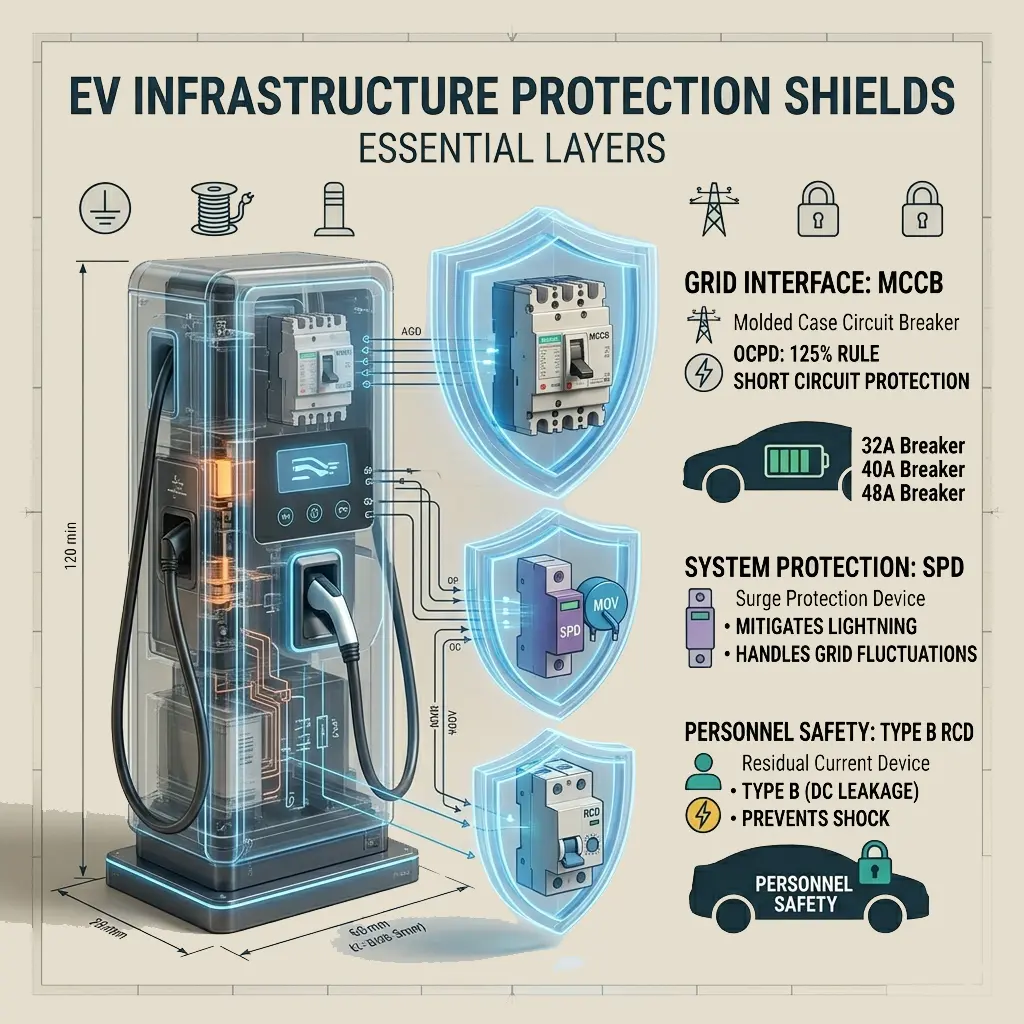
Miniature Circuit Breakers (MCB) and Molded Case Circuit Breakers (MCCB) serve as the primary protective devices against overload and short circuits. While MCBs are typically used for individual low-power AC chargers or internal component protection, MCCBs are deployed at the main distribution panel to handle higher currents for multi-charger hubs.
Residual Current Devices (RCD / RCCB / RCBO)
These devices are the frontline of human protection. Designed specifically for leakage detection, RCDs monitor the balance between live and neutral currents. If an imbalance is detected—indicating current is leaking to earth through a person or fault—the device interrupts the circuit.
Surge Protection Devices (SPD) in EV Charging
SPDs are critical for mitigating the risk of transient overvoltages. They provide essential lightning protection and safeguard the charger’s delicate electronics from grid spikes, ensuring continuous operation even in volatile grid environments.
DC Protection Devices in EV Systems
For high-power DC fast charging stations, specialized DC protection components are required. This includes robust DC breakers capable of extinguishing DC arcs, and advanced DC leakage monitoring systems to ensure battery faults do not compromise the grid or user safety.
Isolation Switches for EV Chargers
While not strictly automatic protection devices, isolation switches are vital for maintenance safety. They provide a visible, physical break in the circuit, allowing technicians to work on the EVSE safely, and serve as an accessible emergency shutdown point.
Why Are Low Voltage Circuit Breakers Critical for EV Charging?
What Is a Low Voltage Circuit Breaker in EV Applications?
A low voltage breaker for EV applications is an electromechanical device designed to operate safely within a voltage range up to 1000V AC. It is engineered to protect electrical circuits from damage caused by excess current, ensuring the safe and reliable delivery of power from the grid to the charging station.
How Circuit Breakers Protect EV Charging Stations
Low voltage circuit breakers protect EV charging stations by providing critical overload protection to prevent overheating during continuous charging cycles, rapid short circuit interruption to clear massive fault currents, and safe equipment isolation to separate faulty chargers from the main grid, thereby ensuring the stability of the entire infrastructure.
Where Are Circuit Breakers Installed in EV Charging Systems?
Effective EV charging protection relies on a tiered installation of circuit breakers:
- Input power distribution: MCCBs at the main switchboard protect the feeder cables supplying the site.
- Charger internal protection: MCBs inside the EVSE protect specific internal modules like controllers and cooling systems.
- Output protection: Breakers and RCDs at the output stage protect the specific charging cable and the connected vehicle.
- Backup systems: Breakers dedicated to isolating battery storage or backup generators integrated into the charging site.
AC vs DC Protection in EV Charging Systems: What Is the Difference?
AC Protection in EV Charging
AC protection focuses on the grid connection. It utilizes standard but highly rated AC EV charger circuit breakers, Type B RCDs, and AC SPDs to manage the flow of alternating current into the charger’s conversion electronics.
DC Protection in Fast Charging Stations
DC protection is deployed downstream of the AC/DC rectification stage. It deals with high-voltage DC (often 400V to 800V+). The primary challenge here is the arc risk; because DC current does not cross zero naturally like AC, extinguishing a DC arc requires specialized, bulky, and fast-acting DC breakers.
Why DC Protection Is More Critical in Fast EV Chargers
Because DC currents do not have a natural zero-crossing point, DC faults are harder to interrupt and require specialized protection devices to prevent sustained arcing, severe equipment damage, and fire.
What Standards Apply to EV Charging Protection? (IEC vs UL)
IEC Standards for EV Charging Protection
In regions following International Electrotechnical Commission guidelines, IEC 61851 sets the comprehensive requirements for EV charging systems, while IEC 60364 dictates the rules for the electrical installations supplying them, heavily emphasizing continuous load ratings and specific RCD requirements.
UL Standards for EV Chargers
In North America, Underwriters Laboratories standards govern safety. UL 2202 outlines the safety standards for EV charging system equipment, and UL 2231 specifically details the requirements for personnel protection systems for EV supply circuits.
Why Compliance Matters for EV Infrastructure Projects
Adhering to these standards is not merely a bureaucratic exercise. Compliance ensures baseline safety, meets local building and electrical regulations, and is generally a strict prerequisite for project acceptance, grid connection approvals, and insurance validity.
Common Electrical Protection Mistakes in EV Charging Installations
Using Standard Breakers Without EV-Specific Considerations
A frequent error is utilizing standard residential or commercial MCBs for EV loads. The continuous, multi-hour peak draw of an EV causes severe thermal stress, leading to a load mismatch where standard breakers undergo nuisance tripping or premature degradation.
Ignoring DC Leakage Protection
Failing to address the difference between Type A and Type B RCDs is a dangerous oversight. Using only a Type A RCD where a Type B is required leaves the system vulnerable to DC leakage, blinding the protection mechanism and putting users at severe risk of electric shock.
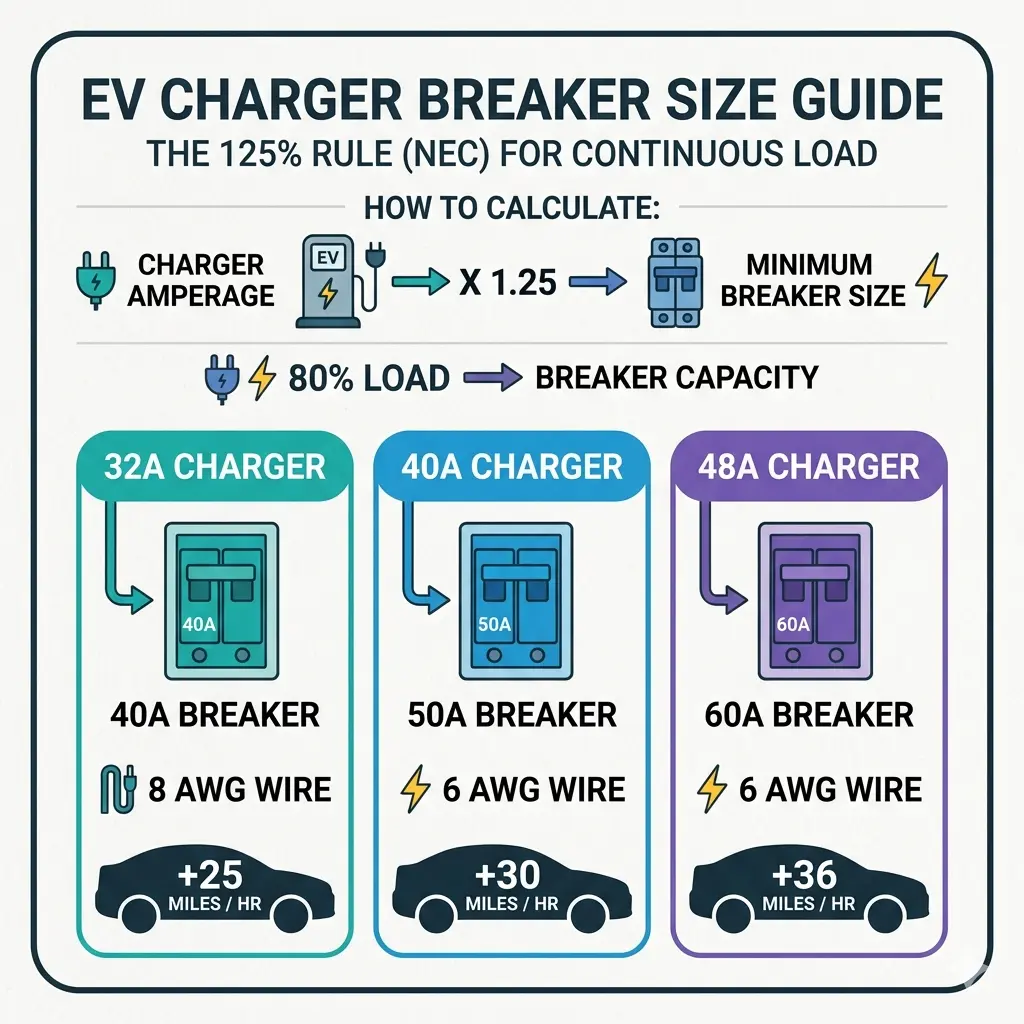
Incorrect Breaker Sizing for EV Chargers
Breakers must be perfectly sized. Undervalued sizing leads to constant tripping and operational frustration, while overvalued sizing fails to protect the cabling from dangerous overheating during an overload condition.
Missing Surge Protection Devices
Omitting SPDs, particularly in outdoor installations, is a costly mistake. The high outdoor charger risk from lightning and grid fluctuations means that without an SPD, a single storm can destroy thousands of dollars worth of charging equipment.
How to Choose the Right Circuit Breaker for EV Charging Stations
Key Selection Factors for EV Charger Breakers
Selecting the optimal EV charger circuit breaker requires analyzing several parameters. Engineers must account for the rated current based on the continuous EV load, the breaking capacity required to clear localized short circuits, the specific load type (AC vs. DC), and the harshness of the installation environment (temperature, humidity, enclosure rating).
Typical Breaker Configuration for EV Charging Systems
A reliable protection setup follows a structured hierarchy. An example configuration includes:
- Input: MCCB (Main protection)
- Charger: MCB (Sub-circuit protection)
- Protection: RCD / RCBO (Personnel safety and earth leakage)
- SPD: Surge protection (Overvoltage safety)
EV Charging Protection System Architecture (Simplified)
Understanding the flow of protection is vital for system design. The standard electrical architecture flows as follows:
Grid → MCCB → SPD → EV Charger → MCB / RCD → Vehicle
FAQ: EV Charging Protection and Circuit Breakers
What protection is required for EV charging stations?
EV charging stations require circuit breakers, RCDs, surge protection devices, and DC protection systems to ensure safe operation.
What type of circuit breaker is used for EV chargers?
MCB is used for small chargers, while MCCB is used for high-power or commercial EV charging systems.
Do EV chargers need special breakers?
Yes, EV chargers require breakers that can handle continuous high loads and possible DC fault currents.
What is the difference between Type A and Type B RCD for EV charging?
Type B RCD detects DC leakage currents, making it essential for EV charging systems where Type A would be blinded.
Is surge protection necessary for EV charging stations?
Yes, especially for outdoor installations where lightning and grid surges are common.
Conclusion: Why Proper Protection Is Essential for EV Charging Infrastructure
In summary, the transition to e-mobility relies heavily on secure electrical infrastructure. First, EV charging introduces unique electrical risks, including continuous high-power loads and DC fault potential. Second, a low voltage breaker for EV applications forms the very foundation of this protection, interrupting faults before they escalate. Finally, executing a proper system design with the correct EV charger circuit breaker ensures not only safety and standard compliance but also the long-term reliability and profitability of the charging network.
Is your charging infrastructure fully protected? Contact our engineering team today to evaluate the breaker selection and protection architecture for your next EV charging project.