For electricians, facility managers, and engineering professionals, ensuring system reliability is paramount. One of the most common and frustrating issues encountered in industrial and commercial electrical systems is a circuit breaker tripping the moment a motor is turned on. Understanding the root causes of this phenomenon and implementing the correct protection coordination strategies are essential for maintaining operational uptime and safeguarding equipment.
Quick Answer: Why Do Breakers Nuisance Trip on Motor Loads?
Motor circuits often cause nuisance tripping because motors generate high inrush current during startup. If a standard MCB with the wrong trip curve is used, the breaker may interpret the temporary startup current as a fault and trip unnecessarily.
When an MCB nuisance tripping motor loads scenario occurs, it is rarely due to an actual short circuit. Instead, it is a mismatch between the motor’s transient electrical characteristics and the instantaneous trip threshold of the thermal magnetic breaker installed in the panel. Resolving this requires a deeper understanding of motor dynamics and breaker trip curves.
What Is Breaker Nuisance Tripping?
Definition of Nuisance Tripping
In electrical engineering, breaker nuisance tripping is a highly disruptive event that compromises system reliability without offering any actual safety benefit. Nuisance tripping occurs when a circuit breaker trips even though no real fault or dangerous condition exists. The protection device acts prematurely, responding to normal, temporary fluctuations in the circuit—such as the momentary power surge required to start heavy machinery—rather than an actual overload or short-circuit fault.
Why Motor Loads Cause Frequent Trips
Electric motors are fundamentally inductive loads. When a motor is energized, it lacks the counter-electromotive force (back EMF) that normally limits current flow once the rotor is spinning at full speed. As a result, Motor loads draw significantly higher current during startup than during normal operation. This phenomenon involves several factors, including the initial startup surge required to magnetize the stator core and the locked rotor current (LRA), which is the maximum current drawn while the rotor is at a complete standstill. Because induction motor behavior relies heavily on overcoming initial mechanical inertia, this sudden spike in electrical demand easily fools poorly specified protection devices into executing an instantaneous trip.
Why This Problem Matters in Industrial Systems
From a B2B operations and procurement perspective, an unreliable electrical protection system is a massive liability. Frequent nuisance trips can lead to downtime, production interruption, and premature equipment wear. Every time a motor startup breaker trip occurs, production lines halt, maintenance personnel must be dispatched to reset panels, and mechanical wear on contactors increases. Over time, these unnecessary interruptions drastically inflate maintenance costs and negatively impact overall equipment longevity. Therefore, solving breaker nuisance tripping is a critical priority for engineering managers aiming to optimize facility efficiency and compliance.
Why Motors Draw High Startup Current
What Is Motor Inrush Current?
To diagnose why an MCB trips, one must first analyze the physics of an electric motor starting up. Motor inrush current is the temporary high current drawn when a motor starts from a standstill. During the very first AC cycles, the motor acts almost like a short circuit because the magnetic field is just forming, and no back EMF is present to oppose the incoming supply voltage. This transient state is entirely normal for induction motors but represents a significant challenge for basic electrical protection systems.
How High Can Startup Current Be?
The magnitude of this current surge is often underestimated during the electrical design phase. Typically, a standard AC induction motor will demand between 5 to 10 times its rated Full Load Amperage (FLA) to get moving. In more severe industrial applications, Some motors can draw up to ten times their normal running current during startup. High-efficiency motors, which have lower winding resistance to minimize energy losses, can sometimes draw even higher inrush spikes, making them particularly prone to causing a motor startup breaker trip if the system design does not account for this intense demand.
Startup Duration and Breaker Response
The duration of a motor’s inrush current varies depending on the mechanical load attached to the shaft. A small fan might reach full speed in just a few milliseconds, whereas a large industrial conveyor belt or a heavy centrifuge might take several seconds to overcome its mechanical inertia. Standard circuit breakers are designed to clear massive short circuits in just a few milliseconds. If the motor’s heavy startup current lasts longer than the breaker’s instantaneous delay threshold, the breaker will disconnect the power, resulting in breaker nuisance tripping.
Why Standard MCBs Trip on Motor Loads
Thermal vs Magnetic Trip Response
Miniature Circuit Breakers (MCBs) typically rely on a thermal magnetic breaker design to provide two different types of protection. The thermal mechanism uses a bimetallic strip that slowly heats up and bends to protect against prolonged, low-level overloads. The magnetic mechanism uses a solenoid coil designed to protect against massive, sudden short circuits. Magnetic trip mechanisms react instantly to high current spikes, including motor startup surges. Because the magnetic trip unit cannot distinguish between a legitimate short circuit and a normal motor inrush current, an instantaneous trip is triggered if the current exceeds the solenoid’s calibrated threshold.
Why Type B MCBs Often Fail on Motors
Breakers are categorized by their trip curves, which dictate their magnetic sensitivity. Type B MCBs have a very low magnetic threshold, designed to trip when the current reaches just 3 to 5 times the rated continuous current. Type B breakers are usually too sensitive for motor applications with high inrush current. Since most motors demand 5 to 10 times their rated current upon startup, a Type B breaker will almost universally execute a nuisance trip, mistaking the standard motor startup for a catastrophic short circuit.
Common Symptoms of Incorrect Breaker Selection
Electricians can often diagnose a trip curve mismatch by observing the physical symptoms in the field. Common signs that the wrong breaker is installed include:
- The breaker trips immediately at startup, the split second the contactor engages.
- The breaker trips intermittently, perhaps only when the motor starts under heavy mechanical load.
- There is no visible short circuit, burning smell, or insulation damage upon inspection, yet the system refuses to start.
Type B vs Type C vs Type D Breakers for Motor Loads
To eliminate MCB nuisance tripping motor loads, electricians must select a breaker with a trip curve that allows for temporary current spikes. The following table illustrates the differences between standard MCB types.
| Breaker Type | Instantaneous Trip Range | Typical Use |
|---|---|---|
| Type B | 3–5× In | Lighting / resistive loads |
| Type C | 5–10× In | General motors |
| Type D | 10–20× In | High inrush motors |
Why Type C Breakers Are Common for Motors
For most standard industrial and commercial motor applications, the Type C curve is the go-to standard. Type C breakers can tolerate moderate startup surges without unnecessary tripping. By ignoring temporary spikes up to 10 times the rated current, they allow general-purpose fans, pumps, and small conveyors to start up smoothly while still providing excellent short-circuit protection for the system wiring.
When to Use Type D Breakers
When dealing with the Type C vs Type D breaker decision, engineers must evaluate the specific mechanical load profile. Type D breakers are designed for applications with very high inrush current, such as compressors and large motors. Transformers, heavy hoists, and large HVAC chillers often require a Type D breaker because their locked rotor current can briefly exceed the 10x threshold of a Type C unit.
Risks of Using the Wrong Trip Curve
Choosing the incorrect curve introduces significant risk. A breaker that is too sensitive (Type B on a motor) will result in relentless nuisance trips. Conversely, installing a Type D breaker on a standard lighting circuit poses a massive safety hazard, as it may not react fast enough to a genuine fault, leading to severe overheating, poor protection coordination, and potential electrical fires. Always align the curve with the load profile.
How to Prevent Breaker Nuisance Tripping on Motors
Choose the Correct Trip Curve
The fundamental rule of motor protection coordination is matching the breaker to the load. Use Type B for resistive heating and lighting, while reserving Type C and Type D for motors and inductive loads. Selecting the proper trip curve is the most effective way to prevent nuisance tripping. This simple engineering check ensures the instantaneous trip mechanism is bypassed during the critical first seconds of operation.
Verify Motor Starting Current
Electricians must consult the motor datasheet or nameplate to verify electrical characteristics before sizing the protection system. Key metrics include the Full Load Amperage (FLA) and the Locked Rotor Amps (LRA). The LRA indicates exactly how much current the motor will draw at 0 RPM. If the LRA exceeds the breaker’s magnetic trip threshold, a motor startup breaker trip is inevitable. Accurate calculations based on OEM datasheets are non-negotiable for system reliability.
Size the Breaker Correctly
Choosing the correct trip curve is only half the battle; the breaker’s continuous amperage rating must also be appropriate. Breaker sizing must account for both continuous load current and startup surge current. It must be sized large enough to carry the running current without overheating the thermal bimetallic strip, yet appropriately matched to the wire gauge to ensure safe electrical compliance and equipment longevity.
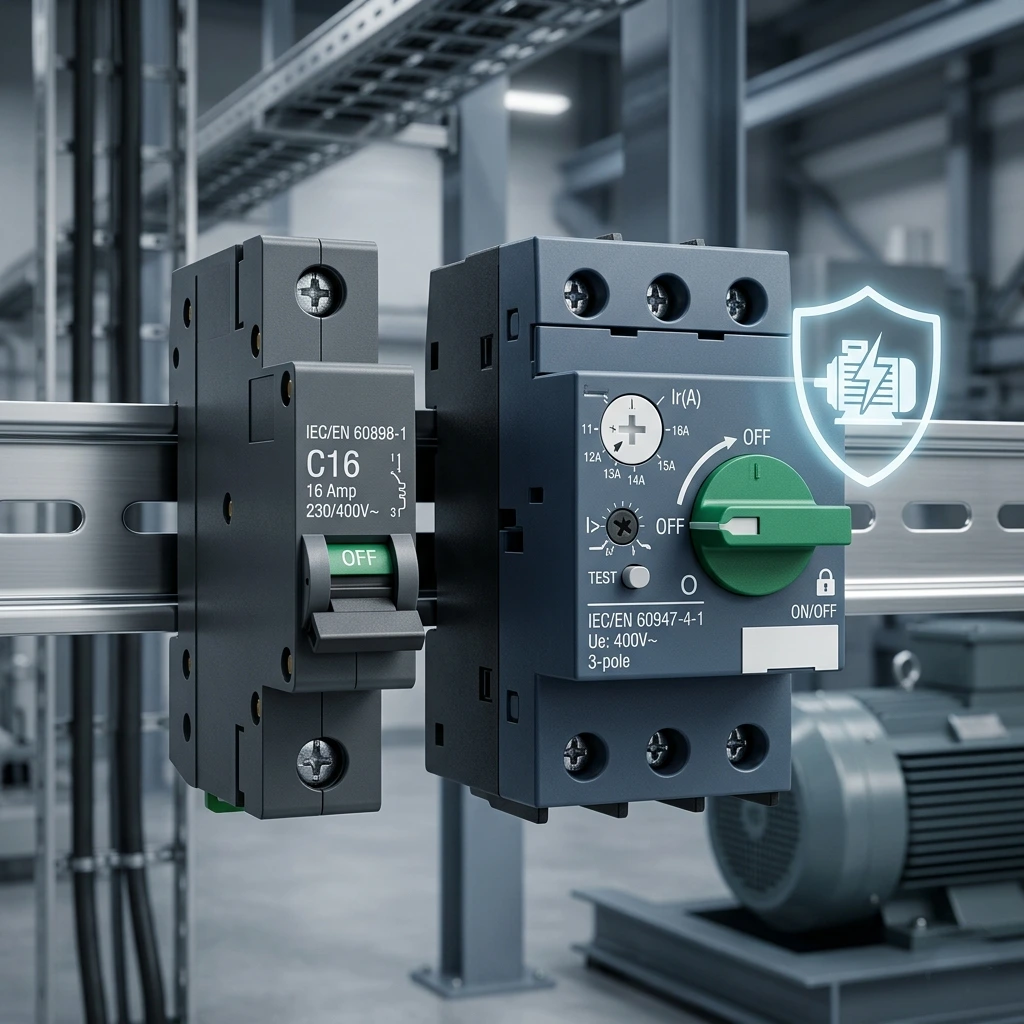
Use Motor Protection Circuit Breakers (MPCB)
For high-stakes industrial machinery, standard MCBs often fall short of optimal protection. Instead, engineers should specify a motor protection breaker. Motor protection circuit breakers are specifically designed to handle motor startup conditions. An MPCB integrates both dedicated motor overload relays and high-tolerance magnetic short-circuit protection into a single, highly adjustable unit, virtually eliminating breaker nuisance tripping while maximizing safety.
Check Cable and Voltage Drop Conditions
It is a lesser-known fact that undervoltage increases startup current duration. If the power supply cables are undersized or the facility suffers from voltage sags, the motor will struggle to generate sufficient torque. This prolongs the startup phase, forcing the motor to draw heavy inrush current for an extended period, which can eventually heat up the thermal mechanism and trigger a trip. Ensuring stable voltage and appropriately sized cabling is critical.
MCB vs MPCB: Which Is Better for Motor Protection?
While both thermal magnetic breakers (MCBs) and Motor Protection Circuit Breakers (MPCBs) interrupt fault currents, their features and optimal use cases differ vastly in a B2B environment.
| Feature | Standard MCB | MPCB |
|---|---|---|
| Overload Protection | Basic | Motor-optimized |
| Inrush Tolerance | Limited | High |
| Phase Loss Protection | No | Yes |
| Motor Applications | Small motors | Industrial motors |
When Standard MCBs Are Acceptable
Standard Type C or Type D MCBs are perfectly acceptable for small motors, single-phase appliances, and light-duty systems where the financial impact of a rare nuisance trip is low. They are cost-effective and readily available, making them suitable for commercial HVAC fans and basic pumping systems.
When MPCBs Are Recommended
For critical infrastructure, the investment in MPCBs is fully justified. Industrial motors with frequent starts typically require dedicated motor protection breakers. MPCBs offer phase loss protection—which prevents three-phase motors from burning out if one power leg drops—and allow for precise, dial-adjustable thermal overload settings, ensuring the highest level of system reliability and protection coordination.
Common Mistakes That Cause Nuisance Tripping
Using Lighting Breakers on Motors
The most frequent error found during field maintenance is the deployment of leftover Type B (lighting) breakers on newly installed motor circuits. This completely ignores the reality of motor inrush current and guarantees an immediate instantaneous trip.
Oversizing the Breaker
When faced with a motor startup breaker trip, inexperienced technicians might simply install a larger amperage breaker (e.g., replacing a 20A breaker with a 40A breaker). Oversizing breakers may reduce nuisance trips but can compromise protection safety. While the motor might start successfully, the electrical wiring is no longer protected against standard overloads, creating a severe fire hazard and violating electrical compliance codes.
Ignoring Ambient Temperature
Thermal magnetic breakers rely on heat to trigger overload protections. If a panel is located in a boiler room or under direct sunlight, the elevated ambient temperature can prematurely heat the breaker’s internal components. This lowers the effective trip threshold, causing the breaker to trip even when the motor is operating normally.
Poor Coordination with Contactors and Overloads
In traditional industrial control panels, a breaker, a contactor, and a thermal overload relay must work in perfect harmony. If the breaker acts faster than the overload relay during a minor mechanical bind, it leads to system-wide power loss rather than an isolated motor stoppage. Proper protection coordination ensures that the correct device clears the fault at the right time.
Troubleshooting Checklist for Motor Breaker Trips
When confronted with persistent breaker nuisance tripping on motor loads, electrical personnel should follow this systematic troubleshooting protocol to isolate the root cause safely and efficiently.
- Step 1: Measure Startup Current. Use a high-quality clamp meter with an “inrush” or “max hold” function to measure the exact current spike during the first few milliseconds of startup. Compare this to the motor’s LRA rating.
- Step 2: Check Breaker Curve Type. Inspect the MCB faceplate. Ensure it is a Type C or Type D breaker rather than a standard Type B. If it is an MPCB, verify the magnetic and thermal dials are calibrated correctly to the motor’s FLA.
- Step 3: Inspect Motor Condition. A motor that struggles to turn mechanically will draw massive current. Inspect for mechanical faults, such as bearing issues, gear binding, or a completely locked rotor, which turn normal inrush current into a sustained fault.
- Step 4: Verify Voltage Stability. Measure the voltage at the motor terminals during startup. Significant voltage drops can extend the duration of the startup surge, causing the thermal protection to trip.
- Step 5: Review Protection Coordination. Ensure the wire gauge, breaker amperage, and contactor ratings are perfectly aligned according to national electrical codes to prevent overlapping protection interference.
FAQ: Breaker Nuisance Tripping on Motor Loads
Why does my breaker trip when the motor starts?
Answer: Because startup current temporarily exceeds the breaker’s magnetic trip threshold.
Which breaker type is best for motors?
Answer: Type C or Type D breakers are commonly used.
Can I use a larger breaker to stop nuisance tripping?
Answer: Only if it still complies with cable and motor protection requirements.
What is the difference between MCB and MPCB?
Answer: MPCBs are specifically designed for motor protection.
Why do compressors trip breakers frequently?
Answer: Compressors often generate very high startup current.
Conclusion: How to Eliminate Motor Startup Nuisance Trips
In professional B2B engineering and electrical contracting, system reliability cannot be left to chance. Diagnosing an MCB nuisance tripping motor loads issue requires a fundamental acknowledgment that motor startup current ≠ fault current. Because inductive loads require massive energy to overcome initial mechanical inertia, trip curve selection is critical to field success. Relying on standard household breakers will inevitably lead to maintenance headaches and reduced equipment longevity. Instead, industrial systems dictate that a Type C / D or MPCB often required to handle the electrical transients safely.
Preventing breaker nuisance tripping on motor loads requires proper trip curve selection, accurate breaker sizing, and consideration of motor startup current characteristics. By rigorously applying these engineering principles, facilities can drastically lower maintenance costs, ensure absolute compliance with safety standards, and maintain uninterrupted production uptime.