Solar PV systems require properly rated AC and DC circuit breakers to safely interrupt fault currents and protect inverters, conductors, and connected equipment. For electricians, solar installers, and EPC contractors, specifying the correct protection devices is the most critical step in ensuring long-term solar project viability, fire prevention, and regulatory compliance.
Key Takeaways
- AC and DC breakers operate on entirely different arc-extinguishing principles; mixing them is a severe fire hazard.
- DC circuits lack a zero-crossing point, requiring specialized magnetic arc-blowout mechanisms.
- Proper sizing mandates a 125% continuous current multiplier based on short-circuit ratings.
- Compliance with NEC, IEC, and UL standards is mandatory for commercial and industrial solar installations.
What Is Solar PV Breaker Selection?
Solar PV breaker selection is the engineering process of identifying, sizing, and specifying the exact circuit breakers needed for both the direct current (DC) and alternating current (AC) sides of a photovoltaic installation. This process ensures that under normal operations, power flows efficiently, but during a fault, the circuit is safely interrupted.
Why Do Solar PV Systems Need Circuit Breakers?
Circuit breakers are non-negotiable safety components in any commercial or residential PV array. They serve multiple functions:
- Overcurrent protection: Preventing excessive current from damaging sensitive solar infrastructure.
- Inverter protection: Shielding the expensive internal components of string and central inverters from grid surges or panel-side shorts.
- Cable protection: Stopping conductors from overheating and melting their insulation, which could lead to ground faults.
- Isolation safety: Providing a reliable physical disconnect for emergency responders.
- Maintenance shutdown: Allowing technicians to isolate specific strings or the entire array safely for routine servicing.
What Is the Difference Between AC and DC Breakers?
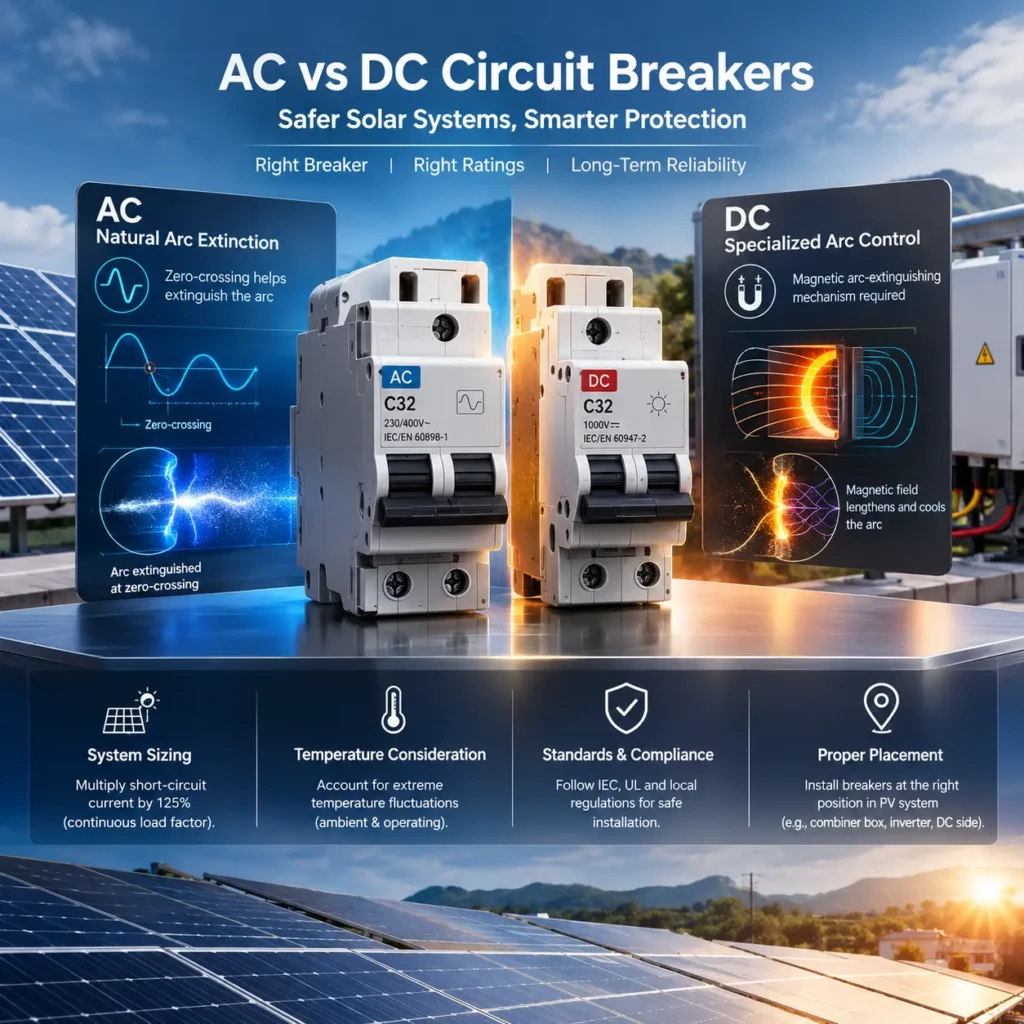
The fundamental difference lies in how they handle electrical arcs. AC breakers rely on the natural AC zero-crossing—where alternating current drops to zero volts 50 or 60 times a second—to extinguish arcs easily. In contrast, DC current represents a constant flow. When a DC breaker opens, it pulls a continuous DC arc. Therefore, DC breakers require specialized internal arc extinguishing designs, such as magnetic blowouts and extended arc chutes, to force the contact separation behavior necessary to break the current.
To understand why AC breakers fail under direct current, explore our comprehensive guide on the key differences between AC and DC circuit breakers.
Why Is Using an AC Breaker on DC Solar Circuits Dangerous?
Using an AC breaker in a DC circuit is a catastrophic error. Because AC breakers lack magnetic arc suppression, opening them under a DC load results in a persistent DC arc. This arc acts like a plasma torch, leading to breaker welding where the contacts fuse together. Subsequently, this causes melted contacts, massive fire hazards inside the combiner box, and potential inverter destruction.
AC vs DC Breakers — What Is the Difference in Solar PV Systems?
How AC Breakers Interrupt Current
AC breakers interrupt current by pulling the mechanical contacts apart and relying on the sine wave of alternating current. Because the voltage drops to absolute zero periodically, the arc naturally loses its sustaining energy and extinguishes within milliseconds.
How DC Breakers Extinguish Arcs
DC breakers extinguish arcs by forcing the electrical plasma into a series of splitter plates (arc chutes). Because there is no zero-voltage point, the breaker uses internal permanent magnets or electromagnetic coils to physically blow the arc away from the contacts, elongating it until the required voltage to sustain the arc exceeds system limits.
Why DC Arc Suppression Is More Difficult
DC arc suppression is significantly more difficult because the direct current provides a constant, unyielding supply of energy. The sustained plasma generated during a fault produces extreme heat. If the separation distance and arc chute design are not explicitly rated for the DC voltage (often up to 1000V or 1500V in solar), the arc will jump the gap indefinitely.
Internal Design Differences Between AC and DC Breakers
Internally, DC breakers are built with wider contact gaps, robust arc chutes, and magnetic blowout coils. AC breakers have simpler mechanisms since the grid frequency does half the work of arc suppression. Physically, they may look similar on the outside, but their internal engineering is vastly different.
| Feature | AC Breaker | DC Breaker |
|---|---|---|
| Arc Extinguishing | Uses AC zero crossing | Requires magnetic/blowout design |
| Current Direction | Alternating | Continuous |
| Contact Separation | Easier to manage naturally | More difficult, requires elongation |
| Fire Risk | Lower (under proper use) | Higher if improperly rated for DC |
| Solar PV Usage | AC output side (Grid/Home) | PV string/DC side (Panels/Combiner) |
Where Are Breakers Used in a Solar PV System?
DC Breakers on PV String Circuits
These are located between the solar panels and the inverter. They protect the individual PV strings from reverse current feeding from parallel strings during shading or fault events.
AC Breakers on Inverter Output
Situated between the inverter and the main service panel or grid tie. These breakers protect the AC wiring and allow the system to be decoupled from the utility grid.
“When connecting the AC inverter output to single-phase or three-phase distribution panels, consult our breakdown of 1P vs 2P vs 3P vs 4P circuit breakers.”
Battery Energy Storage Breakers
For hybrid systems, specialized high-amperage DC breakers are placed between the battery bank and the charge controller/inverter. They must handle massive short-circuit currents from chemical storage.
“For hybrid projects pairing solar arrays with electric vehicle chargers, review our specialized guide on AC vs DC circuit breakers in EV charging systems.”
Combiner Box Protection Devices
In commercial B2B arrays, multiple PV strings converge in a combiner box. Here, DC breakers act as the primary line of defense, isolating individual sub-arrays before the combined power travels to the central inverter.
“Circuit breakers are just one layer of defense; see our overview of essential protection devices in solar power systems for details on SPDs, RCCBs, and isolators.”
How to Select the Correct Solar PV Breaker
Selecting the correct breaker requires a systematic engineering approach to guarantee safety and compliance. Procurement teams and installers must follow these exact steps.
Step 1 — Determine System Voltage
The first step is evaluating the maximum PV string voltage. This involves calculating the open-circuit voltage (Voc) of the panels connected in series. Because solar panels produce more voltage in cold weather, engineers must apply strict temperature correction factors to ensure the breaker’s DC voltage rating is never exceeded on the coldest recorded day.
Step 2 — Calculate Maximum Continuous Current
The breaker must handle the maximum current the panels can produce. This starts with Isc calculations (short-circuit current). Under the NEC 125% rule, solar circuits are considered continuous loads. Therefore, proper continuous current sizing dictates that the base current must be multiplied by a safety factor.
Breaker Current Rating = PV Current × 125%
Step 3 — Select AC or DC Rated Breakers
Never mix the applications. Review the AC output side requirements for grid-tie connections, and strictly enforce DC input side requirements for panel connections. For DC breakers, pay strict attention to polarity considerations; many DC breakers are directional and will fail to clear a fault if wired backward.
Step 4 — Verify Interrupting Capacity
The breaker must survive a dead short. You must calculate the system’s maximum short-circuit current rating. Due to DC fault current challenges, the breaker must have high AIC ratings (Amps Interrupting Capacity), often 10kA or more, to safely trip without exploding.
Step 5 — Confirm Compliance Standards
For B2B buyers and EPCs, certification is everything. Ensure products meet IEC standards globally, UL listings for North America, strict NEC requirements, and any localized local solar codes dictated by the AHJ (Authority Having Jurisdiction).
Attention B2B Buyers & EPCs: Always specify PV-rated, certified circuit breakers for your projects. Ask your manufacturer or distributor for comprehensive datasheets, OEM support, and third-party testing reports to guarantee system reliability and compliance.
“When sizing breakers for large combiner boxes or commercial inverters, read our complete guide on MCB vs MCCB in solar systems to choose the right capacity and breaking rating.”
How to Size DC Breakers for Solar PV Systems
PV String Breaker Sizing Example
Applying the sizing rules is straightforward but critical. You must take the short circuit current (Isc) of the solar panel and apply the standard 125% continuous load factor required by electrical codes.
Sizing Calculation Example:
PV String Current (Isc) = 12A
Calculation: 12A × 125% = 15A
Recommended DC breaker size: 15A
Temperature Effects on DC Breaker Sizing
Ambient temperature inside an outdoor combiner box can easily exceed 50°C (122°F). Breakers are typically calibrated at 30°C or 40°C. Installers must consult the manufacturer’s derating curves; a 15A breaker operating at 60°C might trip at 12A, causing nuisance tripping if temperature effects are ignored.
Parallel String Protection Requirements
When three or more strings are wired in parallel, a fault in one string can cause the other strings to backfeed into it. DC breakers sized properly for reverse current protection are necessary to isolate the faulted string and prevent catastrophic panel failure.
Battery Storage DC Breaker Sizing
Batteries possess extremely low internal resistance, meaning a short circuit can deliver thousands of amps instantly. DC breakers for battery energy storage systems (BESS) must not only match the continuous load but possess an exceptionally high interrupting capacity (often above 20kA) to safely break a battery fault.
“Because PV generation operates for hours under full sun, apply the 125% safety factor as outlined in our guide on proper breaker sizing for continuous loads.”
What Happens if the Wrong Breaker Is Used in a Solar System?
Persistent DC Arc Failures
If an AC breaker is installed on a DC line, tripping it under load will fail to extinguish the arc. The continuous plasma will bridge the internal gap, completely bypassing the breaker’s protection mechanism.
Breaker Contact Welding
The intense heat from unsuppressed arcs melts the copper or silver-alloy contacts. Once cooled, they fuse together. The next time a fault occurs, the breaker will be permanently stuck in the closed position, allowing uncontrolled current flow.
Solar Combiner Box Fires
Welded contacts and persistent arcs rapidly heat the plastic casing of the breaker and surrounding wires. This is the leading cause of solar combiner box fires, which can destroy the entire array and pose massive liability for EPC contractors.
Inverter Damage Risks
Without proper overcurrent interruption, high-voltage surges or short-circuit faults will travel directly into the inverter. Replacing a commercial inverter due to an improperly sized $20 breaker is an enormous and avoidable financial loss.
System Shutdown and Downtime
Nuisance tripping from incorrectly sized components results in frequent system downtime. For commercial operations relying on power generation metrics and Power Purchase Agreements (PPAs), this equates to direct revenue loss.
Solar PV Breaker Standards and Certifications
NEC Requirements for Solar Breakers
In the United States, solar installations must adhere to the National Electrical Code. NEC 690 covers the specialized requirements for Solar Photovoltaic Systems, dictating the 125% sizing rules and disconnect locations. NEC 705 governs interconnected power production sources, crucial for grid-tied AC breaker specifications.
IEC Standards for PV Protection
For international projects, International Electrotechnical Commission standards apply. IEC 60947-2 is the standard for low-voltage switchgear and industrial circuit breakers. IEC 60898 applies to breakers for household and similar installations. Furthermore, IEC 62109 addresses the safety of power converters for use in photovoltaic power systems.
UL Standards for Solar DC Breakers
Underwriters Laboratories provides rigorous testing frameworks. UL 489B is the specific standard for molded-case circuit breakers and switches for use with PV systems, ensuring they can handle DC voltages up to 1500V. UL 1077 covers supplementary protectors, often used internally within equipment.
DC Breaker vs Fuse for Solar PV Protection
Advantages of DC Breakers
DC breakers are resettable, eliminating the need to search for replacement parts after a trip. They function as both overcurrent protection devices and physical disconnect switches, making routine maintenance vastly safer and more convenient.
Advantages of PV Fuses
Fuses are extremely reliable for high short-circuit scenarios. They have no moving parts, so they cannot suffer from mechanical failure or contact welding. Fuses are typically smaller and cheaper upfront for very high voltage ratings.
When Should Solar Installers Use Both?
In utility-scale or large commercial arrays, optimal design often combines both. Fuses are utilized in the combiner box for individual string short-circuit protection (where faults are rare but severe), while DC load-break circuit breakers are installed at the main inverter input for load switching and central isolation.
Cost vs Protection Considerations
While B2B buyers might balk at the higher initial cost of DC breakers compared to fuse holders, the operational expenditure (OpEx) benefits are clear. Breakers reduce maintenance downtime, negate replacement inventory costs, and double as maintenance disconnects, lowering total installation complexity.
Common Solar PV Breaker Selection Mistakes
Using AC Breakers on DC Circuits
As emphasized, this is the most dangerous and common error made by inexperienced installers. It invalidates warranties, violates codes, and virtually guarantees fire upon fault.
Ignoring Temperature Derating
Solar arrays are installed in hot, sun-beaten environments. Failing to apply temperature derating curves means a breaker sized for standard room temperature will trip prematurely under the mid-day sun, frustrating end-users.
Undersizing Breaker Voltage Ratings
Selecting a 500V DC breaker for a string that can produce 600V Voc in freezing temperatures is a critical flaw. When the contacts open, the overvoltage can cause the arc to jump the internal gap, failing to break the circuit.
Incorrect Polarity Installation
Many DC breakers are polarized due to their specific magnetic blowout orientations. Wiring line and load backward means the arc is blown away from the arc chutes instead of into them, leading to immediate breaker destruction.
Using Non-PV Rated Devices
Industrial DC breakers used in automation are not always rated for the unique cyclical load and high-voltage conditions of photovoltaics. Only devices specifically labeled and certified for PV applications should be specified by B2B procurement teams.
How to Improve Solar PV System Safety
Proper Isolation and Disconnect Design
Ensure that breakers are placed logically so that technicians can isolate panels from inverters, and inverters from the grid, without exposing themselves to live busbars.
Arc Fault Detection Systems
Modern codes require DC arc-fault circuit interrupters (AFCI). These systems monitor the circuit for high-frequency noise indicative of an arc and automatically signal the breakers or inverter to shut down.
Thermal Inspection of PV Connections
Regular use of infrared thermal cameras on combiner boxes and breaker terminals helps identify loose connections. A loose terminal increases resistance, generating heat that can melt the breaker casing long before the current exceeds the trip threshold.
Proper Combiner Box Layout
Space breakers adequately within enclosures. Crowded boxes lack airflow, exacerbating temperature derating issues and increasing the likelihood of cascading failures if one component overheats.
Regular Maintenance and Testing
Industrial installations should have annual preventative maintenance schedules. Breakers should be mechanically cycled to ensure mechanisms haven’t seized, and torque specifications on terminals must be verified.
“High ambient temperatures inside outdoor combiner boxes can accelerate lug oxidation; learn how to prevent overheating and loose connection issues through proper torque inspections.”
FAQ — Solar PV Breaker Selection
Can AC Breakers Be Used for DC Solar Applications?
Absolutely not. AC breakers cannot extinguish continuous DC arcs. Using them in a solar PV array is a severe fire hazard and a direct violation of electrical codes.
Why Are DC Breakers More Expensive?
DC breakers require complex internal mechanisms—like magnetic blowout coils and larger arc chutes—to safely handle continuous direct current. This specialized engineering and rigorous safety testing increases manufacturing costs.
What Breaker Is Used Between Solar Panels and Inverters?
A specialized, highly-rated DC circuit breaker (often molded case or specialized miniature DC breaker) designed explicitly for photovoltaic applications is required between panels and the inverter.
How Do You Size a Solar DC Breaker?
Multiply the short-circuit current (Isc) of the solar array by 125% to account for continuous operation. Also, ensure the voltage rating exceeds the maximum open-circuit voltage (Voc) adjusted for minimum local temperatures.
What Voltage Rating Should a Solar Breaker Have?
The voltage rating must strictly exceed the highest possible DC voltage the panels can produce under the coldest local temperature conditions, typically requiring 600V, 1000V, or 1500V DC ratings depending on the system scale.
Do Solar Panels Need DC Circuit Breakers?
Yes. They protect the system from reverse currents, mitigate short circuits, and provide a necessary physical disconnect to allow safe maintenance and emergency shutdown.
What Happens if a DC Arc Is Not Interrupted?
An uninterrupted DC arc creates temperatures exceeding 5,000°C. It will melt the breaker, vaporize copper wiring, and ignite surrounding plastics, causing a devastating electrical fire.