Quick Answer: MCB vs MCCB in Solar Systems
When designing a photovoltaic layout, choosing the correct circuit breaker for solar system protection is critical. Here is the standard breakdown:
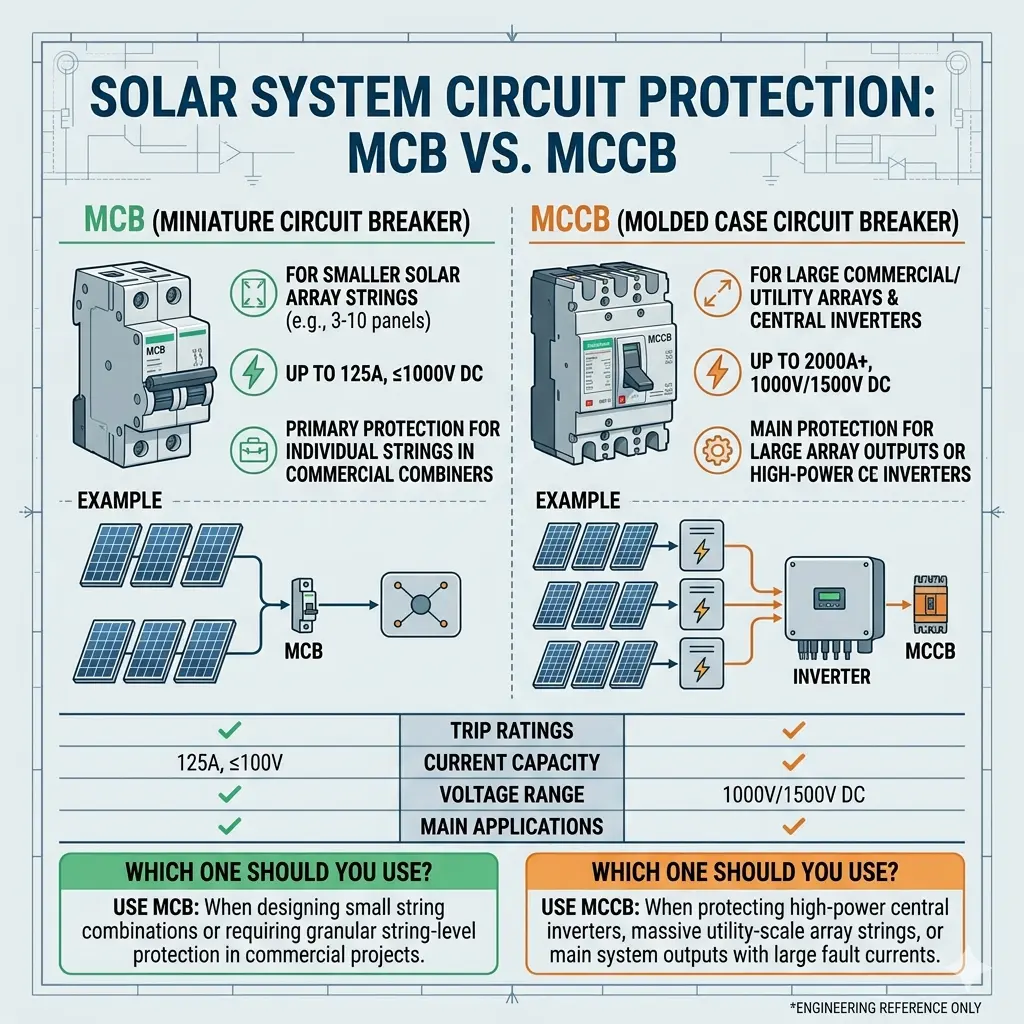
- MCB (Miniature Circuit Breaker) is used for low-current protection in solar systems, typically installed in residential AC distribution panels to protect individual inverter outputs or final circuits.
- MCCB (Molded Case Circuit Breaker) is designed for higher current applications and is commonly used in the main distribution boards of commercial, industrial, or utility-scale solar installations.
Key difference:
MCB = Small capacity + fixed trip settings.
MCCB = High capacity + adjustable protection parameters.
What Is an MCB in Solar Systems?
In the realm of solar breaker selection, the MCB is the most frequently encountered protective device in residential and light-commercial applications. Understanding its specific role ensures that the low-voltage side of a photovoltaic installation remains safe from common electrical faults.
What Does MCB Mean in Solar Applications?
MCB stands for Miniature Circuit Breaker. It is an electromechanical device utilized in low-voltage systems—predominantly on the AC (alternating current) side of a solar installation. Its primary function is to automatically disconnect the circuit when it detects an overload (a sustained current exceeding the rated limit) or a short circuit (a massive, instantaneous spike in current). Inside the breaker, a bimetallic strip handles the slow-acting overload protection, while a magnetic coil triggers instantly to clear short circuits.
Where Are MCBs Used in Solar Power Systems?
Due to their relatively low current carrying capacity, MCBs are strategically placed in specific areas of a solar installation:
- Inverter output (AC side): Positioned immediately after a string inverter to protect the AC wiring leading to the main panel.
- Residential distribution boards: Serving as the integration point where solar power feeds into the home’s electrical grid.
- Small PV systems: Used in localized, off-grid, or tiny home solar setups where overall current generation is minimal.
Advantages of MCB in Solar Installations
Electrical contractors favor MCBs for smaller projects due to several distinct benefits:
- Compact size: They take up minimal space on a standard DIN rail, allowing for clean, organized distribution boards.
- Cost-effective: MCBs are mass-produced and highly affordable, keeping residential project costs down.
- Easy installation: Their modular design makes them quick to install, replace, and integrate alongside other protective devices like RCCBs.
What Is an MCCB in Solar Systems?
As solar installations scale up from residential rooftops to large commercial warehouses and ground-mounted solar farms, the electrical demands surpass the capabilities of standard miniature breakers. This is where the MCCB becomes essential.
What Does MCCB Mean in Solar Installations?
MCCB stands for Molded Case Circuit Breaker. It is a heavy-duty protection device engineered to handle medium to extremely high current systems. Unlike its miniature counterpart, the MCCB is housed in a robust molded plastic case that can withstand immense electrical and thermal stress. Furthermore, an MCCB supports more advanced protection mechanisms, often allowing operators to fine-tune the tripping characteristics to match complex system parameters.
Where Are MCCBs Used in Solar Systems?
You will typically find MCCBs deployed in environments where power generation is substantial:
- Main distribution panel: Acting as the main isolator and protective device where multiple large inverters combine their output.
- Commercial solar systems: Protecting the heavy-gauge cabling that runs from commercial rooftop arrays to the building’s main switchgear.
- Industrial PV installations: Handling the massive AC loads associated with factory-scale solar generation.
Key Features of MCCB for Solar Protection
Electrical distributors often recommend MCCBs for large projects because of these critical features:
- High breaking capacity: They can safely interrupt massive fault currents (often tens of thousands of amps) without sustaining damage or causing a fire.
- Adjustable trip settings: Many MCCBs feature dial settings to adjust the thermal (overload) and magnetic (short circuit) tripping thresholds, allowing for precise coordination with other breakers in the system.
- Better fault handling: The internal arc chutes and robust contact mechanisms are designed to quickly extinguish high-energy arcs, preventing catastrophic equipment failure.
MCB vs MCCB: What Is the Key Difference in Solar Systems?
For electrical contractors and engineers, evaluating MCB vs MCCB is a fundamental step in solar breaker selection. Applying the wrong type of breaker can result in nuisance tripping, code violations, or severe fire hazards. Here is a detailed comparison of their core technical differences.
MCB vs MCCB: Current Rating Comparison
The most immediate differentiator is the current rating. An MCB is strictly designed for low-current applications, typically available in ratings up to 125A. If your solar inverter outputs 30A or 60A, an MCB is perfectly adequate. Conversely, an MCCB is built for heavy loads. You can source MCCBs with current ratings ranging from 16A all the way up to 2500A or more. This makes the MCCB mandatory for large-scale solar arrays producing hundreds of amps.
MCB vs MCCB: Breaking Capacity
Breaking capacity (or interrupting rating) refers to the maximum fault current a breaker can safely interrupt without destroying itself. Because MCBs are used in smaller residential networks where the prospective short-circuit current is relatively low, their breaking capacity usually maxes out around 10kA. MCCBs, operating closer to industrial transformers and large grid connections, face much higher prospective fault currents. Therefore, MCCBs boast breaking capacities ranging from 16kA to over 100kA, making them suitable for safely clearing massive electrical faults.
MCB vs MCCB: Application in Solar Systems
In terms of practical deployment, the rule of thumb is straightforward. The MCB is the standard choice for residential solar—protecting standard string inverters, microinverter branches, and household AC distribution. The MCCB is the backbone of commercial and industrial solar—protecting large central inverters, massive solar combiner boxes, and acting as the main point of interconnection to the utility grid.
MCB vs MCCB: Adjustability and Protection Functions
A critical distinction lies in flexibility. An MCB has fixed trip settings. If you buy a 40A Type C MCB, its overload and short-circuit response curves are locked in at the factory. An MCCB, however, is frequently adjustable. Installers can manually tweak the thermal and magnetic trip elements. This adjustability is vital in large solar networks to achieve “discrimination” or “selectivity”—ensuring that a localized fault only trips the breaker closest to the problem, rather than shutting down the entire solar plant.
MCB vs MCCB Comparison Table (Solar Applications)
To streamline solar breaker selection, refer to this quick comparative matrix outlining the essential characteristics of both devices:
| Feature | MCB (Miniature Circuit Breaker) | MCCB (Molded Case Circuit Breaker) |
|---|---|---|
| Current rating | Low (≤ 125A) | High (up to 2500A+) |
| Application | Residential solar | Commercial / Industrial solar |
| Breaking capacity | Lower (Typically up to 10kA) | Higher (16kA to 100kA+) |
| Adjustability | Fixed (Factory set) | Adjustable (Thermal & Magnetic) |
| Cost | Lower | Higher |
Which Is Better for Solar Systems: MCB or MCCB?
Neither device is universally “better”; rather, their suitability depends entirely on the scale and electrical characteristics of the photovoltaic project. Proper engineering dictates that the right tool is used for the right job.
When Should You Use MCB in Solar Systems?
You should specify an MCB when dealing with small residential PV systems. If you are installing a standard 5kW to 15kW residential inverter, the AC output current will generally fall between 20A and 60A. An MCB is the perfect, cost-effective choice for these low current circuits. Additionally, they are ideal for final distribution circuits, such as protecting the AC wiring between the inverter and the home’s main consumer unit.
When Should You Use MCCB in Solar Systems?
An MCCB must be utilized for large solar installations. When a commercial roof features multiple 50kW or 100kW inverters combined into a single feed, the total current can easily exceed several hundred amps. Here, an MCCB provides the necessary main switch protection. High-power inverter systems demand the robust thermal mass, high breaking capacity, and adjustable coordination that only an MCCB can deliver.
Can MCB Replace MCCB in Solar Systems?
When evaluating whether these devices are interchangeable, the direct conclusion is:
- No for high current systems: Attempting to use multiple parallel MCBs or a standard MCB in a high-fault, high-current commercial setting violates electrical codes and creates a severe fire risk due to inadequate breaking capacity.
- Yes for small circuits only: Within the confines of its rating (e.g., under 125A and low prospective fault current), an MCB is the standard and preferred choice over an unnecessarily expensive MCCB.
Common Mistakes When Choosing MCB or MCCB for Solar Systems
Even experienced contractors can falter when transitioning from traditional electrical work to specialized solar installations. Avoiding these common errors is crucial for safety and system longevity.
Using MCB for High-Power Solar Systems
Cause: Attempting to save money or space by using an MCB on a commercial inverter output that pushes the upper limits of the breaker’s rating.
Risk: This can cause continuous nuisance tripping as the breaker overheats during peak solar generation hours. More severely, it can lead to terminal melting, equipment damage, and electrical fires.
Prevention: Always transition to an MCCB when continuous loads exceed 100A or when operating in high ambient temperature environments where MCBs derate heavily.
Oversizing MCCB Unnecessarily
Cause: A “bigger is better” mentality, where a contractor installs a 400A MCCB on a circuit that only ever generates 150A of solar power.
Risk: This wastes project budget significantly. More importantly, it reduces protection sensitivity. If a moderate overload fault occurs, the oversized MCCB will fail to trip in time, allowing the wiring to overheat and potentially ignite.
Prevention: Strictly adhere to proper solar breaker selection calculations, sizing the breaker at 125% of the continuous maximum output current of the inverter.
Ignoring Breaking Capacity Requirements
Cause: Focusing only on the normal operating current (Amps) and ignoring the fault current calculation (kA) at the point of installation.
Risk: If a short circuit occurs and the fault current exceeds the breaker’s breaking capacity, the breaker’s contacts may weld shut, or the device may physically explode under the arc pressure.
Prevention: Always calculate the prospective short-circuit current from the utility grid and ensure the chosen MCB or MCCB has an interrupting rating that exceeds this value.
How to Choose Between MCB and MCCB for Solar Projects
Mastering solar breaker selection elevates the quality and safety of your installations. Electrical distributors and contractors should follow a systematic approach when specifying protection devices for new photovoltaic systems.
Key Selection Factors
When specifying a circuit breaker for a solar system, evaluate the following parameters:
- Current rating: Calculate 125% of the continuous output current. If it is below 125A, an MCB is usually sufficient. If it is higher, select an MCCB.
- Voltage level: Ensure the breaker is rated for the system voltage (e.g., 230V/400V AC). Be strictly aware that AC breakers cannot be used on the DC solar panel side.
- Fault current: Assess the installation location. Main panels require higher breaking capacities (favoring MCCBs), while sub-panels may allow lower capacities.
- System size: Residential scales align with MCBs; commercial and utility scales mandate MCCBs.
Buying considerations for contractors and distributors: Beyond technical specs, consider standards compliance (IEC/UL certifications), selectivity and coordination capabilities, stock planning for common sizes, reliability of the brand, after-sales support, and the availability of clear documentation for commissioning and inspection purposes.
Typical Solar System Breaker Configuration
To understand how these devices harmonize in a real-world project, consider the following typical layout for a medium-to-large solar system:
- PV array → DC breaker: Specialized DC breakers protect the high-voltage direct current strings coming from the roof, handling DC arc suppression.
- Inverter → MCB: The immediate AC output of each individual inverter is protected by an appropriately sized MCB, guarding against localized overloads.
- Main panel → MCCB: Where multiple inverter outputs combine to feed into the grid or main facility infrastructure, a large MCCB acts as the primary isolator and high-capacity fault protector.
This hierarchical arrangement ensures that a fault at a single inverter only trips its respective MCB, leaving the rest of the solar plant operational, while the MCCB stands guard over the entire consolidated system against massive grid-side faults.
FAQ: MCB vs MCCB in Solar Systems
What is the difference between MCB and MCCB in solar systems?
The fundamental difference is capacity and application. An MCB is used for low-current residential AC circuits with fixed trip settings, while an MCCB is designed for high-current commercial and industrial solar systems, featuring higher breaking capacities and adjustable protection settings.
Can I use MCB instead of MCCB in a solar system?
You can only use an MCB instead of an MCCB in small, low-current solar systems (typically under 125A) where the prospective fault current is low. For high-current commercial applications, an MCCB is strictly required for safety and code compliance.
Which breaker is used for solar inverter protection?
The choice depends on the inverter’s size. A small residential string inverter typically uses an MCB at its AC output. A large, high-capacity central inverter used in commercial applications requires an MCCB for adequate protection.
What breaker is used in residential solar systems?
The MCB is the most commonly used circuit breaker in residential solar installations, alongside specialized DC breakers for the panel side and RCCBs/RCBOs for earth leakage protection.
Do commercial solar systems require MCCB?
Yes. Commercial solar systems generate substantial electrical current that exceeds the safe handling limits of miniature breakers. An MCCB is required to handle these heavy loads and provide reliable fault interruption at the main distribution boards.
Why do large solar systems need adjustable breakers?
Adjustable breakers (MCCBs) allow engineers to achieve selectivity. By fine-tuning the trip curves, they ensure that a minor fault only trips the breaker closest to the issue, rather than shutting down the main breaker and taking the entire commercial solar plant offline.
Conclusion: MCB vs MCCB in Solar Systems
In summary, navigating the choice between an MCB and an MCCB is a foundational aspect of designing a safe, reliable photovoltaic installation. The rule is highly practical: use an MCB for small systems and low-current circuits (such as residential rooftops), and deploy an MCCB for large systems and high-current applications (such as commercial factories and solar farms). Correct solar breaker selection is not merely a box-ticking exercise; it directly improves life safety, enables cost optimization, and guarantees the long-term stability and profitability of the solar power system.